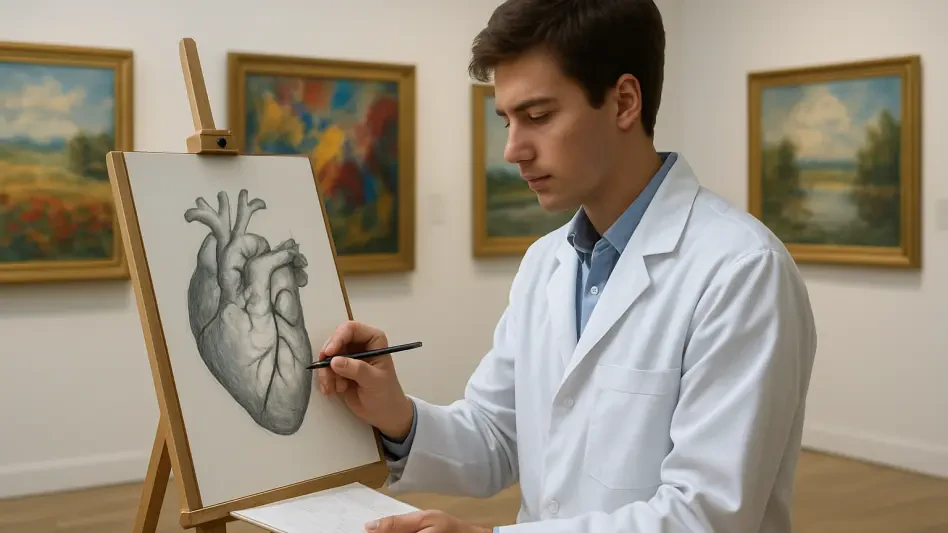
Participating in Visual Thinking Strategies at contemporary art galleries helps medical students identify subtle clinical signs by training them to avoid jumping to conclusions during patient examinations. This paradigm shift at the University of Colorado Anschutz School of Medicine suggests that the path to becoming a superior physician is paved not just with scientific data, but also with charcoal sketches, linocut prints, and poetic reflection. This comprehensive analysis explores the initiatives led by medical students Victoria Gonzales, Madi Clements, and Jessica Woon, who have spent their critical training years investigating whether the arts can foster more resilient, empathetic, and observant doctors. The core subject of this analysis is the integration of arts and humanities into the rigorous curriculum of modern medical education, focusing on a cohort of thirty students in the Colorado Springs Branch program. This period serves as a vital bridge between the theoretical lecture hall environment and the high-stakes, front-line care environment of hospitals and clinics, where diagnostic accuracy meets human vulnerability.
Bridging the Gap Between Science and Humanity
Enhancing Observation: The Art of Clinical Clarity
Through a collaboration with the UCCS Galleries of Contemporary Art, students participate in Visual Thinking Strategies to refine their perceptual abilities. This technique requires students to look deeply at complex artworks and articulate what they see without making immediate assumptions about the subject matter or the artist’s intent. In a medical context, this practice translates directly to patient care by training future doctors to resist the urge to jump to conclusions the moment they walk into a patient’s room. By engaging with ambiguous visual stimuli, students learn to identify subtle clinical signs and navigate their own subconscious biases, which often cloud judgment during the initial phases of a physical examination. This refined observational skill is essential for accurate diagnosis and the creation of personalized treatment plans that account for more than just the most obvious symptoms.
When a practitioner enters a clinical setting, the pressure to reach a diagnosis quickly can lead to cognitive shortcuts that overlook minor details. These shortcuts often result in “premature closure,” a common diagnostic error where a physician stops looking for more information once a preliminary theory is formed. By practicing meticulous observation in a gallery, students develop the patience required to remain objective and gather comprehensive data. This approach fosters a more holistic understanding of the patient’s condition, ensuring that the biological, psychological, and social factors are all accounted for before a definitive conclusion is reached. The ability to slow down and observe with a critical eye is perhaps the most valuable tool a physician can carry into the examination room, especially as cases grow more complex in modern healthcare.
Emotional Endurance: Mitigating Burnout Through Creativity
Medical school is notoriously grueling, often leading to significant mental strain and emotional exhaustion. Research conducted by Gonzales, Clements, and Woon revealed a troubling trend regarding the loss of creative outlets during intensive training. While half of their classmates used art for stress relief prior to entering medical school, that number plummeted to only 33 percent during their second year. The students argue that creative expression should be viewed as an essential “tool for the toolbox” that helps maintain mental health and prevents the physician burnout that plagues the industry. By reintegrating art into their lives, students find a necessary psychological outlet for the high-pressure environment of clinical rotations, allowing them to process the daily challenges of their profession in a constructive and restorative manner.
Beyond simple stress relief, the act of making art provides a sense of agency in an environment where students often feel powerless. The transition from being a student to a front-line care provider involves witnessing suffering and making difficult decisions that can weigh heavily on the psyche. Engaging in charcoal sketching or printmaking allows for the externalization of these internal conflicts. This process of externalization is critical for building resilience, as it provides a way to confront and categorize complex emotions rather than suppressing them. As the healthcare field continues to address the crisis of physician attrition, these artistic interventions offer a practical strategy for sustaining the long-term well-being of the medical workforce, ensuring that doctors remain as healthy as the patients they serve.
Institutional Shifts and Curricular Integration
Educational Standards: From Elective Interest to Core Requirement
There is a growing institutional consensus, backed by the Association of American Medical Colleges, that the humanities are fundamental to medical education. This shift recognizes that these disciplines provide doctors with new perspectives and deeper insights into their roles that traditional science courses cannot offer. At CU Anschutz, this is formalized through the Center for Bioethics and Humanities, signaling a major transition where the arts are no longer viewed as mere extracurricular activities. Instead, they are being woven into the core identity of the medical curriculum. This evolution ensures that future healthcare providers are prepared for the complexities of modern medicine, which requires balancing technical proficiency with a profound understanding of the human condition and the ethics of care.
The move toward integration is not just about aesthetics; it is about the practical application of emotional intelligence in a clinical setting. As the medical field becomes increasingly digitized and data-driven, the human element risks being sidelined. Institutional leaders are now arguing that the ability to interpret a narrative or understand a metaphor is as important as interpreting a lab result. By making arts and humanities a core requirement, medical schools are acknowledging that the best physicians are those who can navigate the ambiguity of human life with the same confidence they bring to a surgical procedure. This systemic change reflects a broader movement within the global medical community to prioritize the development of well-rounded, empathetic practitioners who can connect with patients on a truly personal level.
Curricular Leadership: Implementing Creative Pedagogy
Dr. Jaime Baker, the assistant dean, exemplifies this trend by weaving arts into the mandatory curriculum for the Colorado Springs Branch. Her leadership has led to the implementation of painting assignments and writing exercises that are evaluated alongside more traditional medical milestones. This reflects a broader shift in the medical field: acknowledging that a doctor’s effectiveness is tied as much to their observational acuity as to their scientific knowledge. By normalizing these activities within the standard academic schedule, the program removes the stigma that art is a “soft” or “unnecessary” pursuit. This intentional design forces students to engage with their creative sides during their most formative years of training, establishing habits of reflection that will serve them throughout their careers.
The leadership in this department has created a blueprint that other branches and institutions are beginning to follow as they recognize the limitations of a purely science-based education. The curriculum now includes specific sessions dedicated to the intersection of anatomy and aesthetics, where students might study the musculature of the human form through both dissection and figure drawing. This dual approach reinforces anatomical knowledge while simultaneously fostering an appreciation for the beauty and fragility of the human body. By providing students with multiple ways to learn and express their findings, the program accommodates various learning styles and encourages a more diverse range of perspectives within the student body. This innovative pedagogy is essential for producing doctors who are prepared for the multifaceted challenges of clinical practice.
Artistic Expressions of Clinical Realities
Symbolic Practice: Repetition and Technical Mastery
Victoria Gonzales’s contribution to the program involved tying approximately 50 pieces of suture thread into hundreds of surgical knots on a pair of medical scissors. This sculpture-like work served a dual purpose: it was a literal practice of a technical skill and a meditative act of stress relief. Her work symbolizes the repetition, patience, and effort inherent in medical training, where progress often feels incremental and exhausting. Each knot represents a moment of focus and a commitment to mastery, mirroring the countless hours spent in the operating room or the clinic. This artistic approach to a technical task highlights how the physical act of creation can parallel the physical demands of medical labor, providing a bridge between the art gallery and the surgical suite.
Madi Clements utilized linocut block printing to depict the contradictions inherent in modern medical care, specifically focusing on the emotional weight of “do-not-resuscitate” orders. Her work highlights the physician’s role in holding seemingly contradictory truths when supporting families through terminal illnesses. The stark, high-contrast nature of the linocut medium effectively conveys the gravity of these life-and-death decisions. By translating these heavy clinical experiences into a visual format, Clements and her peers are able to confront the moral complexities of their work in a way that words often fail to capture. These symbolic representations provide a window into the inner lives of medical students, revealing the deep empathy and concern that underpins their professional training and their interactions with patients.
Human Connection: Technology and Lifelong Practice
Jessica Woon’s mixed-media piece addressed the modern tension between technology and tradition by placing human hands against a backdrop of computer code representing Artificial Intelligence. Her work serves as a reminder that while AI will inevitably transform healthcare, it cannot replace the doctor’s ability to recognize the subtle complexities of a patient’s story or the therapeutic power of human touch. In an era where machine learning can process data faster than any human, Woon’s art emphasizes that the physician’s primary value lies in their humanity. This perspective is vital for medical students who must learn to integrate advanced technology into their practice without losing sight of the individual patient’s lived experience and emotional needs.
The inclusion of professional doctors, such as hospitalist Dr. Renna Becerra, provides a longitudinal view of the arts in medicine, showing that the need for reflection does not end upon graduation. Her painting of low-light landscapes compared the thinning veil of reality in art to the experiences of patients suffering from dementia. This connection suggests that artistic reflection is a lifelong requirement for the practicing physician to maintain their empathy and understanding of complex neurological conditions. By having faculty and practicing doctors participate in the art show, the program demonstrates that the humanities are a permanent part of a medical career. This continuity helps students see that their current artistic efforts are not just a phase of their education but the beginning of a sustained professional practice that values the spirit as much as the body.
The Long-term Impact on Clinical Practice
Clinical Application: From Observation to Actionable Care
The aggregated information from this initiative suggests that the practice of “slow looking” in art galleries directly improves the diagnostic process by reducing errors caused by bias. This method of deep observation allows physicians to notice the slight tremor in a hand, the subtle discoloration of the skin, or the hesitation in a patient’s voice that might otherwise be missed in a rushed encounter. Furthermore, there is a burgeoning interest in “social prescribing,” where doctors connect patients with arts and community programs to improve holistic well-being. By engaging in art themselves, students are better prepared to advocate for these resources, bridging the gap between clinical treatment and community health. This approach shifts the physician’s role from a purely scientific technician to a community-focused healer who understands the diverse factors that contribute to a patient’s overall quality of life.
The integration of art into medical pedagogy has already begun to transform the way diagnostic teams approach complex cases. By fostering an environment where different interpretations are encouraged, the program produces doctors who are more open to collaboration and less likely to dismiss the insights of their colleagues. This collaborative spirit is essential in modern hospital settings where multidisciplinary teams must work together to solve intricate medical puzzles. The practice of interpreting art helps students become more comfortable with ambiguity, a state of mind that is common in medicine when a clear diagnosis is not immediately apparent. As a result, these future doctors are equipped to handle the uncertainty of clinical practice with greater composure and clarity, ultimately leading to safer and more effective patient care outcomes.
Future Considerations: Scaling the Humanistic Model
The initiative in Colorado Springs has established a blueprint for the future of medical training, with plans to further embed these practices into the standard curriculum for the 2027 academic year. To ensure the long-term success of this model, medical schools should prioritize the creation of dedicated spaces for artistic expression and reflection within hospital and campus environments. This includes establishing formal partnerships with local museums and galleries to facilitate regular visual training sessions. Furthermore, the development of standardized metrics to measure the impact of arts-based education on diagnostic accuracy and physician well-being will be crucial for securing continued institutional support. By quantifying the benefits of these programs, educators can justify the inclusion of humanities in a field that is increasingly focused on data-driven outcomes and clinical efficiency.
Looking forward, the role of the physician must continue to evolve in response to the rapid advancement of technology. While AI and automated diagnostics will handle much of the data processing, the human doctor must remain the primary interpreter of the patient’s narrative and the guardian of their dignity. The integration of art into medical training is an investment in this “human touch,” ensuring that the next generation of doctors is equipped to care for both the body and the spirit. Actions taken today to foster empathy and resilience through creative pedagogy will define the quality of healthcare for decades to come. By embracing the arts as a vital component of medical science, institutions can produce practitioners who are not only technically proficient but also deeply attuned to the nuances of the human experience, leading to a more compassionate and effective healthcare system.