
The staggering 63% rise in acute medical responses in Norway over the last twelve years demonstrates the unsustainable trajectory of current manual EMS operations. As healthcare systems across Europe face the dual challenge of an aging population and a dwindling clinical workforce, the integration of artificial intelligence is no longer a luxury but a necessity for operational survival. A landmark study recently published in the Scandinavian Journal of Trauma, Resuscitation and Emergency Medicine has shed light on how frontline clinicians in Germany, Norway, and Switzerland perceive the shift toward AI-based voice assistance systems. These systems promise to transform the high-stakes environment of prehospital care by replacing labor-intensive manual documentation with streamlined, hands-free automation. By examining the attitudes of emergency physicians and paramedics, researchers have begun to map out a transition from traditional mission management to a sophisticated, digitally augmented workflow that could redefine patient outcomes.
Assessing Professional Readiness
Current Digital Literacy and Usage
The contemporary emergency medical services workforce exhibits a remarkably high level of digital competence, with nearly three-quarters of personnel identifying as proficient in modern healthcare technology. This literacy is primarily rooted in the daily use of electronic patient charting and tablet-based reporting systems, which have already replaced paper records in most jurisdictions. Despite this strong foundation, the application of advanced generative tools remains a peripheral activity rather than a standard clinical practice. While many clinicians experiment with large language models in their personal lives, the structured integration of these tools into the high-pressure environment of an ambulance remains limited. This gap suggests that while the workforce is ready for innovation, the industry has yet to provide specialized, reliable tools that meet the rigorous demands of emergency medicine in 2026.
Bridging the divide between general technological proficiency and clinical AI application requires a focused effort on user-centric design that respects the intensity of the paramedic’s environment. Personnel have indicated that while they are comfortable with digital interfaces, any new voice-activated tool must offer immediate, tangible benefits to be worth the transition from current tablet-based methods. The evolution of digital literacy in the field is moving toward a preference for background automation rather than active device management. As paramedics become increasingly overwhelmed by the complexity of modern patient cases, their willingness to adopt voice assistance is growing, provided the technology acts as a silent partner that reduces cognitive load rather than adding another layer of digital administration to an already saturated mission profile.
Regional Variations in Technology
Digital infrastructure within European emergency services is far from uniform, as each nation has developed specialized tools tailored to its specific healthcare architecture. In Germany, for instance, there is a heavy emphasis on hospital pre-notification systems and real-time occupancy tracking, which allows crews to see exactly which emergency departments are capable of receiving specific patient types. Conversely, personnel in Switzerland and Norway place a higher priority on digital medical guidelines and reference formularies that assist with on-site clinical decision-making. These regional preferences reflect broader differences in how each country handles the transition from the ambulance to the hospital, highlighting the need for AI voice assistants that are modular and adaptable to various national standards and operational priorities.
For an AI voice assistant to be successfully implemented across these borders, it must transcend a one-size-fits-all approach and integrate seamlessly with existing local software ecosystems. Norwegian crews operating in remote, mountainous terrain have different communication needs compared to German teams navigating dense urban centers where hospital density is high. The study results emphasize that the perceived value of technological intervention is directly linked to how well it solves local logistical challenges. Consequently, developers must ensure that voice-driven platforms can pull from national medicine registries and sync with regional dispatch protocols. This flexibility will be the determining factor in whether AI tools are seen as universal assets or as localized experiments that fail to achieve widespread adoption in the broader European emergency landscape.
Identifying Vital Features
High-Priority Functional Requirements
Clinicians have identified real-time foreign-language translation as a transformative capability for voice-activated AI, ranking it as a top-tier functional requirement. In an increasingly globalized environment, the ability to communicate instantly with patients who do not speak the local language is seen as a critical safety feature that could prevent misdiagnosis or treatment errors. Beyond translation, paramedics are eager for features that automate the summarization of a patient’s medical history, pulling vital data from national records to inform acute care decisions. These high-priority “delighters” are viewed as essential for reducing the mental strain of the “golden hour” in emergency medicine, where every second spent searching for data or struggling with language barriers is a second taken away from direct life-saving interventions.
The automation of drug dosage calculations and toxicological record retrieval represents another significant area where AI voice assistants can provide immediate clinical support. High-stress scenarios often increase the risk of mathematical errors during the administration of potent medications; having a voice-activated system provide verbal confirmation of dosages based on patient weight and condition could significantly enhance patient safety. Furthermore, the ability to record clinical interventions through voice commands in real-time allows for more accurate documentation that is synchronized with the actual time of treatment. This hands-free approach ensures that the medical record is a precise reflection of the event, rather than a reconstructed summary written hours later after the crew has returned to the station and the details have begun to blur.
Baseline and Unnecessary Capabilities
While advanced AI features capture much of the industry’s attention, clinicians maintain that basic operational tools must remain the bedrock of any voice assistant system. Functional mission timers, automated stopwatches for cardiopulmonary resuscitation cycles, and integrated telephony are considered essential requirements that must work flawlessly before more complex features are introduced. These fundamental tools are the components paramedics rely on most frequently during critical missions, and their integration into a hands-free interface is seen as a logical step in the evolution of ambulance technology. By consolidating these basic functions into a single, voice-responsive system, developers can create a more cohesive work environment that minimizes the need for multiple manual devices and physical distractions.
In contrast, there is a clear consensus among emergency professionals regarding which features are unnecessary or even detrimental to their workflow. Clinicians have largely rejected the inclusion of general consumer-grade capabilities, such as internet search functions or vehicle maintenance monitoring, within the medical AI interface. The prevailing sentiment is that the ambulance cabin should remain a focused clinical space, and any technology that introduces non-essential information or distractions is viewed as a liability. Paramedics argue that monitoring fuel levels or battery status is the responsibility of fleet management and should not clutter the audio environment during a patient transport. This boundary between medical necessity and general utility is critical, as it ensures that the AI remains a dedicated clinical tool rather than a generic digital assistant.
Hardware and Interface Design
Practicality of Wearable Technology
The physical environment of an ambulance and the dynamic nature of patient care pose significant challenges to the use of wearable technology among EMS personnel. Nearly half of the surveyed professionals expressed strong reservations about the comfort and practicality of body-worn headsets or in-ear pieces during long, physically demanding shifts. There is a legitimate concern that such devices could become dislodged during heavy lifting or interfere with the use of traditional stethoscopes and other diagnostic tools. Furthermore, the requirement to maintain a sterile field during certain procedures makes touching or adjusting head-worn gear a potential contamination risk. These ergonomic hurdles suggest that the standard consumer approach to voice interaction is not directly transferable to the prehospital setting.
Beyond simple comfort, the adoption of smartwatches and augmented reality eyewear has met with significant skepticism from the frontline workforce. Clinicians fear that these devices might snag on equipment or patient clothing during the rapid movements required in an emergency, potentially causing injury or equipment failure. The maintenance of a sterile environment is also a major factor, as wearable devices are notoriously difficult to disinfect between calls. Consequently, the industry is moving toward a consensus that hardware should be integrated into the vehicle and the patient-care compartment rather than being attached to the clinician’s body. This approach avoids the physical burden of wearables while still providing the benefits of hands-free interaction, ensuring that technology supports the paramedic without becoming a physical encumbrance.
Preferred Human-Machine Interfaces
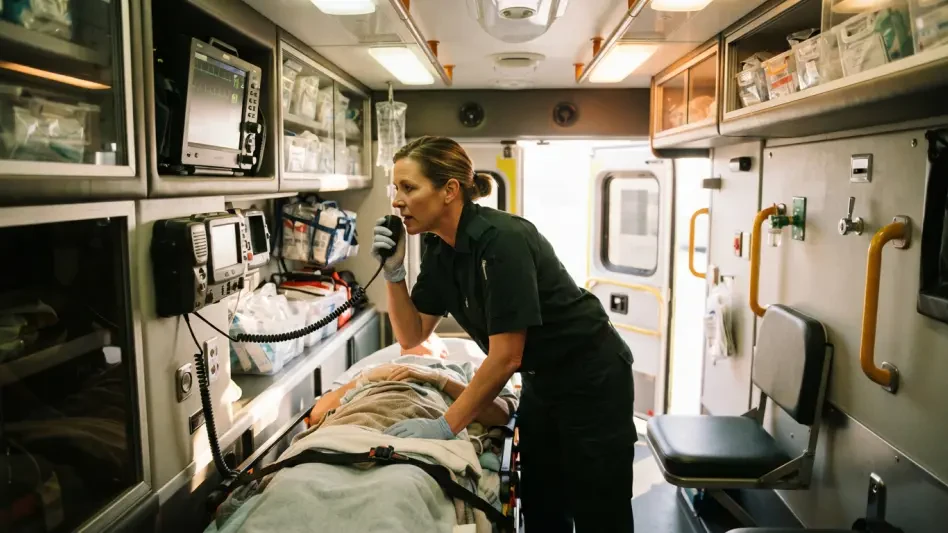
The preferred design for human-machine interaction in 2026 combines high-quality vehicle-mounted audio systems with large, clear graphical displays. This dual-modal approach allows clinicians to issue verbal commands and receive audio feedback while simultaneously having a visual reference to verify the accuracy of the AI’s data processing. Having a screen that displays the information being recorded—such as vital signs or medication dosages—provides a critical “human-in-the-loop” safety check. Paramedics have indicated that they are much more comfortable with a system that allows them to visually confirm what the AI has understood, as this minimizes the risk of transcription errors or misinterpreted commands that could lead to clinical mistakes during high-pressure situations.
High-quality vehicle speakers and localized microphones are seen as the most viable alternative to headsets, as they provide an ambient interface that everyone in the patient compartment can interact with. This setup facilitates a collaborative environment where both the primary paramedic and their partner can hear and verify the information being processed by the assistant. However, this design also requires sophisticated noise-canceling technology to filter out the sound of sirens, road noise, and medical equipment. By focusing on a vehicle-integrated interface, developers can create a robust and reliable system that fits into the existing physical layout of the ambulance. This approach respects the workflow of the crew while leveraging the power of AI to manage the documentation and logistical aspects of the mission.
Overcoming Critical Barriers
Technical Reliability and Ethics
For any voice-activated AI to be accepted in the emergency medical field, it must achieve a level of technical reliability that matches the “no-fail” nature of the service. Clinicians emphasize that the system must be capable of understanding diverse regional dialects and accents, even when the speaker is wearing a protective face mask or operating in a high-decibel environment. The frustration of a misunderstood command is more than a minor annoyance in an ambulance; it is a potential threat to patient safety. Therefore, the development of specialized acoustic models that are trained specifically on the sounds and speech patterns found in emergency settings was a major focus of recent research. Only when the technology can guarantee near-perfect accuracy will it gain the full trust of the professional community.
The implementation of these systems also raised significant ethical and privacy concerns that must be addressed before widespread deployment. Over half of the surveyed clinicians expressed anxiety regarding the use of commercial cloud servers for storing sensitive patient health data, advocating instead for secure, localized processing. There is also a practical privacy concern regarding the use of loudspeakers in the presence of bystanders or family members, who might inadvertently overhear private medical details. Ethically, there is a lingering fear of “cognitive deskilling,” where paramedics might become overly reliant on AI prompts for drug dosages or clinical steps, potentially eroding their own autonomous expertise. Addressing these concerns required the development of strict data protocols and clear guidelines on the role of AI as a supportive tool rather than a replacement for professional judgment.
Systemic Integration and Hurdles
The final barrier to the success of AI voice assistants in emergency care is the organizational challenge of achieving total systemic integration with hospital infrastructures. The study highlighted that a significant portion of prehospital data is currently lost or omitted during the transition from the ambulance to the emergency department, creating a dangerous information gap. An AI system that can automatically synchronize its mission summary with a hospital’s electronic health records would solve this problem, but it requires a level of interoperability that many healthcare systems have yet to fully realize. Stakeholders argued that for AI to be truly effective, it must be part of a unified digital ecosystem where data flows seamlessly from the first emergency call to the final hospital discharge.
Securing the necessary capital investment and overcoming “digital fatigue” among staff also remained significant hurdles for EMS organizations as they moved toward 2026. The transition to AI-supported care involved not just the purchase of software, but also extensive training and the upgrading of cellular infrastructure to ensure consistent coverage in rural areas. The research concluded that successful adoption was most common in regions where the technology was introduced as a solution to specific workload burdens rather than as a top-down mandate. By focusing on how AI can alleviate the daily pressures of documentation and logistics, organizations were able to turn skepticism into support. In the end, the path forward for prehospital AI depended on demonstrating that these tools could return the clinician’s focus to the patient, where it truly belongs.