
Faisal Zain has spent his career at the intersection of medical device manufacturing and clinical diagnostics, witnessing firsthand how the digital revolution has reshaped patient care. As a leading voice in medical technology and clinical informatics, he understands that the value of any innovation lies not in its complexity, but in its ability to fade into the background of a clinician’s busy day while providing life-saving insights. This dialogue explores the convergence of clinical intelligence and real-time diagnostic platforms, focusing on the elimination of platform fatigue, the measurable impact of AI on stroke recovery metrics, and the ethical necessity of transparent, evidence-based data in modern hospital systems.
AI tools often require clinicians to toggle between various platforms, disrupting their focus during critical moments. How does the integration of expert resources directly into a care coordination platform solve this friction, and what does it mean for the quality of care?
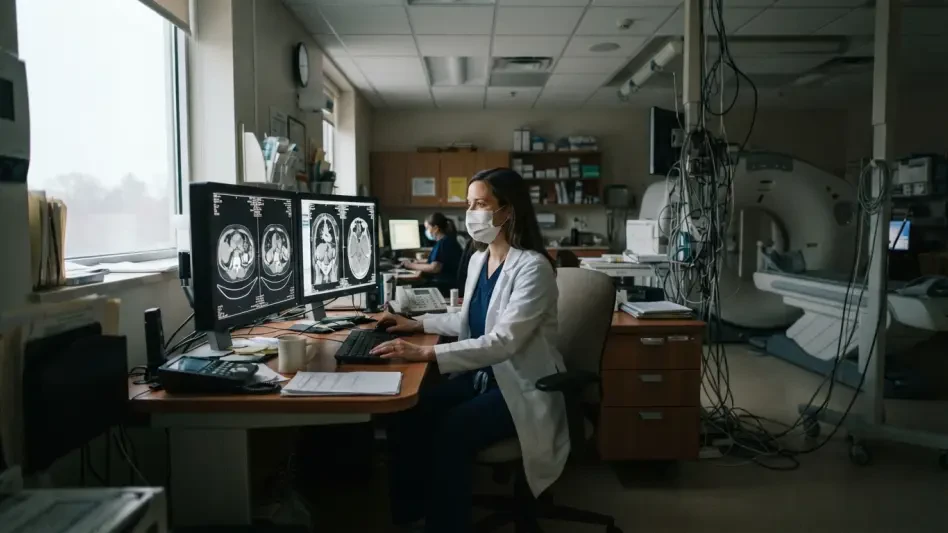
The “toggle tax” is a very real burden in modern medicine, where every second spent switching between an imaging app and a reference database is a second taken away from the patient. By embedding UpToDate Expert AI directly into the Viz.ai One platform, we are effectively removing the walls between diagnosis and the clinical roadmap. This integration allows a physician to ask complex clinical questions and receive evidence-based answers informed by the specific patient data already in the system, all within a single interface. When a clinician doesn’t have to stop what they are doing to hunt for the latest treatment protocols, they maintain a “flow state” that is essential for managing the sickest patients in the hospital. It transforms the AI from a simple notification tool into a comprehensive clinical partner that supports the entire journey from detection to treatment.
In time-sensitive scenarios like a stroke, every second counts. Could you elaborate on how these synchronized communication tools and real-time detection platforms translate into tangible patient outcomes?
The impact of this technology is most visible when we look at the “door-to-groin” times, which is the critical window between a patient’s arrival and the moment a catheter is inserted for a thrombectomy. A study published in the American Journal of Neuroradiology highlighted that after implementing these AI-powered coordination tools, hospitals saw a 39% decrease in these times for patients with large vessel occlusions during off-hours. This is a staggering improvement because, in the world of neurology, “time is brain,” and faster access to imaging and synchronized communication literally saves functional ability. By automating the detection of a stroke and immediately alerting the entire care team, the platform ensures that the surgical suite is ready before the patient even clears the initial triage. These concrete numbers prove that when we streamline the communication of 2,000 different hospitals, we aren’t just saving time; we are preventing long-term disability for thousands of individuals.
There is a significant difference between a generic AI response and one rooted in decades of peer-reviewed clinical evidence. Why is it essential for clinicians to see the specific sources of their information, especially when dealing with the sickest patients?
Trust is the foundation of clinical practice, and physicians are naturally skeptical of “black box” AI that offers answers without explaining the “why” behind them. The deliberate choice to keep sources visible within the app is a safeguard that keeps the physician in the driver’s seat, checking the AI’s reasoning rather than just blindly accepting a suggestion. UpToDate has been a trusted resource for physicians for decades because its content is authored and reviewed by thousands of doctors, providing a level of reliability that generic large language models simply cannot match. When dealing with high-stakes conditions, knowing that your guidance comes from a synthesized, evidence-based library ensures that the care provided is both modern and safe. This transparency bridges the gap between cutting-edge technology and the traditional rigors of medical ethics.
With these platforms already deployed in 2,000 hospitals, what does the scale of this partnership suggest about the future of clinical informatics on a global stage?
We are seeing a shift from isolated digital tools to massive, interconnected ecosystems that can serve customers in over 180 countries. When a San Francisco-based AI company partners with a global leader like Wolters Kluwer Health, it creates a standardized level of care that can be exported to almost any clinical environment. The fact that 2,000 hospitals in the United States are already utilizing real-time disease detection and synchronized communication suggests that the industry is moving toward a “command center” model of medicine. This scale allows for the collection of massive amounts of data that can further refine how we spot early disease markers across diverse populations. It’s no longer just about one hospital being high-tech; it’s about a global network of professionals having the same high-quality, evidence-based resources at their fingertips regardless of their geographic location.
What is your forecast for the evolution of AI-driven clinical decision support?
I believe we are moving toward a future where AI will not only detect the presence of a disease but will also proactively simulate the outcomes of various treatment paths based on real-time physiological data. We will likely see these platforms move beyond stroke and cardiovascular care into almost every specialty, from oncology to rare genetic disorders, providing a “living” textbook that updates as the patient’s condition changes. The integration of clinical evidence will become so seamless that the distinction between a “software tool” and “medical knowledge” will effectively disappear. Ultimately, my forecast is that these systems will reduce the cognitive load on healthcare providers so significantly that we will see a resurgence in the “human” side of medicine, as doctors spend less time on screens and more time at the bedside.