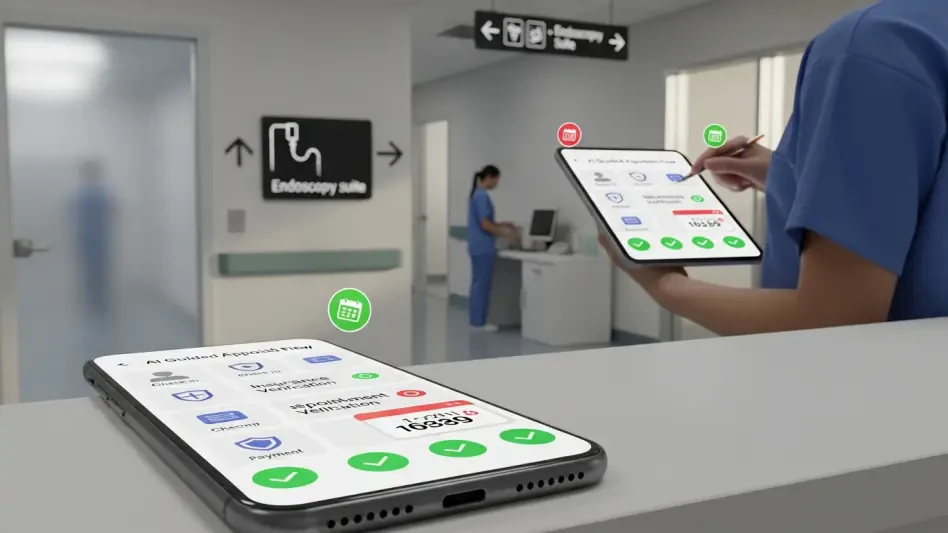

Rising colorectal cancer deaths among adults under 50 have turned missed screenings into an avoidable market failure where operational friction, not medical knowledge, dictates outcomes and revenue.
Market Context and Purpose
Colorectal cancer screening has shifted from a routine age-based check to a high-stakes operational race. As incidence climbs in younger adults and guidelines push the starting age to 45, health systems face a surge of eligible patients who need timely navigation through outreach, scheduling, preparation, and confirmation. The public-health imperative now aligns with a clear market opportunity: closing the execution gap that stalls life-saving colonoscopies.
This analysis examines how patient-facing AI is transforming last-mile coordination into a scalable, measurable capability. The aim is not to replace clinicians or administrative staff, but to move repetitive, time-bound tasks into an always-on layer that reduces no-shows, accelerates time-to-procedure, and improves completion rates. The lens is deliberately operational because that is where throughput—and ultimately outcomes—are won or lost.
Market Dynamics and Demand Drivers
Eligibility Expansion and Rising Throughput Needs
Lowering the screening age widened the funnel overnight, bringing millions more into scope while existing teams already struggled to convert referrals into scheduled procedures. The friction points are ordinary but decisive: failed calls, long waitlists, unclear prep, and weak loop closure. Each missed touchpoint compounds the risk that a patient never completes a colonoscopy, despite clear clinical benefit and payer support.
Moreover, early detection economics are compelling. Localized disease carries a five-year survival rate above 90%, and colonoscopy prevents cancer by removing precancerous polyps. Delays increase mortality month by month—more than 12% per month, about 39% by three months—creating a measurable cost of inaction for both providers and payers.
Administrative Overload and Cost Pressures
Administrative spending in U.S. healthcare exceeds $1 trillion annually, roughly a quarter of total costs, yet reliability in preventive pathways remains inconsistent. The paradox is striking: higher spending coincides with uneven execution of basic workflows that should be routine. This mismatch fuels an appetite for automation that is specific, auditable, and integrated with scheduling and messaging systems already in place.
Health systems now prioritize operational ROI over experimental pilots. The metrics that matter are concrete and near term: contact rate, scheduled rate, prep adherence, day-before confirmations, completion rate, and time-to-procedure. Solutions that raise these indicators without adding headcount or burden achieve fast stakeholder buy-in.
Burnout, Churn, and Reliability Risk
High turnover among administrative teams—often surpassing 50% within two years—erodes institutional memory and consistency. Clinicians report spending about a third of their time on paperwork and inbox management, and the majority cite this load as a driver of burnout. In this environment, even diligent teams miss follow-ups that require serial touches across weeks.
The market consequence is predictable: unreliable conversion from recommendation to completed screening. Investors and executives increasingly view this as a systems-engineering problem rather than a staffing problem, steering demand toward technology that can sustain volume and cadence without fatigue.
Patient-Facing AI as the Coordination Layer
Modern patient-facing AI excels at the unglamorous tasks that move care forward: high-volume outreach, eligibility checks, real-time scheduling, bidirectional prep support by text or voice, dynamic reminders, easy rescheduling, and confirmation of completion with automatic re-engagement. These interactions are rules-based and time-sensitive, making them ideal for automation that escalates edge cases to humans.
Real-world outcomes have accelerated adoption. Health systems report reduced no-shows and higher throughput when AI manages engagement end to end. Patients respond to convenience and clarity; engagement with AI tools has grown roughly 20x year over year, signaling a durable preference for on-demand navigation.
Adoption, Regulation, and Economics
Roughly 80% of hospitals report using AI for care and workflow efficiency, and capital flows reflect that momentum: AI health startups raise about 83% more per deal than non-AI peers. Regulators emphasize safety, transparency, consent, and auditability, but current guidance supports technologies that close gaps in preventive care—especially when escalation paths and data protections are explicit.
Economically, the business case is straightforward. Preventing advanced disease avoids catastrophic costs, and automating coordination shifts staff time to higher-value work rather than eliminating roles. Value-based contracts, quality metrics, and colorectal screening targets further align incentives toward tools that lift completion rates.
Forecast and Strategic Outlook
The market is consolidating around platforms that integrate tightly with EHRs, scheduling APIs, and payer eligibility services. The next competitive frontier is continuous optimization—A/B-tested outreach scripts, multilingual and culturally attuned messaging, and real-time exception handling that routes complex needs to human navigators within minutes.
Expect rapid expansion from colonoscopy scheduling to adjacent pathways with similar dynamics: FIT and FOBT distribution and returns, positive-test colonoscopy follow-up, and navigation-heavy specialties such as lung, breast, and cervical screening. Vendors that demonstrate repeatable lifts across lines of service will gain enterprise traction, while point solutions that cannot prove end-to-end impact may be relegated to niche roles.
Pricing models are shifting toward outcome-linked fees. Contracts increasingly reward completed screenings and reduced time-to-procedure rather than message volume. This performance orientation favors vendors with strong analytics, transparent audit logs, and clear escalation policies that satisfy compliance teams and frontline managers alike.
Strategic Implications and Playbook
For providers, the fastest wins come from targeting 45–49-year-olds and overdue patients, measuring success as completed colonoscopies and days saved. Automation should cover the entire loop—outreach through confirmation—so that manual follow-up becomes the exception, not the rule. Staff must remain central: AI should tee up high-touch interventions for anxious patients, language barriers, or complex comorbidities.
For payers, subsidizing or contracting for AI-enabled navigation aligns with medical-loss-ratio goals and improves member experience. Incentive structures that reward timely completion will accelerate adoption among provider networks and deliver consistent population-level gains.
For vendors, credibility hinges on security, consent management, and explainability. The strongest differentiators are measurable lift, clean integrations, and operational resilience during staffing fluctuations, weather disruptions, and supply constraints.
Actions That Shift the Curve
The data pointed to a solvable execution problem hiding in plain sight: screening succeeded when outreach connected, scheduling was instant, preparation support was interactive, and loop closure was automated. Patient-facing AI delivered those mechanics at scale, reduced no-shows, and shortened time-to-procedure without displacing human judgment. Health systems that standardized on an AI coordination layer gained throughput, lowered operational risk, and reallocated staff to the cases that truly needed a human touch. The next step had been clear: treat navigation as a performance discipline, pay for outcomes, and expand the model across preventive pathways until reliability became the default rather than the exception.