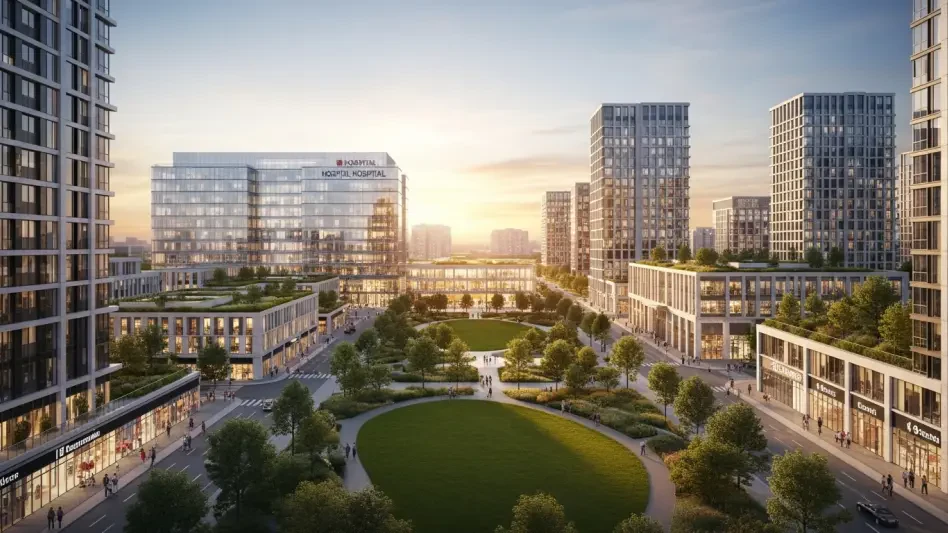

With a portfolio valued at approximately AED 130 billion and a delivery track record of over 10,000 homes, Ahmed Alkhoshaibi has steered Arada to become a formidable force in the Middle Eastern real estate market. His strategy transcends traditional property development, focusing instead on building holistic, self-sustaining ecosystems that integrate healthcare, education, and lifestyle. By pivoting toward long-term recurring revenue through major acquisitions like Reem Hospital, he is redefining what it means to be a sustainable developer in a historically volatile industry.
This discussion explores the shift from cyclical sales to stable earnings, the operational intricacies of launching a multi-city medical network, and the fiscal discipline required to prioritize expansion over immediate profits. We also delve into the philosophy of designing for end-users and the strategic importance of controlling internal brands to maximize the value of raw land.
Real estate is notoriously cyclical, often swinging between boom and bust. How do you balance immediate “build-to-sell” sales with long-term recurring revenue streams, and what specific benchmarks do you use to ensure these new business lines remain self-sustaining?
Our strategy is rooted in the realization that we cannot simply ride a wave and follow the traditional patterns of the real estate market. To insulate ourselves from the “bust” periods, we have diversified into seven distinct verticals, ensuring that our business remains robust even when the sales market cools. The acquisition of a controlling stake in Reem Hospital for AED 2 billion is a prime example of how we are securing sustainable, recurring revenue streams. We look at solid benchmarks like Reem Hospital’s recent performance, which saw revenues of AED 500 million and an EBITDA of just under AED 100 million. By shifting our focus from pure build-to-sell to these high-performing service sectors, we create a financial floor that allows us to sustain our staff and operations regardless of the property cycle.
Scaling a medical network across Abu Dhabi, Sharjah, and Dubai within a three-year window is an ambitious undertaking. What are the primary operational challenges in replicating a facility’s success across different regions, and how do you maintain consistent clinical standards while managing such a rapid rollout?
The primary challenge lies in the sheer logistical scale of delivering three more hospitals across three different emirates while maintaining the high clinical standards established in Abu Dhabi. We are not just building structures; we are transplanting a complex service business into different regulatory and demographic environments, including our Aljada masterplan in Sharjah and a new site in Dubai. To manage this, we utilize our in-house construction and development verticals to ensure the physical infrastructure is delivered on time and according to the specific needs of a healthcare provider. Consistency is maintained by leveraging the existing expertise of the Reem Hospital team, using their established protocols as the blueprint for every new facility we launch. It’s about taking a proven success and scaling it with the speed that only an integrated developer can provide.
With clinical revenues reaching several hundred million, the decision to reinvest profits into expansion rather than seeking immediate payback is a significant fiscal commitment. How does this approach influence your debt strategy, and what metrics determine when a specific facility is ready for further capital injection?
We are currently sitting on a cash reserve of about AED 3 billion, which gives us the flexibility to prioritize growth over immediate dividends. My philosophy is that we are not looking for a quick payback; instead, we are focused on reinvesting every dirham of profit back into expanding the existing hospital and the wider network. While a deal of this magnitude—over half a billion dollars—unlikely exists without some level of debt, our strong cash position allows us to manage that leverage conservatively. We decide to inject further capital based on the facility’s ability to meet demand and its potential to act as a value-driver for our surrounding real estate. If a facility shows it can sustain its own operations while contributing to the overall brand equity of the community, it becomes a candidate for further expansion.
Integrating specialized anchors like hospitals and schools can transform the inherent value of raw land. Can you walk through the step-by-step process of selecting these anchors for a masterplan and explain how controlling these internal brands helps you maintain project timelines compared to using third-party providers?
The process begins with a piece of “desert” land that we might have acquired for relatively little, which we then transform by strategically placing our own branded anchors. We identify the essential needs of a future community—healthcare, education, retail, and fitness—and rather than outsourcing these to third parties who may have different timelines or priorities, we use our own brands. This control is vital because it eliminates the friction of negotiating with external providers and ensures that a hospital or school opens exactly when the residents move in. When I can say I have an in-house hospital, a school, and a fitness center, that land automatically appreciates in value. It allows us to dictate the quality and the pace of the entire masterplan, turning a blank slate into a vibrant, high-value city.
There is often a tension between designing small units for high-yield investors and creating larger, livable spaces for families. Why do you prioritize end-user-focused designs, and what long-term impact does this have on a community’s brand equity and resale value over the next decade?
I have a very firm rule: I will never design a building that is only attractive to investors, which usually means avoiding the tiny, cramped apartments that investors love for their yields but people hate living in. When a building is finished, if it isn’t a livable space for a family, the brand eventually gets diluted and the community suffers. By focusing on the end-user, we ensure that the majority of our customers are people who actually want to stay, which creates a stable, high-quality neighborhood. Over the next decade, this approach protects resale values because a community full of happy residents is always more desirable than a transient one. We have already delivered over 10,000 homes with this philosophy, and it is the reason our brand remains strong while others may fade.
Managing seven distinct business verticals requires immense oversight. How do you foster synergy between your construction, retail, and healthcare teams, and under what specific market conditions would you consider expanding into a new industry category beyond your current portfolio?
Synergy is achieved by viewing our various verticals—from construction to restaurants—as a single toolkit designed to add value to our masterplans. Our in-house construction team understands the specific requirements of our retail and healthcare brands, which prevents the communication gaps you see with external contractors. For example, our fitness centers and restaurants are integrated into the development phase, ensuring they are perfectly positioned to serve the community from day one. Regarding further expansion, I believe we are currently tapped into the verticals we had planned, such as healthcare, education, and asset management. We would only consider a new category if it filled a critical gap in our “city-building” model, but for now, our focus is on executing our current pipeline of 55,000 units.
What is your forecast for the integration of healthcare and residential masterplans?
I believe the future of real estate lies in “wellness-centric” urbanism, where healthcare is no longer a destination you drive to, but a service woven into the fabric of your neighborhood. In the coming years, we will see a shift where developers who do not control their own essential services, particularly healthcare, will struggle to compete. By owning the hospital, we aren’t just selling a home; we are selling a lifetime of care and security, which is a far more powerful value proposition. My forecast is that this integrated model will become the gold standard, as residents increasingly demand that their communities provide everything from primary care to specialized medical treatment within walking distance. This evolution will turn developers into holistic service providers, making the “build-to-sell” model look increasingly obsolete.