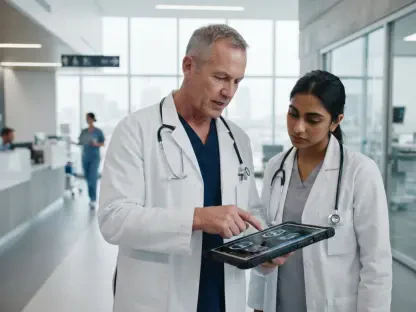

The traditional stethoscope is rapidly becoming a secondary artifact as algorithmic diagnostic engines begin to interpret the subtle whispers of biological data with superhuman precision. In the current landscape of 2026, the integration of artificial intelligence into clinical workflows has transitioned from a speculative luxury to a fundamental necessity for modern healthcare systems. This review examines how these computational frameworks are reshaping the diagnostic journey, focusing on the sophisticated interplay between raw medical data and high-level cognitive assistance. By examining the current technological baseline, it becomes clear that the value of AI lies not in replacing the physician but in augmenting the human capacity to identify patterns within increasingly massive and complex datasets.
The Evolution: A Digital Transformation in Clinical Diagnostics
The journey of AI in medicine began with basic rule-based systems, but the current era is defined by deep learning architectures that mimic neural processing. These systems are designed to ingest multi-modal data—ranging from genomic sequences to real-time physiological telemetry—and provide insights that were previously hidden from manual review. This evolution was accelerated by the need for greater efficiency in overburdened healthcare infrastructures where the volume of patient data began to exceed the processing speed of even the most experienced clinical teams. Consequently, AI has emerged as the primary tool for triaging critical cases and ensuring that no subtle abnormality remains overlooked during the initial screening process.
Beyond simple automation, the modern diagnostic AI is characterized by its ability to learn from dynamic environments. Rather than remaining static, these models are continuously refined through feedback loops, allowing them to adapt to new disease variants or changing clinical protocols. This adaptability is particularly relevant in the broader technological landscape, where healthcare is merging with high-performance computing. The context of this evolution is not merely about speed; it is about the transition toward a more proactive, predictive model of care that prioritizes early intervention over late-stage treatment.
Core Pillars: The Foundation of AI-Driven Systems
Computer Vision and Medical Imaging
Computer vision represents the most mature pillar of AI-powered diagnosis, functioning through the granular analysis of pixels in radiological scans. These algorithms utilize convolutional neural networks to detect micro-calcifications in mammograms or early-stage nodules in lung CT scans with a sensitivity that frequently surpasses the human eye. The significance of this technology lies in its consistency; unlike human practitioners who may suffer from fatigue or cognitive bias, an AI system maintains a uniform level of scrutiny regardless of the workload volume. Furthermore, these systems provide a quantitative layer to imaging, turning visual patterns into actionable data points for longitudinal tracking of disease progression.
The performance of these imaging tools has reached a point where they can autonomously flag urgent findings for immediate radiologist review. This “priority-based” workflow ensures that life-threatening conditions, such as intracranial hemorrhages or pulmonary embolisms, are addressed within minutes rather than hours. However, the true power of computer vision in 2026 is its integration with historical patient data. By comparing a current scan with years of previous images, the AI can detect the most minute changes in tissue density, providing a level of temporal analysis that is nearly impossible for a human to perform manually across thousands of patients.
Predictive Analytics and Clinical Decision Support
Predictive analytics acts as the intellectual engine of clinical decision support, processing the vast quantities of data stored in electronic health records. By synthesizing laboratory results, vital signs, and medication histories, these systems can forecast clinical deterioration before physical symptoms manifest. For instance, in acute care settings, predictive models are now the gold standard for identifying the early onset of sepsis, allowing clinicians to initiate life-saving interventions hours earlier than was possible through traditional monitoring. This capability transforms the role of the clinician from a reactive responder to a proactive strategist.
In real-world usage, these support systems serve as a sophisticated safety net. They analyze the technical aspects of drug interactions and patient comorbidities in real-time, offering suggestions that refine the diagnostic path. The performance characteristics of these systems are measured not just by accuracy, but by their ability to reduce the “cognitive load” on medical staff. By filtering out the noise of non-essential alerts and highlighting the most critical data points, predictive analytics allows healthcare professionals to focus their attention where it is most needed, thereby improving the overall quality of patient outcomes.
Current Trends: Localized Data and Behavioral Shifts
A significant shift in the industry involves the move toward localized data validation, moving away from universal models that often fail to account for regional nuances. In diverse environments like the UAE, developers are prioritizing the training of algorithms on local demographic data to ensure that factors like genetic markers, lifestyle habits, and environmental influences are properly represented. This trend toward “precision localization” ensures that diagnostic outputs are truly relevant to the specific population being served, reducing the risk of bias that occurs when models are trained solely on Western datasets.
Moreover, there is a visible shift in consumer behavior as patients become more comfortable with AI-driven preliminary screenings. The rise of wearable technology and home-based diagnostic kits has decentralized the initial phase of medical inquiry. People are now using AI-powered apps to monitor chronic conditions or screen skin lesions before even stepping into a clinic. This behavioral change is forcing the healthcare industry to integrate consumer-level data with professional medical systems, creating a seamless flow of information that empowers patients while providing doctors with a more comprehensive view of their health status.
Real-World Applications: Precision Across Medical Disciplines
In the field of oncology, AI is proving to be a transformative force, particularly in the early detection of breast and lung cancers. Large-scale clinical trials have confirmed that AI-augmented mammography can identify significantly more malignancies while simultaneously reducing the administrative burden on radiologists. This implementation is unique because it demonstrates how technology can handle high-volume repetitive tasks, allowing specialists to dedicate more time to complex cases and patient communication. The success in oncology is being mirrored in ophthalmology, where AI-driven retinal imaging is now a standard tool for screening diabetic retinopathy, preventing vision loss through early detection in high-risk populations.
Critical care and cardiovascular health have also seen notable implementations of AI diagnostic tools. In intensive care units, systems monitor subtle fluctuations in patient vitals to predict respiratory failure or acute kidney injury. Meanwhile, in cardiology, AI algorithms analyze electrocardiograms to detect structural heart issues that might be missed during a standard examination. These applications highlight the versatility of the technology; it is not a niche tool but a broad-spectrum enhancement that improves diagnostic accuracy across nearly every specialty in the medical field.
The Challenges: Technical and Regulatory Obstacles
Despite its rapid advancement, AI-powered diagnosis faces significant hurdles, particularly regarding data privacy and the “black box” nature of deep learning. Ensuring the security of massive datasets against cyber threats remains a top priority for regulators and healthcare providers alike. Furthermore, the lack of transparency in how some algorithms reach their conclusions can create a trust gap between the technology and the clinician. Efforts are currently underway to develop “explainable AI” that provides a clear rationale for its findings, which is essential for maintaining clinical accountability and professional trust.
Regulatory and legal frameworks are also struggling to keep pace with technological progress. The question of liability remains a complex issue: if an AI system misses a diagnosis, the legal responsibility currently falls on the human physician, even if the error originated in the code. Additionally, “alert fatigue” continues to plague clinical environments, where an overabundance of automated warnings can lead to desensitization among medical staff. Overcoming these obstacles requires a balanced approach that combines technical innovation with robust policy development and continuous education for healthcare professionals.
Future Outlook: The Synergy of Human and Machine
The trajectory of AI in medicine is heading toward a future of deep human-AI synergy, where the strengths of both are maximized. As we look from 2026 to 2028, we expect to see the emergence of fully integrated diagnostic ecosystems that operate invisibly in the background of every patient interaction. These systems will likely move beyond simple detection into the realm of personalized treatment simulation, predicting how a specific patient will respond to different therapeutic options based on their unique biological profile. This transition will redefine the patient experience, making healthcare more personalized and less invasive.
Long-term, the impact of this technology will be felt in the democratization of high-quality medical care. AI-powered diagnostic tools can be deployed in underserved regions where specialists are scarce, providing a baseline of expertise that was previously inaccessible. Breakthroughs in natural language processing will also allow for more intuitive interactions between doctors and diagnostic engines, making the technology a natural extension of the clinical thought process. Ultimately, the industry is moving toward a model where AI handles the data-intensive tasks, freeing human doctors to focus on the ethical, emotional, and complex aspects of healing.
Final Assessment: The Impact of AI-Integrated Healthcare
The review of current AI-powered diagnostic systems demonstrated that the technology has reached a level of maturity where it significantly improved clinical efficiency and patient safety. The analysis underscored that while the tools provided superior data processing and pattern recognition, the human element remained indispensable for final clinical judgment. It was observed that the most successful implementations were those that prioritized localized data validation and seamless integration into existing medical workflows. Stakeholders recognized that the initial fears of automation were largely replaced by an appreciation for the “augmented clinician” model.
The findings suggested that the industry must now focus on solving the remaining challenges of interoperability and medico-legal accountability to ensure sustainable growth. Healthcare providers who adopted these technologies early gained a clear competitive advantage in terms of diagnostic speed and accuracy. In summary, the integration of AI into medical diagnosis was not merely a technical upgrade but a foundational shift that redefined the boundaries of what is possible in modern medicine. The path forward required a commitment to ethical transparency and a continued focus on keeping the patient-doctor relationship at the center of the technological revolution.