
Market Context and Purpose
Hospitals sat on shelves of promising algorithms while bedside workflows waited for proof, uptime, and seamless delivery that never quite arrived until platforms reframed the game. The center of gravity in healthcare AI moved from model novelty to operational fidelity. This analysis evaluates how Nvidia and Hoppr reposition demand: away from buying black-box apps and toward building hospital-native pipelines that fit clinical tempo, data constraints, and governance rules.
The purpose is to assess whether platformization resolves the “last mile” problem—validation, integration, and change control—or simply trades app sprawl for platform sprawl. The answer carries real budget implications, as buyers now prioritize deployment reliability, regulatory readiness, and integration depth over leaderboard performance alone.
How Value Is Changing: From Algorithms to Deployment
A decade of imaging breakthroughs created model abundance, yet adoption lagged because PHI rules restrict data movement, scanners vary by site, and integrations into PACS/RIS/VNA remain brittle. Procurement cycles favored pilots that dazzled but struggled to scale across diverse fleets and reporting norms. As a result, ROI hinged not on better math, but on repeatable, secure operations that survive clinical pressure.
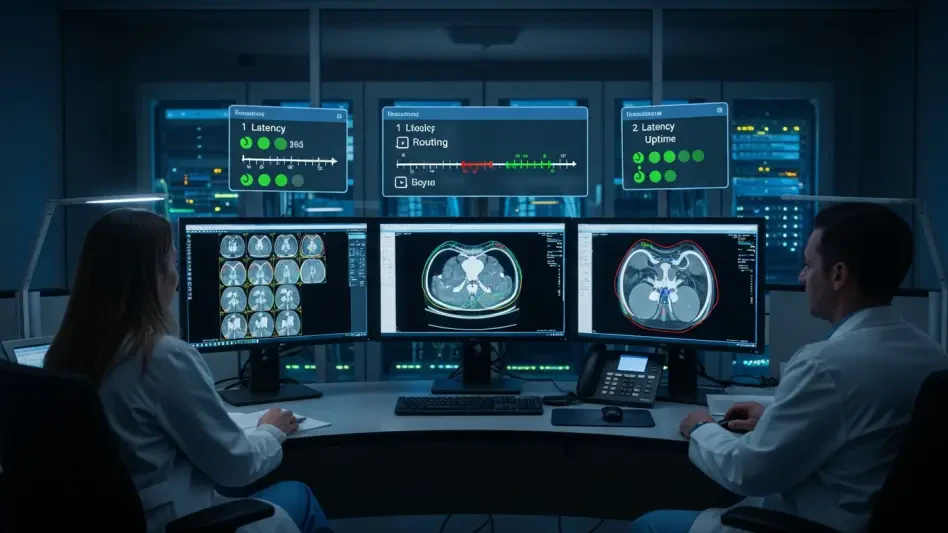
Nvidia and Hoppr target that gap. Hoppr’s foundry uses Nvidia’s GPUs and imaging backbones to fine-tune with smaller local datasets, cutting curation costs and speeding iteration. Crucially, outputs are embedded as DICOM-native artifacts and routed via standards like HL7/FHIR, so results land where radiologists work, with latency aligned to STAT demand.
Platform Mechanics: Foundry, Governance, and Workflow Fit
The playbook favors pre-trained models for modality-specific tasks—triage, quality control, quantification—adapted to local protocols and demographics. Early users report tighter validation loops: site-by-site thresholds, scanner-specific calibration, and drift monitoring that ties alerts to clinical impact. That shortens the path from sandbox to service line.
However, hospital-grade rigor still rules. Versioning, auditability, and cybersecurity require policy-backed pipelines: approval gates, rollback plans, and uptime SLAs. The platforms that win balance portability with safety, enabling federated fine-tuning and synthetic augmentation to reduce data movement while preserving fidelity to local artifacts.
Competitive Landscape and Economics
An ecosystem approach compresses integration overhead by standardizing one deployment surface for many use cases. Shared model catalogs, validation packs, and usage-based pricing tilt economics toward time-to-value rather than perpetual licenses. Providers gain leverage by owning fit-for-purpose models while vendors supply the rails—compute, orchestration, and safety tooling.
The risk is lock-in. As departments proliferate models, governance can fragment, and cross-site generalization can stall without common registries and consistent monitoring. Buyers therefore score vendors on exit options, open standards, and evidence generation—not just FLOPs and accuracy.
Outlook and Projections
Near-term momentum points to containerized inference at the edge, zero- and few-shot adaptation for new protocols, and regulated pipelines that treat post-market surveillance as routine. Health systems that master continuous learning—safe updates, cohort-specific audits, equity checks—expand use cases faster and negotiate better terms.
Market share is likely to accrue to platforms that prove latency discipline, reduce integration effort per new model, and document outcomes improvement. As adaptive AI pathways mature, hospitals transition from pilot budgets to operational spend, institutionalizing updates as part of clinical quality.
Strategic Guidance for Buyers and Partners
Start with workflow maps, not model menus: define decision points, turnaround targets, and reporting endpoints before training. Prioritize foundation models to cut data needs, then localize relentlessly across scanners and populations. Build a governance spine early—thresholds, monitoring, and rollback—so expansion does not stall under scrutiny.
On procurement, insist on multi-model orchestration, open standards, and clear exit ramps. Tie payments to measurable gains—throughput, turnaround times, quality scores—and reserve funds for ongoing optimization, not just go-live.
Conclusion: Where Scale Would Actually Happen
Evidence indicated that the last mile was solved by platforms that united compute, foundation models, and workflow-native delivery rather than by new algorithms alone. Nvidia supplied performance and toolchains; Hoppr translated them into hospital-ready foundry operations. The practical path forward rested on governance discipline, deep integrations, and measured change management, positioning buyers to own clinical IP while outsourcing the rails that kept it safe and scalable.