
Faisal Zain is a distinguished healthcare expert and innovator who has spent years at the intersection of medical technology and clinical operations. With a deep background in the manufacturing of sophisticated medical devices used for both diagnostics and treatment, he has a unique perspective on how hardware and software must collaborate to improve patient outcomes. Currently, he is a leading voice in the integration of artificial intelligence within large-scale health systems, focusing on how technology can alleviate the mounting pressures on the medical workforce. In this conversation, Zain discusses the formation of the Diagnostic AI Consortium, a massive collaborative effort involving twelve major U.S. health systems and Aidoc, aimed at navigating the current diagnostic capacity crisis. We explore the critical differences between general AI and diagnostic tools, the importance of cross-institutional data, and the long-term roadmap for reclaiming speed and safety in American radiology.
The data reveals a stark reality: outpatient imaging turnaround times have more than doubled over the last decade, while the radiologist workforce is shrinking at a rate 50% higher than just a few years ago. How is the medical technology sector pivoting to address this specific bottleneck without compromising the “first, do no harm” principle?
We are facing a genuine capacity crisis where the sheer volume of data is beginning to overwhelm the human experts we rely on for accurate diagnoses. According to researchers at the Harvey L. Neiman Health Policy Institute, the shortage of radiologists is projected to persist through 2055 unless we take deliberate, technological action to augment the existing workforce. In the clinical environment, you can practically feel the sensory weight of this pressure; it’s the sound of a workstation constantly chiming with new scans and the sight of a backlog that never seems to shrink despite the long hours. By using AI to prioritize the most critical cases, we are moving away from the “first-in, first-out” model and toward a “sickest-first” priority system. This shift allows us to move a critical finding through the care pathway in a matter of hours rather than the days it might have taken previously, ensuring that speed and safety are no longer treated as opposing forces.
Twelve major health systems, caring for nearly 20 million patients annually, have formed a consortium to tackle these diagnostic challenges together. Why is this collective approach essential for the success of AI, rather than individual hospitals developing their own proprietary solutions in silos?
No single hospital, regardless of its size or reputation, can capture the full spectrum of human and clinical diversity needed to build AI models that generalize safely at a global scale. When institutions like Advocate Health, Cedars-Sinai, and Northwestern Medicine join forces, they are contributing a massive variety of imaging data, disease contexts, and scanner types that a solo effort simply cannot replicate. This collaboration allows us to establish shared standards and governance practices that protect against “drift” and “bias,” which are common pitfalls when AI is trained on too narrow a dataset. By working together, these twelve systems—including Northwell Health, Sutter Health, and Houston Methodist—are essentially building a common language for diagnostic excellence. It is about earning the right to scale this technology by proving it works across diverse populations, from the busy urban centers of Mount Sinai to the varied clinical settings of WellSpan Health and Mercy.
There is a lot of buzz around generative AI in the general tech world, but you’ve emphasized that diagnostic AI is a fundamentally different challenge. How does detecting subtle clinical signals differ from answering questions, and why is this distinction so vital for physician decision-making?
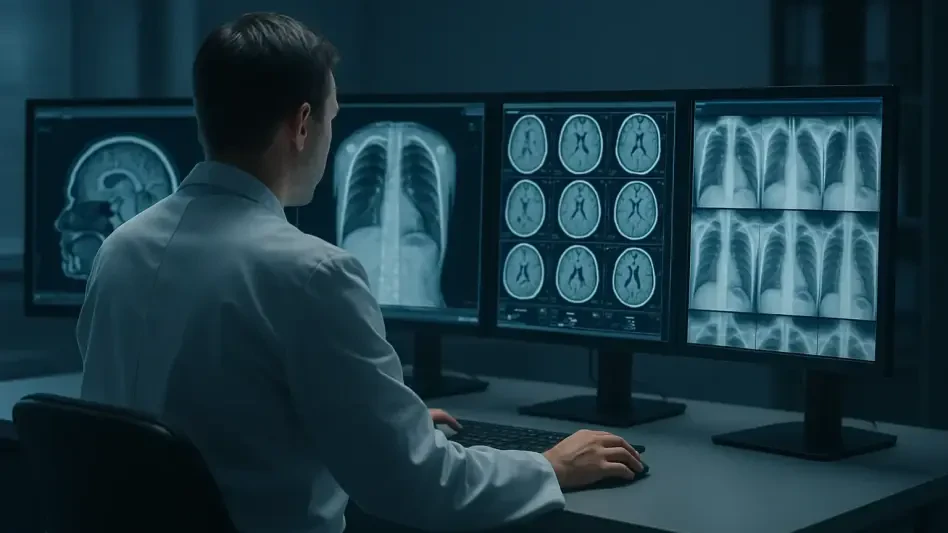
Generative AI is designed to create content or provide conversational answers, but in medicine, the stakes require something much more precise: the detection of subtle clinical signals across imaging, pathology, and laboratory data. Diagnostic AI doesn’t just “chat” with a doctor; it meticulously analyzes thousands of images to find a microscopic fracture or a faint shadow that could indicate the earliest stages of disease. This requires tools that are purpose-built for clinical decision-making and rigorously validated through FDA clearance to ensure they improve measurable patient outcomes. Physicians today are tasked with synthesizing an ever-expanding volume of information from the medical record, often under intense operational stress. The AI acts as a digital safety net, flagging high-risk cases so the physician can act faster and with greater confidence, rather than just adding more noise to an already crowded digital workspace.
Aidoc is providing the infrastructure for this massive undertaking, including their CARE™ foundation model and aiOS™. How do these technical foundations help manage the ongoing monitoring of AI performance across such a vast network of 2,000 hospitals?
The scale of this operation is unprecedented, with AI already running in nearly 2,000 hospitals and analyzing 60 million patient cases every year. Having a unified enterprise AI operating system like aiOS allows us to manage deployment and workflow integration seamlessly, so the technology becomes an invisible but essential part of the care process. One of the most critical functions of this infrastructure is post-deployment monitoring, which ensures the AI continues to perform accurately as patient demographics or hospital equipment change over time. In my years in medical technology, I’ve seen how important it is to have a robust foundation that can handle the “plumbing” of AI—the data flow, the scanner integration, and the real-time alerting. This operational experience, provided by Aidoc, ensures that the AI doesn’t just work in a lab setting, but thrives in the high-pressure, real-world environment of a busy emergency room or an outpatient imaging center.
As the consortium works toward sharing its initial results in 2027, what are the primary metrics that will define success for these AI-enabled workflows in terms of real-world patient care?
Success will be defined by our ability to measurably improve the safety, quality, and speed of every diagnosis made across the member sites, which include the University of Florida Health and University Hospitals of Cleveland. We are looking for concrete evidence that we have shortened the interval between a patient’s initial scan and the delivery of critical results to their treating physician. If we can prove that AI-enabled workflows allow the sickest patients to be correctly prioritized, we are directly impacting survival rates and long-term recovery prospects. Furthermore, the goal is to turn these findings into shared implementation practices that any health system, whether they are part of the consortium or not, can adopt to stabilize their own diagnostic capacity. We want to see a future where a diagnostic workup that currently stretches across several stressful days can be completed with total accuracy in just a few hours.
What is your forecast for the diagnostic AI field?
I expect that over the next several years, we will see a fundamental shift from isolated AI applications toward a fully integrated, enterprise-wide diagnostic ecosystem. The work being done by these twelve health systems will lead to a reality where AI is not just a “plugin” but the central nervous system of hospital operations, helping to manage the care of 20 million patients with a level of precision we’ve never seen. As we move closer to 2027 and beyond, the data gathered from 60 million annual cases will refine these models to a point where they can predict and flag complications before a physician even opens the file. We are moving toward a healthcare environment where the technology works silently in the background to ensure no critical finding is ever missed, effectively bridging the gap created by the radiologist shortage and setting a new global standard for diagnostic speed and patient safety.