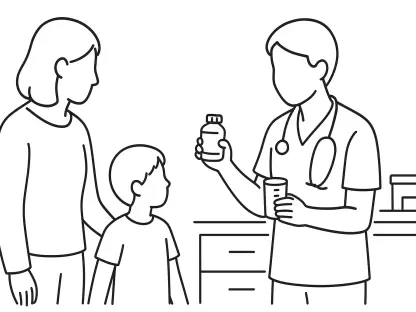

A quiet shift is already reshaping clinic visits as millions of people now ask chatbots for health answers before calling a nurse line, and the speed of that change keeps outpacing the slow, careful work of proving what is safe, effective, and fair.
The Clinical AI Surge: Who’s Building It, Who’s Using It, and Why It Matters
Segments, Use Cases, and Clinical Touchpoints
Large language models, imaging AI, decision support, and workflow tools now permeate primary care, specialty clinics, emergency departments, telehealth, and patient apps. Their tasks cluster around triage, symptom checks, documentation, coding, prior authorization, and discharge guidance.
These are not exotic pilots; they are the new front door to care and the backstage of clinical work. The stakes rise because guidance generated in seconds can steer a visit, a referral, or a bill.
Ecosystem and Incentives Shaping Adoption
Tech vendors, EHR companies, startups, health systems, insurers, regulators, and researchers all pull adoption in different directions. Cost containment, throughput, burnout relief, and competitive positioning create a strong commercial tailwind.
Early guardrails—IRBs, governance committees, procurement policies, and clinical leadership review—exist but vary in strength. Fragmentation leaves room for uneven standards and inconsistent risk tolerance.
Hype vs. Reality: What Trends Reveal About Clinical Readiness
Signal from the Noise: Trajectories in Use, Claims, and Behaviors
Consumers increasingly bypass clinicians for chatbot advice, amplifying exposure to unvetted guidance. Marketing narratives often run ahead of peer-reviewed evidence and real-world validation.
Clinicians experiment with drafts, coding support, and data handling, yet confidence is mixed. Concern grows over hallucinations, bias, and brittleness in ambiguous cases.
What the Numbers Say: Adoption, Performance, and Near-Term Outlook
Surveys show broad experimentation across health systems and patients, but controlled success seldom translates to bedside complexity. Benchmark wins falter when symptoms are vague or data are messy.
Early indicators include safety events, overrides, trust gaps, and faster turnarounds in low-risk tasks. Near-term deployment will cluster in documentation and prior auth, while diagnostic uses remain cautious.
Fragility at the Bedside: Technical, Clinical, and Organizational Challenges
Model Limitations that Undercut Reliability
Hallucinations, source fabrication, and compounded errors persist in multi-step reasoning. Sensitivity to prompt phrasing, context limits, and gaps for underrepresented groups undermines reliability.
Domain shift and EHR integration issues further degrade performance. Real-world variability exposes brittle edges that benchmarks miss.
Clinical Risks and the Erosion of Scientific Rigor
Diagnostic accuracy craters in ambiguous or atypical presentations; a JAMA Medicine study showed frequent misses. AI-generated or -amplified errors have even seeped into preprints and later-retracted papers.
Unchecked reliance by researchers and trainees normalizes shortcuts. Scientific standards erode when speed outruns verification.
Operational and Human Factors that Make or Break Outcomes
Workflow fit, alert fatigue, and unclear handoffs increase risk. Accountability, auditability, and incident response remain patchy.
Data quality, labeling practices, and maintenance debt weigh on live systems. Without stewardship, technical debt becomes clinical debt.
Practical Paths to Mitigation
Human-in-the-loop designs with clear escalation and fail-safes temper failure modes. Retrieval augmentation, citation checks, and uncertainty signaling reduce overreach.
Post-deployment monitoring—drift detection, bias audits, and tight feedback loops—keeps models honest. Continuous learning must be paired with continuous scrutiny.
Rules That Matter: Standards, Evidence, and Oversight Catching Up
The Emerging Playbook for Proof
Clinical impact must be defined across outcomes, safety, equity, cost, and workflow. Prospective trials, cluster RCTs, stepped-wedge, and pragmatic designs match messy care environments.
Transparent reporting on data provenance, evaluation sets, comparators, and error taxonomies is nonnegotiable. Clarity aligns claims with evidence.
Regulatory and Compliance Landscape
Regulators refine pathways for software as a medical device and adaptive algorithms. Privacy and security obligations demand HIPAA compliance, state protections, and auditable trails.
Hospitals add risk tiers, credentialing, procurement standards, and model change control. Governance turns from paperwork to performance.
Benchmarking, Validation, and Reproducibility
Standardized test suites must mirror real-case complexity and demographic diversity. External validation across sites beats retrospective or synthetic comfort.
Shared repositories, challenge datasets, and reproducible protocols anchor comparability. Openness becomes a safety feature.
Where We Go Next: Innovation with Proof, Not Just Promise
Near-Term Win Zones and Cautious Rollouts
Low-risk, measurable-impact areas—documentation, coding, summarization, prior auth—offer fast gains. Pilots, opt-in use, clear disclaimers, and outcome tracking shape safer scaling.
Success depends on clear scope and reversible decisions. The point is utility without clinical overreach.
Breakthroughs on the Horizon
Multimodal models tuned for clinical context can blend text, image, and signal. Tool-using agents with verified sources, constrained generation, and audit-ready logs elevate trust.
Privacy-preserving learning and federated validation let systems learn without pooling data. Collaboration replaces secrecy as a core capability.
Market and Cultural Shifts That Will Shape Adoption
Purchasers will demand evidence, warranties, and service-level accountability. Clinicians need education on limits, prompt discipline, and error recognition.
Consumers expect transparency, consent, and clear recourse when tools fail. Trust becomes a competitive advantage.
The Bottom Line: Caution, Clarity, and Commitments That Build Trust
Key Takeaways from the Evidence Gap
Adoption is outpacing validation; demos are not outcomes. Hallucinations and fabricated sources remain unresolved hazards.
Real-world performance lags controlled benchmarks in complex settings. The credibility gap is an execution gap.
Recommendations for Stakeholders
Developers should pre-specify claims, run rigorous trials, and publish transparent methods and errors. Health systems should require external validation, stage deployments, and monitor safety and equity.
Regulators and journals should enforce standards for claims, reporting, and post-market surveillance. Clinicians and researchers should bound tasks, verify sources, and document limitations.
A Responsible Path Forward
Progress should reward proven impact over performative metrics. Shared benchmarks, open validation, and incident reporting should be funded as core infrastructure.
Clear communication of limits protected patients and sustained trust as adoption scaled.