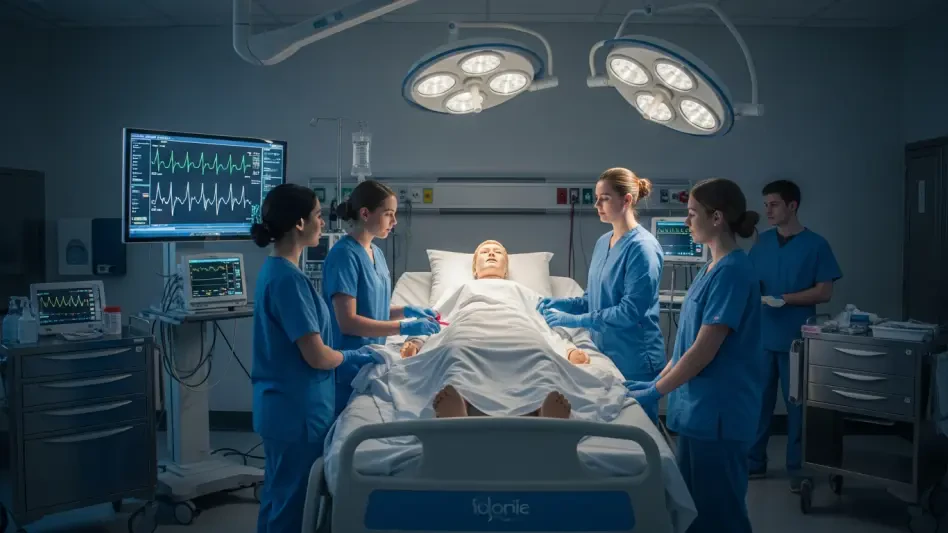

A student nurse stands over a high-fidelity mannequin whose chest heaves with mechanical effort as a sudden alarm pierces the quiet of the simulated hospital suite. This controlled environment represents a critical evolution in how medical institutions bridge the gap between theoretical knowledge and the life-altering demands of a clinical setting. By removing the immediate risk to human life, simulation allows learners to navigate the messy reality of patient care without the paralysis often caused by the fear of making a fatal mistake. These centers provide a safe harbor where errors serve as profound teaching moments rather than tragedies, fostering a culture of rigorous self-reflection and iterative improvement. As healthcare systems continue to struggle with high turnover and the need for rapid onboarding, the role of simulated experience has become indispensable. It transforms a static textbook education into a dynamic journey that prepares the next generation of caregivers for the unpredictable rhythms of the hospital floor.
Transitioning from Classroom to Clinic
Technical Mastery: The Tiered Instructional Approach
Technical mastery begins with isolated procedures that require steady hands and precise knowledge of anatomy, such as catheterization or complex wound dressing. In the structured environment of a lab, students can repeat these actions dozens of times until the mechanical sequence becomes a muscle memory response that requires little conscious thought. This foundational phase is crucial because it frees up the student’s mental bandwidth for higher-level cognitive tasks they will face in more advanced rotations. Faculty members utilize high-fidelity mannequins that can blink, bleed, and respond to pharmacological interventions with realistic vital sign changes on the monitors. By mastering these discrete skills first, the learner develops a sense of self-efficacy that is vital when they eventually transition to a bustling ward where the stakes are significantly higher. This tiered instructional design ensures that no student is overwhelmed by the complexity of patient care before the basics are conquered.
Cognitive Development: Synthesis and Critical Thinking
Once basic technical proficiency is established, the curriculum shifts toward complex, multi-faceted scenarios that force students to synthesize diverse streams of information simultaneously. In a simulated intensive care unit, a student might have to manage a patient with deteriorating respiratory function while also coordinating with a simulated interdisciplinary team. These exercises are not just about performing a task; they are about triage, prioritization, and the ability to pivot when a patient’s condition changes unexpectedly. The use of sophisticated debriefing rooms, where sessions are recorded and played back for critique, allows for an objective analysis of clinical decision-making. Students see exactly where their focus lagged or where they missed a critical subtle symptom, such as a drop in oxygen saturation or a slight change in heart rhythm. This intense scrutiny, conducted in a supportive academic atmosphere, builds the resilience needed to remain calm during the inevitable crises of medicine.
Prioritizing the Human Element of Care
Emotional Intelligence: Communication with Standardized Patients
While technical proficiency is a vital component of nursing, the profession also demands high levels of emotional intelligence and effective communication to ensure patient success. Simulation centers increasingly prioritize these human elements by incorporating standardized patients, who are real people trained to act out medical conditions and emotional distress. This approach allows students to practice building rapport and providing reassurance to patients and their families in a way that a plastic mannequin cannot replicate. These interactions teach future nurses how to maintain a calm demeanor and a professional presence, which are just as critical as medical accuracy in fostering a healing environment. By navigating these difficult conversations in a safe space, students learn to handle the psychological complexities of the job. This focus on the human side of care ensures that technical skills are always balanced with empathy, leading to a more compassionate and effective healthcare experience.
Professional Readiness: Safety and Systemic Improvements
The successful integration of these simulation methodologies proved that clinical readiness was as much about psychological resilience as it was about technical capability. Educational institutions moved toward a model that prioritized active learning, requiring students to engage in regular, high-stakes simulations as a mandatory component of their certification. This shift necessitated a significant investment in both faculty training and technological infrastructure to maintain the realism of clinical scenarios. Healthcare organizations then implemented continuous simulation-based training for existing staff to ensure that skills remained sharp and that new protocols were seamlessly integrated into the daily workflow. By viewing simulation not just as a school requirement but as a lifelong professional tool, the industry effectively reduced medical errors and improved nurse retention. These efforts demonstrated that a proactive approach to hands-on learning prepared the workforce for the complex, ever-evolving landscape of modern medical care.