
The ability to peer inside the human body without a single incision was once the pinnacle of medical wonder, but today, that wonder is straining under the weight of a global imaging crisis. As the demand for Computed Tomography and Magnetic Resonance Imaging surges at double-digit rates annually, the healthcare sector faces a paralyzing bottleneck: there are simply not enough clinical placements to train the next generation of radiographers. This scarcity has transformed simulation from a supplemental teaching aid into a mission-critical bridge between classroom theory and the high-stakes environment of the hospital. By replicating complex patient anatomy and intricate equipment physics in a risk-free setting, simulation technology is fundamentally rewriting the playbook for medical education. This evolution is not merely about digitizing old textbooks; it is about creating a high-fidelity sandbox where mistakes provide lessons rather than casualties.
Current imaging landscapes require practitioners who can handle sophisticated machinery while managing patient anxiety and physical limitations. The shift toward simulation addresses the educational gap created by overstretched hospital departments that no longer have the “breathing room” to mentor students in real time. Unlike the traditional apprenticeship model, which relies on the luck of the draw regarding which patients walk through the door, simulation offers a standardized, repeatable curriculum. It ensures that every student, regardless of their geographical location or placement site, encounters the same high-level challenges. This transition aligns radiography with other high-stakes industries like aviation, where no pilot takes to the sky without hundreds of hours in a simulated cockpit.
Introduction to Radiography Simulation Technology
At its heart, radiography simulation operates on the principle of high-fidelity mimicry, creating a digital or physical mirror of the clinical workflow. This involves more than just showing a picture of an X-ray machine; it requires the integration of ionizing radiation physics, spatial awareness, and realistic patient interactions. In the past, students relied heavily on “phantoms,” which were essentially plastic skeletons used for positioning. Today, the field has moved toward sophisticated virtual reality (VR) and computer-based platforms that can calculate dose distributions and image quality in real time. This allows a trainee to see exactly how changing a technical parameter, such as kilovoltage or milliampere-seconds, affects the resulting image without ever exposing a living soul to radiation.
The drivers behind this adoption are rooted in a global workforce shortage that has become too severe to ignore. With vacancy rates in many imaging departments hovering above ten percent, clinical staff are often too busy to provide the one-on-one supervision required for novice learners. By moving the initial phases of technical mastery into a simulated environment, universities can ensure that students arrive at their first hospital placement with a foundational level of competence. This “pre-clinical” seasoning reduces the burden on hospital staff and allows students to focus on the nuances of patient care rather than fumbling with the basic controls of the machinery. It is a strategic response to a systemic failure in the traditional healthcare training pipeline.
Technical Modalities: Core Components
Part-Task Trainers and Physical Phantoms
Physical phantoms, such as the widely recognized PIXY model, remain the bedrock of musculoskeletal training because they allow for the physical manipulation of “patient” limbs. These anthropomorphic tools are essential for teaching students how to find bony landmarks and how to angle the X-ray tube to compensate for various anatomical quirks. While they lack the reactive nature of a human being, they provide a tactile experience that digital screens cannot yet fully replicate. Their primary value lies in their durability and their ability to be used with actual diagnostic equipment, providing a direct link between physical positioning and the resulting radiographic output.
Virtual Reality and Haptic Systems
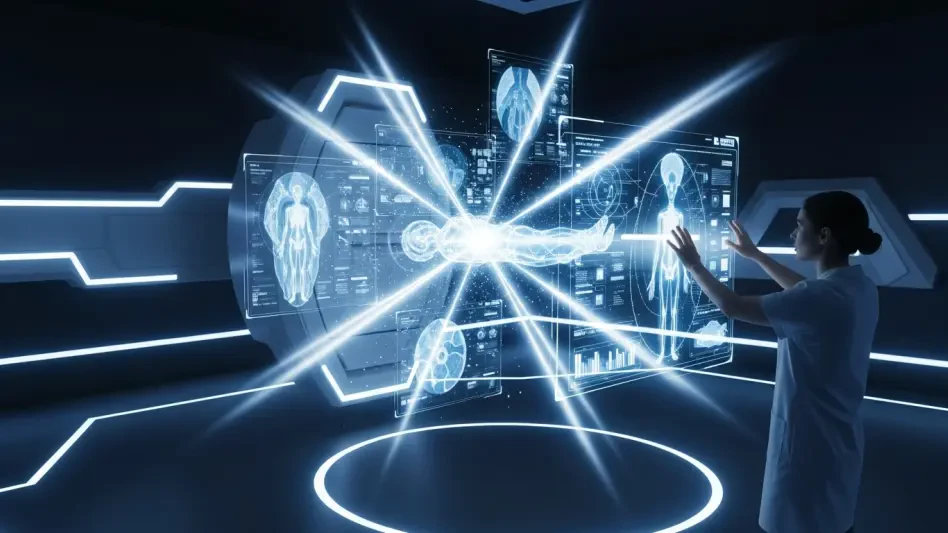
The introduction of immersive VR platforms like ProjectionVR™ has changed the spatial dynamics of the classroom. These systems allow students to don a headset and walk around a three-dimensional X-ray room, interacting with the floating control panels and the patient table as if they were physically present. What makes this implementation unique is the inclusion of physics-based feedback; if a student positions the X-ray tube incorrectly, the software generates a virtual “mistake” that illustrates the resulting image distortion. This visual feedback loop is immediate and visceral, reinforcing the mathematical principles of radiation physics through direct, simulated experience.
Computer-Based and High-Fidelity Integrated Simulators
Desktop-based simulators have revolutionized specialized training for complex modalities like MRI and CT, which are traditionally difficult to teach to beginners due to the high cost of the equipment and the safety risks involved. Software such as ScanLabMR allows learners to practice pulse sequencing and slice planning on a standard computer, turning a million-dollar piece of hardware into an accessible digital tool. Meanwhile, high-fidelity mannequins like SimMan® 3G are deployed to teach emergency response. These robots can simulate an anaphylactic reaction to contrast media, forcing students to practice life-saving protocols in a high-pressure, yet safe, environment where the “patient” can be reset with the click of a button.
Emerging Trends: Innovations in Simulation
The landscape of medical training was permanently altered by the sudden necessity of remote learning, which served as a massive, unplanned pilot program for digital simulation. This period proved that many technical competencies could be acquired outside the hospital walls, leading to the rise of “Hybrid Learning Models.” In these frameworks, simulation is not just a backup plan; it is a calculated prerequisite. Students now engage in condensed, high-intensity clinical rotations only after they have demonstrated technical proficiency in a simulated suite. This ensures that the limited time spent in actual hospitals is used for high-value learning, such as managing complex pathologies or interacting with diverse patient populations, rather than learning which button to press.
Furthermore, regulatory bodies have begun to catch up with the technological reality. Professional organizations are increasingly formalizing the role of simulation, with some even allowing a specific number of simulated hours to count toward professional accreditation. This shift is significant because it validates simulation as a legitimate form of clinical practice rather than just a “video game” for students. There is also a growing movement toward inter-professional simulation, where radiography students work alongside nursing and medical students in a shared virtual space. This approach mirrors the multidisciplinary nature of modern healthcare, breaking down the silos that often lead to communication failures in real-world hospital departments.
Real-World Applications: Sector Deployment
Higher education institutions have become the primary testing grounds for these technologies, using them to “front-load” skills before clinical exposure. This deployment strategy addresses the “placement bottleneck” by allowing universities to take on more students without needing a proportional increase in hospital slots. By the time a student enters a real imaging department, they have already performed hundreds of “virtual” scans, significantly reducing the learning curve. This preparation is particularly vital in specialized areas like pediatrics or trauma, where students might not see enough real-world cases during their short rotations to achieve mastery.
In addition to initial training, simulation has become a vital tool for workforce upskilling and the management of “rare events.” Even an experienced radiographer may go years without seeing a severe reaction to an intravenous contrast injection. Simulation allows seasoned professionals to maintain their emergency skills in a controlled setting, ensuring they are ready when every second counts. It also provides a playground for testing new protocols or equipment software updates before they are rolled out to live patients. By treating radiography like aviation—where “re-certification” in a simulator is a standard part of the job—the industry is moving toward a more robust model of continuous quality improvement.
Challenges and Limitations: Widespread Adoption
Despite the clear benefits, the path to full integration is blocked by significant technical and financial hurdles. One of the most persistent criticisms of VR and computer-based simulation is the “human touch” gap. Radiography is a physical profession that requires palpating bony landmarks and physically assisting patients who may be in pain or have limited mobility. Current haptic technology, while improving, cannot yet replicate the subtle resistance of human tissue or the unpredictable movements of a confused patient. Consequently, there is a risk that students may become “technically perfect” in a digital world but struggle when faced with the messy, tactile reality of a living, breathing human being.
Financial barriers also remain a major deterrent for many institutions. High-end VR hardware, specialized software subscriptions, and the need for dedicated technical support staff represent a significant capital investment. For smaller universities, the cost-to-benefit ratio can be difficult to justify, especially when empirical evidence linking simulated hours to real-world clinical outcomes is still being gathered. There is an ongoing “Evidence Gap” where researchers are struggling to prove that a student trained primarily through simulation is truly equivalent to one trained in a traditional hospital setting. Without this hard data, some regulatory bodies remain hesitant to allow simulation to replace a larger portion of clinical placement hours.
Future Outlook: Long-Term Trajectory
The next frontier for radiography simulation lies in the integration of Artificial Intelligence (AI) to create “reactive” standardized patients. Imagine a virtual patient that doesn’t just sit still, but responds to a student’s communication style, showing signs of pain or anxiety based on how they are handled. These AI-driven avatars will move simulation beyond technical skill acquisition and into the realm of behavioral and soft-skill development. This would allow students to practice de-escalation techniques or explain complex procedures to a virtual patient who can actually “understand” and react to their words.
Looking further ahead, the development of fully immersive, Metaverse-style training environments could allow for global collaboration. A student in London could work on a complex trauma case in a virtual suite with a supervisor in New York, sharing the same digital space and equipment. This decentralization of expertise would be a game-changer for regions with limited access to specialized training. Ultimately, the industry is moving toward a competency-based model where the number of hours spent in a building matters less than the skills demonstrated in a rigorous, high-fidelity simulation. This shift will likely be the key to solving the global healthcare labor shortage by providing faster, more efficient, and more consistent training pathways.
Summary and Final Assessment
The evolution of radiography simulation demonstrated that the technology has moved far beyond its origins as a simple novelty. It has matured into a functional necessity that provides a viable answer to the clinical placement crisis while enhancing the safety and quality of student training. While physical phantoms and part-task trainers provided the initial foundation, the modern integration of VR and high-fidelity mannequins allowed for a much broader scope of practice, covering everything from basic positioning to life-threatening emergency maneuvers. The move toward hybrid models showed that simulation is most effective when used as a targeted preparation tool, ensuring that actual clinical time is reserved for the most complex human interactions.
The implementation of these tools proved that while technology can replicate the technical parameters of an X-ray room, the “human element” remains the final frontier. Educators had to balance the efficiency of digital platforms with the irreplaceable value of physical touch and patient communication. As the field moves forward, the focus must shift from simply acquiring hardware to developing robust, evidence-based curricula that maximize the potential of these tools. The ultimate verdict was clear: simulation has successfully transformed radiography education from a gamble of “seeing what walks in the door” to a structured, high-performance training regime. This technological shift did not replace the clinical experience; instead, it ensured that every student was truly ready for it.