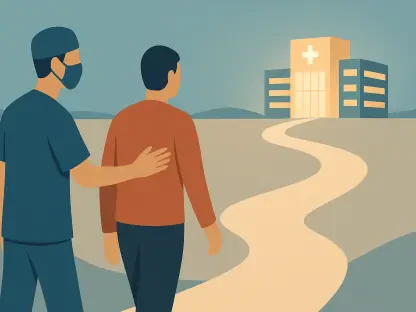

The sudden onset of double vision turns a routine afternoon into a terrifying race against a clock that might be ticking toward a permanent neurological catastrophe. In such moments, the high-level intellectual pursuit of a specific disease name becomes entirely secondary to the immediate logistical necessity of survival. While the medical community often celebrates the “Sherlock Holmes” archetype of a physician who unmasks a rare ailment, the reality of patient care hinges on the efficiency of the next medical intervention. The success of a clinical outcome is rarely measured by the elegance of a final diagnosis but rather by the speed and accuracy with which a patient is navigated through a complex, often overburdened healthcare system.
Consider the scenario of an individual experiencing sudden cranial nerve palsy. The primary objective is not to immediately identify a post-viral complication like Covid-19, but to rule out life-threatening alternatives such as an acute stroke or an aneurysm. In this hierarchy of medical needs, safety is the foundation upon which all subsequent care is built. A diagnosis provided hours or days later is of little comfort if the initial window for emergency intervention was missed. Therefore, the focus of any medical encounter must begin with an assessment of risk and the determination of the most appropriate immediate setting for care, establishing triage as the most critical component of the healthcare journey.
The Diagnostic Obsession in Modern Healthcare AI
The current landscape of medical technology development is dominated by a pursuit of “superhuman” diagnostic performance, often at the expense of systemic utility. Developers have historically prioritized high-profile feats, such as training deep neural networks to identify pneumonia or specific malignancies in medical imaging with greater accuracy than human radiologists. These accomplishments are attractive because they provide quantifiable wins and flashy metrics that are easy to market. However, this diagnostic obsession often ignores the messy, non-linear reality of patient logistics, where the most significant failures occur during the first few minutes of contact.
When AI is built solely to act as a brilliant diagnostician, it risks becoming a tool that is functionally useless within the existing medical infrastructure. A model that can identify a rare condition with 99% accuracy is of limited value if the patient cannot navigate the administrative or clinical hurdles required to reach the specialist who can treat it. The most critical medical errors frequently stem from a failure to recognize the urgency of a situation at the digital or physical front door. By focusing on the final “label” of a disease, the industry has overlooked the bottleneck of triage, which serves as the true gatekeeper for patient safety and resource allocation.
Redefining Triage as the Essential Infrastructure for AI
Triage must be viewed not merely as a preliminary administrative task but as the functional nervous system of clinical care. It is a continuous process of managing uncertainty and prioritizing the “next best step” based on evolving clinical data. In a world where medical resources are finite, the ability of a system to distinguish between a patient who can wait for a primary care appointment and one who requires an immediate trauma team is the most vital technological requirement. Triage-centric AI prioritizes the assessment of risk and the mitigation of harm over the definitive labeling of a condition, acknowledging that many clinical cases involve a degree of diagnostic ambiguity that may never be fully resolved.
A reliable triage framework acts as the prerequisite for any broader AI integration in medicine. Because illness is fluid, a patient’s status can deteriorate rapidly, requiring a system that is capable of continuous reassessment rather than a one-time gatekeeping decision. If an AI is to be trusted with patient lives, it must demonstrate a “safety-first” capability that flags unknowns as high-risk by default. This approach ensures that the technology supports the clinical team’s judgment by identifying potential emergencies before they escalate, creating a robust infrastructure that supports the patient throughout their entire medical journey rather than just at the moment of diagnosis.
The Digital Front Door: LLMs and Conversational Triage
The integration of Large Language Models (LLMs) has shifted the point of triage from the hospital intake desk directly into the patient’s living room. These conversational AI agents now serve as the digital front door for healthcare systems, fielding inquiries from patients at all hours. Because these models can be integrated with Electronic Health Records (EHR), they possess a degree of contextual awareness that far exceeds traditional telephone hotlines. However, this domestic shift also elevates the stakes of every interaction, as a simple request for information can quickly evolve into a high-stakes clinical conversation requiring immediate medical intervention.
Every healthcare bot, regardless of its primary function, must be equipped with emergency bypass protocols to handle “accidental” clinical disclosures. If a user mentions symptoms like crushing chest pain or severe allergic reactions during a routine scheduling task, the AI interface has a responsibility to escalate the situation in real-time. This includes the ability to route the user to emergency services or provide immediate instructions for stabilization. The transition from informational scheduling to real-time 9-1-1 routing represents the most significant shift in the responsibility of the medical interface, turning AI agents into active participants in the emergency response network.
Strategies for Building Triage-Centric Medical AI
The development of effective triage-centric AI required a departure from traditional performance metrics toward a focus on patient safety outcomes and seamless hand-offs. Rather than measuring success by the percentage of correct diagnoses, the industry shifted toward assessing how often an AI correctly identifies the need for escalation and how efficiently it facilitates the transition to human providers. This involved building algorithms designed to handle uncertainty with caution, flagging ambiguous symptoms for human review instead of forcing a low-confidence diagnosis. By prioritizing the “hand-off,” developers ensured that the AI acted as a bridge to professional care rather than a standalone silo of information.
The path toward widespread adoption of these tools was paved by establishing rigorous industry standards for safety and reliability. Stakeholders recognized that earning the trust of both clinicians and patients required a proven track record in high-stakes triage environments before moving into more complex diagnostic tasks. The focus remained on creating a resilient medical ecosystem where AI enhanced the speed and safety of patient navigation. This strategic shift ensured that technology served the most urgent needs of healthcare, transforming the digital front door into a sophisticated, safety-oriented gateway that protected patients and optimized the delivery of care across the entire medical landscape.