
The landscape of surgical care is undergoing a profound transformation as we navigate the complexities of 2026, particularly with the widespread adoption of robotic-assisted systems. My guest today is a leading authority in perioperative management, focusing on the intersection of patient safety and clinical efficiency. Throughout our discussion, we explore the often-overlooked connection between thermal regulation and physical positioning, the systemic challenges posed by inadvertent hypothermia, and how modern operating rooms are being forced to rethink their physical and operational workflows to support better patient outcomes.
How significant is the challenge of temperature management in modern surgery, and what does the data tell us about the frequency of these complications across the country?
Despite our advanced medical technology, inadvertent perioperative hypothermia remains a persistent and arguably preventable crisis in our operating rooms. Current studies estimate that between 20% and 70% of surgical patients experience a drop in core body temperature below 36°C during their procedures. This isn’t just a minor statistical anomaly; it is a pervasive reality that clinicians face daily, often hiding in plain sight while we focus on the more visible aspects of surgery. When you walk into a sterile, climate-controlled suite, you can almost feel the vulnerability of the patient whose body is fighting against the cool ambient air. We must confront the fact that this temperature drop is one of the most common complications in the perioperative period, yet it is frequently minimized as a mere issue of patient comfort rather than a clinical risk.
Beyond the immediate discomfort a patient feels when waking up, how does a drop in core temperature fundamentally alter the body’s ability to recover from a procedure?
The physiological fallout of a patient’s temperature dipping below that critical 36°C threshold is extensive and touches nearly every system in the body. We observe a significant impact on clotting mechanisms, which inevitably leads to increased blood loss and a higher demand for transfusions. The cold also hampers the body’s immune response, which, combined with reduced oxygen delivery to tissues, results in delayed wound healing and a much higher risk of surgical site infections. There is also a distinct sensory and emotional burden on the patient who wakes up shivering uncontrollably, feeling a deep, bone-chilling cold that can be quite traumatic. Furthermore, altered drug metabolism means that anesthesia recovery times are extended, leaving patients in a groggy, vulnerable state for much longer than necessary, which complicates the entire post-operative journey.
Historically, warming and positioning were treated as separate clinical silos; why has this fragmented approach persisted for so long in our hospitals?
For many years, we were able to treat these as separate issues because, in traditional open surgeries, the protocols for warming didn’t physically get in the way of how we positioned the patient. Different teams managed different products—one group was focused on the blankets and heaters, while another handled the foam pads and securement straps. This “siloed” mentality became ingrained in our hospital culture, governed by separate protocols that rarely overlapped. However, as procedures have become more complex, this lack of integration has started to create friction in the workflow. We are now realizing that when these elements are managed through separate processes, it adds a layer of complexity that surgical teams simply don’t need in a high-stakes environment.
With robotic-assisted surgery now a standard in many specialties, what specific physical hurdles are teams facing when trying to balance steep positioning with heat retention?
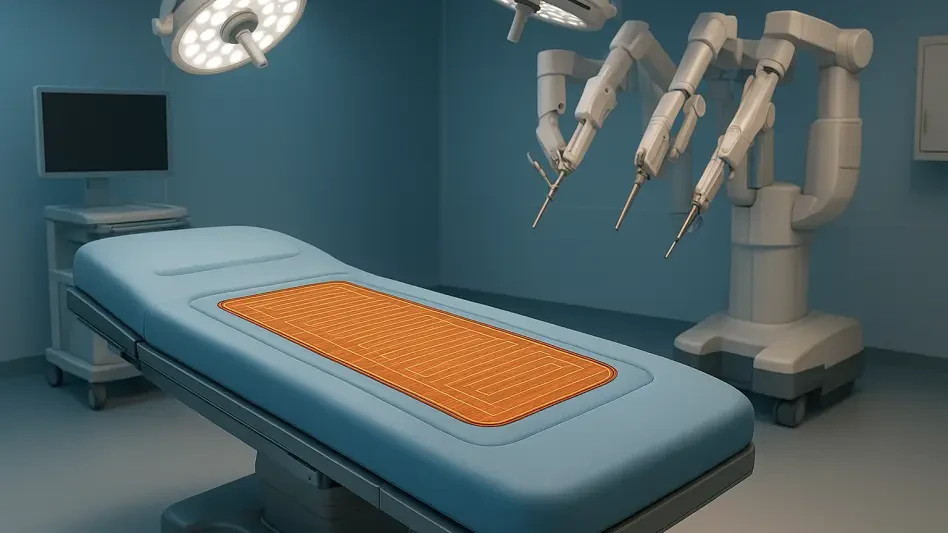
The introduction of robotic systems has turned the patient’s body into “high-value real estate” where every inch is contested. In robotic procedures, we often use a steep Trendelenburg position, tilting the patient head-down to allow gravity to shift organs and provide surgical access. This position creates a massive need for securement to prevent the patient from sliding, which requires the under-body space to be clear for anti-slip technologies. Simultaneously, the large robotic arms occupy the space above the patient, making it nearly impossible to use traditional over-body warming blankets without interfering with the machine’s movement. This forces us into a corner where we must use under-body warming, but that is the exact same area needed for positioning and securement, creating a literal physical conflict that can lead to pressure injuries if not managed with an integrated solution.
From a leadership and operational perspective, how do these seemingly minor preventable injuries ripple out to affect the efficiency of a whole surgical department?
We have to look at the operating room as a highly coordinated ecosystem where any delay or complication has a domino effect on the rest of the day. When a patient suffers from hypothermia or a positioning-related nerve injury, it doesn’t just affect that individual; it strains the entire clinical team. These complications lead to longer recovery times in the PACU, which creates a bottleneck that prevents the next surgery from starting on time. From 2026 to 2028, we expect the pressure on hospital throughput to only increase, and preventable issues like surgical site infections or extended anesthesia recovery represent a significant drain on resources. If we want to improve operational efficiency, we have to stop looking at these as isolated incidents and start seeing them as systemic failures that disrupt our entire workflow and limit our ability to provide high-quality care.
What does a more integrated approach to perioperative safety look like, and how can technology bridge the gap between patient securement and thermal regulation?
The future lies in moving away from a series of individual interventions and toward a single, seamless continuum of care. We are seeing the emergence of technologies that combine traditionally separate functions—like integrating warming elements directly into the securement systems used for positioning. By doing this, we eliminate the “competition for real estate” on the patient’s body and allow clinicians to address multiple safety concerns with a single piece of equipment. This reduces the complexity of the setup, ensures that the patient remains warm even in steep tilts, and allows the surgical team to focus on the procedure itself rather than troubleshooting equipment. It’s about supporting the clinicians with tools that are as sophisticated and integrated as the robotic systems they are using.
What is your forecast for the evolution of surgical safety over the next few years?
My forecast for the next several years is a shift toward “intelligent integration,” where the artificial boundaries between warming, positioning, and monitoring finally dissolve. We will see a greater emphasis on proactive, data-driven warming that begins the moment a patient enters the surgical suite, rather than waiting for their temperature to drop. As we move from 2026 toward 2030, the hospitals that succeed will be the ones that adopt systems capable of managing the patient as a whole, rather than a collection of separate clinical tasks. We will finally reach a point where preventing hypothermia and pressure injuries is not a secondary concern but an automated, foundational part of every surgical intervention. Ultimately, the greatest innovations won’t just be new surgical tools, but the smarter, more connected ways we protect the patient throughout their entire journey.