
By 2030, the arrival of 6G connectivity is expected to support a vastly larger number of connected devices with near-instantaneous response times for emergency alerts. This development marks a significant moment in medical history, driven by a research initiative between the National University Health System, Singtel, and Ericsson. Through the creation of the National University XG AI Centre, these organizations explored how next-generation telecommunications can be fused with artificial intelligence to modernize hospital services and patient recovery. This collaborative mission focuses on establishing a hyper-connected ecosystem where clinical data flows seamlessly across physical boundaries. By leveraging the ultra-low latency and massive bandwidth of 6G, the medical community aims to transition toward a model where technology remains invisible yet omnipresent. This approach not only enhances surgical precision but also ensures that high-quality care is accessible regardless of a patient’s proximity to a physical hospital ward.
The New Frontier: Hospital Wards Without Walls
The transition toward decentralized healthcare centered on the concept of “hospital wards without walls,” a model that shifts acute medical care from traditional clinical settings into the patient’s home. This shift was facilitated by sophisticated AI-powered wearable equipment designed to monitor physiological markers around the clock. Unlike previous iterations of monitoring technology, these advanced devices utilized local and cloud-based algorithms to assess the severity of biometric anomalies in real-time. By tracking vital signs such as blood pressure and heart rate with high precision, the system could distinguish between minor fluctuations and critical medical events. This decentralized approach allowed for a significant reduction in the burden on physical hospital infrastructure while maintaining a high standard of clinical oversight for patients with complex needs. The ability to provide intensive monitoring in a domestic environment represents a major step toward making the home a viable extension of the hospital.
When a life-threatening irregularity was detected by these intelligent sensors, the high-speed network ensured an instantaneous alert was transmitted to remote hospital staff and emergency services. This real-time response capability is critical for home-based care, as it provides a safety net that rivals the oversight found in traditional intensive care units. The reliability of next-generation connectivity eliminated the risk of signal latency that could delay life-saving interventions. Furthermore, the integration of high-definition video feeds allowed physicians to perform virtual rounds and consult with patients through secure, lag-free connections. This hybrid model of care empowered patients by providing them with more comfort and autonomy during recovery while ensuring that medical professionals remained constantly informed of their status. As a result, hospitals were able to optimize their resources by focusing physical bed space on patients requiring surgical or immediate manual interventions, while managing others remotely.
Technological Evolution: From 5G-Advanced to 6G
While 5G networks provided a solid foundation for the initial wave of digital health monitoring, they lacked the capacity to handle the projected “data explosion” associated with thousands of simultaneous biometric streams. To overcome these limitations, the industry focused on the development of 5G-Advanced and 6G networks, which offered significantly higher throughput and near-zero latency. These advancements were necessary to support the massive amount of information generated by high-resolution medical imaging and real-time sensor arrays. By creating a more robust digital infrastructure, 6G allowed for the seamless integration of AI tools that could process vast datasets without experiencing bottlenecks. This technological evolution was essential for maintaining the integrity of remote healthcare systems that require constant, uninterrupted communication between devices and clinical databases. The shift toward higher frequency bands and improved spectral efficiency ensured that the medical network remained resilient under heavy loads.
A major breakthrough facilitated by 6G was the ability to shift data processing from the physical hardware to the cloud, which had profound implications for the design of medical tools. Previous versions of augmented reality headsets used by surgeons were often bulky and uncomfortable because they required internal processors and large batteries. With the high-speed throughput of 6G, these devices were transformed into slim, lightweight glasses that could project high-resolution 3D holograms of a patient’s internal organs directly onto their body. These holographic overlays, derived from real-time CT scans, provided surgeons with pinpoint accuracy during complex operations by revealing the exact location of blood vessels and tumors. By offloading the computational burden, the technology became less intrusive and more practical for long-term use in the operating room. This innovation not only improved the ergonomic experience for surgical teams but also enhanced the precision and safety of many medical procedures.
Operational Excellence: Robotics and Systemic Management
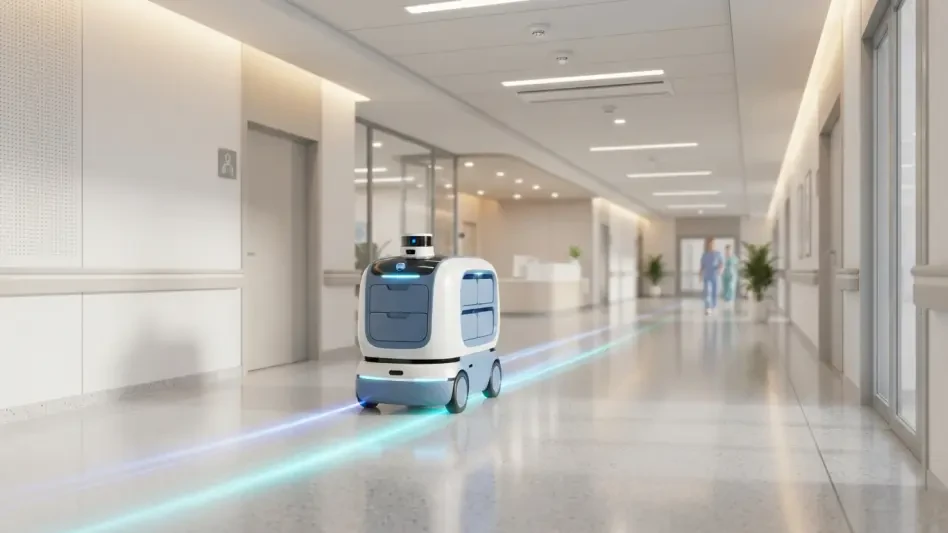
The integration of AI and 6G extended to autonomous mobile robots that functioned as a centrally controlled fleet within the hospital ecosystem. These machines communicated via a cloud-based intelligence system to streamline essential logistics, such as the delivery of medicine and the maintenance of facility hygiene. For instance, if a nursing robot identified a hazard like a liquid spill, it automatically triggered a cleaning robot to address the issue while rerouting its own path to maintain efficiency. Furthermore, the deployment of “network radar” allowed the 6G infrastructure to track patient locations and vital signs using low-power wearables. Because these sensors did not need to actively broadcast signals, they were made smaller and more comfortable for long-term use without frequent recharging. This passive monitoring capability ensured that healthcare providers could maintain continuous visibility over patient safety and health status throughout the entire medical facility.
Beyond individual patient care, the use of “Online AI” enabled hospital-wide optimization by analyzing real-time data to predict surges in admissions and resource demands. These tools provided actionable recommendations to administrators, such as identifying specific areas where bed space could be optimized before an emergency occurred. By simulating various load scenarios, the system ensured that the institution remained resilient during periods of extreme demand. This strategic foresight allowed for better staffing decisions and ensured that equipment was always available where it was most needed. Ultimately, the synergy between 6G and AI created a hyper-connected environment where technology worked behind the scenes to improve patient outcomes and operational efficiency. The transition to this advanced digital framework marked a turning point in how medical services were organized, moving the industry toward a proactive model that anticipated needs rather than merely reacting to crises.