
A Simvastatin case study proved that the open-source PK-Sim tool can achieve predictive accuracy comparable to industry-leading commercial standards like Simcyp. This finding marks a significant milestone in the computational evolution of drug development, suggesting that the long-held dominance of expensive, proprietary software is finally being challenged by community-driven innovation. In the current landscape, the pharmaceutical industry is navigating a transition that mirrors natural selection, where software tools must demonstrate extreme reliability or face rapid obsolescence. This evolution is defined by a nuanced spectrum of accessibility, moving away from a simple choice between open and closed systems. Instead, researchers are utilizing a variety of architectures, including open-weight models and web-based servers, to balance the need for scientific transparency with the strict demands of corporate security and intellectual property protection.
The Transformation of Early Discovery and Chemical Design
The pharmaceutical sector has historically relied on closed ecosystems to protect high-value data, but the rise of transparent frameworks is fundamentally changing the early stages of discovery. While proprietary platforms offer dedicated support and validated lineages, open-source alternatives are now robust enough to handle routine laboratory applications and chemical structure depictions. The choice between these systems often hinges on the sensitivity of the data involved; while free web servers are convenient, they frequently require the upload of proprietary molecular structures to remote locations, which remains a non-starter for many commercial discovery campaigns. Consequently, a hybrid approach has emerged where open tools are used for foundational research and educational tasks, while closed-loop systems are reserved for the final stages of a drug’s development where regulatory scrutiny is highest.
Advancements in Protein Structure and Binding Prediction: The Boltz-2 Era
In the field of protein structure prediction, the divergence between vendor-managed systems and community repositories has become particularly pronounced following recent technological breakthroughs. Open-weight frameworks like OpenFold and the MIT-licensed Boltz-2 are now providing academic researchers with capabilities that were previously restricted to elite commercial entities using engines like IsoDDE. Boltz-2, in particular, represents a massive leap in efficiency, claiming to predict macromolecular structures and small-molecule binding affinities at approximately one-thousandth of the computational cost associated with traditional physics-based free-energy perturbation calculations. This democratization of high-level predictive power allows smaller laboratories to conduct complex simulations that were once financially prohibitive, though the community remains cautious, demanding rigorous independent replication of these efficiency claims before they are fully integrated into the standard scientific consensus.
Beyond structural prediction, these open-weight models are facilitating a deeper understanding of dynamic biological interactions that were once considered too complex for non-proprietary software. The accessibility of the Boltz-2 framework allows for rapid iterations in binding site analysis, which is crucial for the design of specialized therapeutics. However, the transition from unreviewed preprints to established pharmaceutical tools requires a disciplined approach to model validation. Researchers are currently focusing on benchmarking these tools against historical datasets to ensure that the speed of AI-driven prediction does not come at the cost of biological accuracy. As these frameworks continue to mature, the industry is seeing a shift where the value of a tool is measured not by its licensing fee, but by the transparency of its training data and the reproducibility of its structural outputs in real-world scenarios.
Generative Chemistry and the Reality of Molecular Docking: Balancing Innovation
Generative chemistry has seen a parallel expansion of open architectures, with platforms like REINVENT and MolGPT enabling institutions to execute de novo design pipelines without the burden of heavy licensing costs. These tools have demonstrated the ability to design potent inhibitors for targets like DDR1 kinase in as little as 21 days, showcasing the potential for AI to drastically shorten the early discovery phase. Programmatic infrastructures provided by RDKit and DeepChem further support this by offering descriptor generation powered by massive open databases like PubChem. This open ecosystem fosters a collaborative environment where breakthroughs in molecular generation can be shared and refined across the global scientific community, effectively accelerating the search for novel therapeutic compounds.
Despite the excitement surrounding generative models, the field of molecular docking serves as a sobering reminder that newer AI methods are not always superior to classical techniques. Independent evaluations using the PoseBusters suite have revealed that deep learning docking engines, such as DiffDock, often struggle to consistently outperform physics-based software like AutoDock Vina or CCDC GOLD. These modern AI models sometimes produce results that lack geometric plausibility, particularly when they encounter molecular complexes that were not well-represented in their initial training sets. This highlights a critical lesson for the industry: while generative AI can propose thousands of new molecules, the fundamental principles of physical chemistry must still be the ultimate arbiter of a tool’s effectiveness. The integration of AI in docking is therefore becoming more of a synergistic process where machine learning identifies potential candidates and classical physics-based software validates their structural feasibility.
Practical Applications in Synthesis and Preclinical Modeling
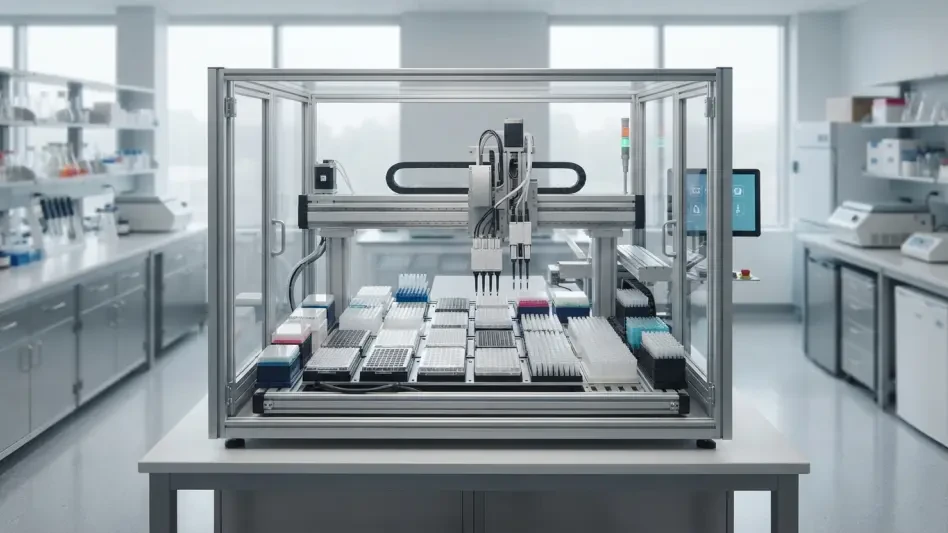
The application of artificial intelligence has moved beyond the purely digital realm and is now actively directing operations in physical laboratories. This shift is characterized by the integration of autonomous frontier language models with high-throughput robotics to optimize complex chemical reactions that were previously reliant on trial-and-error. By automating the screening process, AI can analyze thousands of reaction conditions in a fraction of the time required by human researchers, identifying optimal additives and catalysts with a level of precision that was previously unattainable. This transition into the “wet-lab” environment is turning AI from a passive forecasting tool into an active partner in the physical creation of new medicines, bridging the gap between computational theory and tangible chemical output.
AI Integration in the Physical Laboratory: Autonomous Synthesis
A landmark development in this evolution involved the deployment of advanced language models to optimize the Chan-Lam coupling reaction, a process notoriously difficult to refine for primary sulfonamides. By leveraging high-throughput robotics, the AI system screened over 10,000 individual reactions, eventually identifying TEMPO as a mild additive that significantly boosted product yields. This achievement demonstrated the capacity of AI to handle the nuances of synthetic chemistry, managing variables that would take human scientists months or years to explore manually. The success of such “self-driving” laboratories suggests a future where the mechanical aspects of chemistry are increasingly managed by algorithms, allowing human researchers to focus on higher-level strategic decisions and the interpretation of complex reaction data.
The implementation of these autonomous systems also provides a solution to the reproducibility crisis that has long plagued the chemical sciences. Because every step of the AI-directed synthesis is digitally logged and executed by precision robotics, the conditions can be replicated exactly across different facilities. This level of standardization is essential for the scaling of drug production from small-batch research to industrial manufacturing. Furthermore, as these systems gain more experience through massive screening campaigns, they become more adept at predicting potential synthetic failures before they occur in the physical world. This predictive capability reduces material waste and enhances the overall sustainability of pharmaceutical research, proving that the synergy between digital intelligence and physical automation is a fundamental requirement for modern laboratory efficiency.
Predictive Modeling for Formulations and Pharmacokinetics: Bridging the Gap
In the preclinical and formulation phases, AI tools are now used to forecast excipient compatibility and predict how a drug will behave within the human body. Web-based platforms such as FormulationAI are bridging the gap between initial chemical design and clinical application by providing physiologically based pharmacokinetic (PBPK) simulations. These tools allow researchers to model human disposition profiles across vast datasets, ensuring that a compound’s delivery mechanism is as optimized as its molecular structure. While proprietary suites like GastroPlus remain the industry standard due to their long history of validation, the emergence of the open-source Open Systems Pharmacology suite has provided a credible alternative for researchers who require transparency in their pharmacokinetic modeling.
The growing reliance on these predictive models is particularly evident in the development of “digital twins,” which use historical patient data to simulate how individuals might respond to a new therapeutic. These models are increasingly utilized to forecast the trajectories of control arms in clinical trials, which improves the statistical power of a study while minimizing the number of human participants required for early-phase testing. Regulatory bodies have begun to qualify these prognostic adjustments, recognizing the value of AI-driven simulations in enhancing trial design. By integrating pharmacokinetic data early in the development cycle, pharmaceutical companies can identify potential absorption or metabolic issues long before a drug enters expensive human trials, thereby reducing the high rate of clinical failure that has traditionally burdened the industry.
Governance, Credibility, and the Role of Human Expertise
As computational tools become deeply embedded in the drug submission process, the focus of the industry is shifting toward formal governance and the establishment of algorithmic standards. Health authorities have recognized that the lack of transparency in some AI models poses a risk to patient safety, leading to the development of risk-based credibility frameworks. These frameworks prioritize the “context of use,” meaning that the level of scrutiny applied to an algorithm is directly proportional to its impact on clinical outcomes. This regulatory evolution ensures that AI is not just a “black box” but a verifiable component of the pharmaceutical lifecycle, subject to the same rigorous oversight as traditional physical assays.
Regulatory Oversight and Algorithm Standards: Navigating Compliance
The U.S. Food and Drug Administration and the European Medicines Agency have established clear guidelines for the use of machine learning in pharmaceutical applications, emphasizing the need for validated software lineages. Algorithms that are developed without strict inventory control or clear data provenance are often categorized as “Software of Unknown Provenance” (SOUP). This classification requires researchers to perform additional monitoring and rigorous qualification to prevent prospective harm to patients. Since the mid-2010s, the number of drug applications containing computational components has grown significantly, necessitating a collaborative effort between global agencies to standardize the principles of good machine learning practice and ensure that AI-generated data is as reliable as traditional laboratory results.
Furthermore, these regulatory frameworks are increasingly focused on the entire lifecycle of the AI model, rather than just the initial output. Continuous monitoring is required to ensure that a model’s performance does not degrade over time as it encounters new types of patient data—a phenomenon known as model drift. Manufacturers are now expected to provide detailed documentation on how their algorithms were trained, including the quality and origin of the input data, following the FAIR principles of findability, accessibility, interoperability, and reusability. This level of oversight ensures that as AI becomes more autonomous, it remains tethered to established safety protocols. The collaboration between international regulators helps create a predictable environment for pharmaceutical companies, where the requirements for AI validation are clearly defined and globally harmonized.
Defining Credibility and Preventing Automation Bias: The Human Element
Ensuring the credibility of an AI model requires a focus on five verifiable dimensions: predictive performance, reproducibility, data provenance, regulatory alignment, and human oversight. Among these, the structured involvement of human experts remains the most critical safeguard against the risks of automation. Researchers must distinguish between being “in-the-loop,” where they actively validate every decision, and being “in-command,” where they hold the institutional authority to override algorithmic outputs. Without this critical distance, the industry faces the threat of automation bias, where scientists might passively accept the results of an AI simulation without sufficient skepticism, potentially overlooking errors that could have serious implications for drug safety or efficacy.
To combat this, pharmaceutical organizations are investing in a new form of technical literacy that emphasizes the ability to audit and challenge algorithmic conclusions. This involves moving away from the blind mastery of specific software packages toward a deep understanding of the underlying mathematical principles and potential failure modes of AI models. By fostering a culture of healthy skepticism, the industry can ensure that the rapid adoption of technology does not lead to a deskilling of its workforce. Human researchers must remain the final authority in the scientific process, providing the causal interpretation and ethical accountability that machines cannot replicate. This balance between technological speed and human judgment is what ultimately ensures that the evolution of pharmaceutical science remains focused on the primary goal of improving patient health.
Future Perspectives on Pharmaceutical Literacy
The competitive landscape of pharmaceutical science was fundamentally altered by the pervasive adoption of artificial intelligence, shifting the definition of expertise from software mastery to algorithmic governance. It became clear that the tools themselves would eventually reach a point of parity, where open-weight architectures matched the reasoning capabilities of the most advanced proprietary systems. In this environment, the real value of a researcher was determined by their ability to validate models, ensure data provenance, and maintain a rigorous chain of accountability throughout the development process. The “self-driving” laboratories of the late 2020s successfully managed the majority of routine design cycles, but the responsibility for causal interpretation and ethical decision-making remained a uniquely human endeavor.
The successful integration of AI into medicine development was achieved by those who balanced technological speed with uncompromising scientific rigor. The industry moved toward a future where transparency and auditability were as important as the speed of discovery, ensuring that the transition to digital-first research did not compromise the safety of the end-user. Scientists prioritized the creation of an environment where every computational prediction was backed by an empirical foundation, effectively mitigating the risks of automation bias. As we looked toward the middle of the century, the standard for excellence in the field was no longer just the creation of a new molecule, but the implementation of a transparent and ethically sound pathway from digital conception to clinical reality. Building on this foundation, the next generation of researchers established a framework where technology served as a powerful assistant to human ingenuity, rather than its replacement.