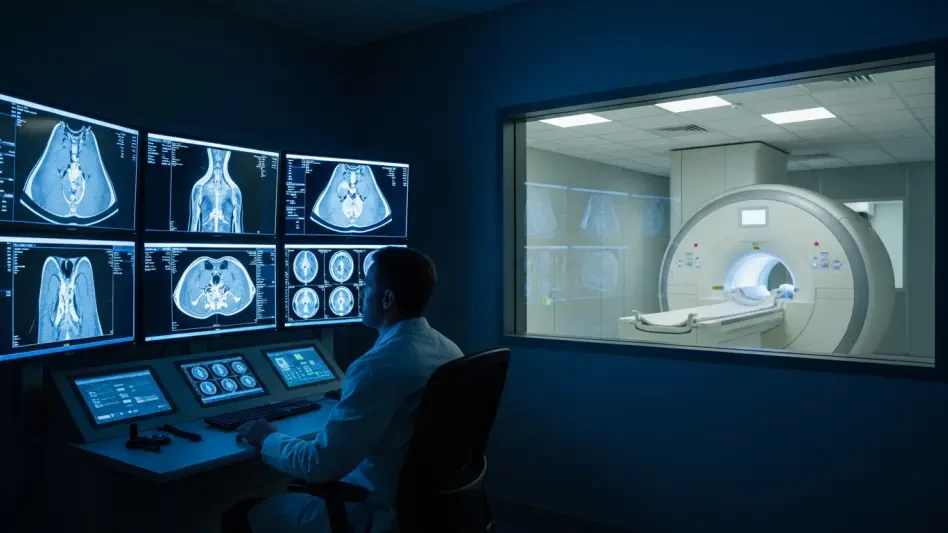

The modern landscape of preventive health has shifted dramatically from hospital corridors to luxury wellness centers where advanced magnetic resonance imaging serves as a status symbol for the health-conscious elite. This transition marks a significant departure from traditional medicine, where imaging was once a reactive tool used strictly to investigate symptoms or monitor known conditions. Today, a new generation of healthcare consumers is bypassing the traditional referral system, opting instead for elective whole-body MRI scans marketed as a “peace of mind” solution for the asymptomatic. These services promise to identify life-threatening conditions like cancer, aneurysms, and silent heart disease long before a patient feels the first symptom. However, as these high-tech screenings gain popularity, a sharp divide has emerged between commercial innovators and the established medical community regarding the clinical utility and safety of scanning healthy populations.
The Rise: High-Tech Preventive Screening in the Wellness Era
The evolution of MRI technology from a clinical necessity to a consumer-driven wellness product reflects a broader shift toward proactive health management among the affluent. Companies operating in this space have successfully rebranded a complex diagnostic procedure into an accessible, albeit expensive, health “audit.” By offering these scans directly to the public, the industry has tapped into a growing desire for personal health data that traditional insurance models typically do not support. Because most major medical societies do not currently recommend whole-body screening for individuals without symptoms, these tests remain an out-of-pocket expense, often retailing for $2,500 or more. This price tag creates a distinct market segment where health-consciousness and financial means intersect, positioning the scan as a premium tier of self-care.
This commercial expansion is significantly influenced by a modern marketing apparatus that utilizes celebrity endorsements to build trust and demand. High-profile figures and influencers have frequently shared their personal experiences with these scans, often framing them as essential tools for longevity. This celebrity-backed approach has been remarkably effective at bypassing the usual skepticism of the medical establishment, creating a cultural momentum that outpaces the development of formal clinical guidelines. Consequently, the traditional healthcare system now finds itself in a state of friction with this new wellness sector. While consumers perceive these scans as the ultimate safeguard, many clinical practitioners remain concerned that the marketing narrative oversimplifies the complexities of diagnostic medicine and ignores the potential for systemic over-medicalization.
The significance of this shift lies in how it challenges the foundational principles of medical screening. Traditionally, a screening test is only widely adopted if it is proven to be cost-effective and capable of reducing mortality within a specific population. The elective MRI industry, however, operates on a model of individual autonomy where the consumer decides the value of the information. This creates a tension between the rigorous evidentiary standards demanded by clinical researchers and the immediate, intuitive appeal of “knowing everything” about one’s internal health. As more individuals choose to invest in these scans, the medical community is forced to grapple with how to integrate this influx of data into a system that was built to be reactive rather than indiscriminately proactive.
Navigating the Intersection: Clinical Evidence and Commercial Expansion
The Incidentaloma DilemmThe Risky Cascade of Follow-up Care
One of the primary concerns highlighted by clinical researchers involves the high frequency of “incidentalomas”—benign abnormalities that are found during a scan but have no actual impact on a person’s health. According to prominent editorials in leading medical journals, when sensitive imaging is applied to a healthy population, the likelihood of finding a non-threatening spot or lesion is exceptionally high. Estimates suggest that between twenty and forty percent of asymptomatic individuals will have an incidental finding that requires some form of follow-up. This creates a difficult situation for both the patient and the physician, as the uncertainty of a “suspicious” result can lead to significant psychological distress and the perceived need for further investigation.
This initial finding often triggers what medical experts describe as a “downstream cascade” of medical interventions. Once a spot is identified on a kidney, liver, or lung, the standard of care usually dictates further testing to rule out malignancy. This may include more frequent follow-up scans, which expose the patient to additional costs and anxiety, or more invasive procedures like biopsies. A biopsy is not a risk-free event; it carries the potential for internal bleeding, infection, and other complications that can lead to hospitalization. In these instances, a patient who felt perfectly healthy before the scan may find themselves undergoing treatment for a condition that would never have caused a problem in their lifetime, resulting in a net harm rather than a benefit.
Radiologists often point out that the intuitive logic of “catching it early” does not always align with the statistical reality of over-diagnosis. While finding a fast-growing tumor early is undeniably beneficial, many of the abnormalities detected by whole-body MRIs are slow-growing or even stagnant. In a traditional clinical setting, these would never be discovered and would never affect the patient’s lifespan. By labeling these findings as “abnormalities,” the screening industry may be turning healthy people into patients unnecessarily. This phenomenon challenges the definition of health and raises questions about whether more information is always better, particularly when that information leads to invasive medical journeys for non-threatening issues.
Lessons From History: When Increased Detection Fails to Improve Mortality
The skepticism surrounding elective MRIs is often rooted in historical examples where mass screening programs failed to deliver on their promises. A frequently cited case study is the thyroid cancer screening initiative in South Korea during the first decade of the millennium. The program led to a massive increase in the detection of small thyroid nodules, resulting in a significant rise in surgeries to remove the thyroid gland. However, despite the surge in diagnoses and treatments, the mortality rate for thyroid cancer remained virtually unchanged. The primary outcome of the program was a high volume of surgical complications, such as lifelong hormone replacement therapy and vocal cord paralysis, without any corresponding increase in lives saved.
Similar patterns have been observed in other screening contexts, such as historical trials for ovarian cancer. These trials often revealed that for every case of cancer detected, dozens of women underwent unnecessary surgeries to investigate benign masses. The complication rates for these surgeries were often high, sometimes reaching fifteen percent, which negated the benefits of early detection for the population as a whole. These historical precedents serve as a cautionary tale for the elective MRI industry, suggesting that the ability to see more of the human body does not automatically translate into better health outcomes. It illustrates the danger of focusing on diagnostic accuracy while ignoring clinical utility—the measure of whether a test actually helps a patient live longer or better.
There is also an economic dimension to this risk, as the consequences of an elective scan often spill over into the broader healthcare system. When a private screening company identifies a suspicious finding, the subsequent follow-up care is typically handled by the patient’s primary care physician and covered by traditional insurance. This shifts the financial and clinical burden of investigating “incidentalomas” from the private sector to public and private insurance pools. Consequently, the healthcare system may end up spending vast resources on investigating benign findings in wealthy, healthy individuals, potentially diverting funds and attention away from evidence-based interventions for higher-risk or underserved populations.
The Economic Engine: The Absence of Long-Term Clinical Validation
A major hurdle for the elective MRI industry is the lack of randomized controlled trials that demonstrate a genuine reduction in mortality. To prove that a screening tool saves lives, researchers must follow tens of thousands of participants over several decades to compare the outcomes of those who were scanned with those who were not. Such trials are incredibly expensive and time-consuming, often requiring thirty years of follow-up to see a statistically significant difference in cancer or cardiovascular deaths. Currently, no such data exists for elective whole-body MRIs in asymptomatic populations, leaving the industry in a position where it is marketing a product based on theoretical benefits rather than proven results.
From a commercial perspective, there are significant financial disincentives for companies to fund these long-term studies. If a rigorous trial were to conclude that the scans do not improve mortality or that the rate of harm from follow-up care is too high, the current business models for these companies would likely collapse. Furthermore, if a trial were to prove the scans are highly effective, it might lead to insurance companies covering the procedure, which would likely result in standardized, lower reimbursement rates. This creates a paradox where the industry benefits from the “scientific gray area,” allowing them to sell the promise of early detection without being held to the same pre-market efficacy standards that are required for new pharmaceuticals or medical devices.
Critics of the industry argue that diagnostic innovations should not be exempt from rigorous validation just because they are non-invasive. They contend that the information provided by a scan is a powerful intervention in itself, one that can fundamentally alter a person’s medical trajectory. Without standardizing the results and proving that they lead to better clinical decisions, the industry remains driven by consumer demand rather than medical necessity. This disconnect raises ethical questions about the responsibility of screening companies to provide transparent data on the likelihood of false positives and the potential for “downstream” complications, ensuring that consumers are making informed decisions based on science rather than marketing.
Technological Evolution: AI Integration and the Defense of Subspecialization
In response to these criticisms, the elective imaging industry has turned toward technological innovation as a way to mitigate the risks of over-diagnosis. One of the primary rebuttals from screening providers is the integration of artificial intelligence to assist in the interpretation of results. Industry proponents argue that AI can help radiologists distinguish between benign variations and genuine threats more accurately than the human eye alone. By training algorithms on vast datasets of both healthy and diseased tissues, these companies aim to reduce the frequency of false positives and provide a more nuanced risk assessment for each individual patient.
Furthermore, some companies are focusing on longitudinal tracking as a key differentiator. Instead of viewing a single scan in isolation, they advocate for regular screenings over several years to establish a personal baseline for each patient. By using AI to track whether a small nodule or lesion is growing, shrinking, or staying the same over time, radiologists can make more informed recommendations about whether follow-up care is truly necessary. This “watchful waiting” approach, powered by high-resolution imaging, is marketed as a way to transform medical noise into actionable data. This perspective views even benign findings as valuable information that can help a person understand their unique biological landscape.
The industry also emphasizes the importance of subspecialization in the reading of whole-body scans. Rather than having a single general radiologist interpret the entire body, some providers use a team of specialists—such as neuroradiologists for the brain and musculoskeletal experts for the joints—to review their respective areas of expertise. This level of specialization is often higher than what is found in standard hospital settings, where a generalist might handle a wide range of imaging tasks. Proponents believe that this expert-led approach, combined with cutting-edge technology, allows them to provide a higher standard of care that minimizes the “incidentaloma” problem while maximizing the chances of detecting significant disease early.
Strategic Frameworks for Navigating the Elective Imaging Market
The debate over elective MRIs underscores the importance of a nuanced approach for individuals considering these services. While the absence of long-term mortality proof is a valid clinical concern, it is not necessarily proof that the scans provide no value to specific individuals. However, the lack of clinical consensus suggests that caution should remain the priority for anyone entering this market. Consumers must recognize that a whole-body MRI is not a “simple” test but a complex medical intervention that can have long-lasting consequences for their healthcare journey. Navigating this landscape requires a shift from passive consumption to an active, risk-aware strategy that prioritizes communication with traditional medical providers.
For those interested in elective screening, the most critical step is to discuss personal and family risk factors with a primary care physician before booking an appointment. A scan may be more appropriate for someone with a strong family history of specific cancers or genetic predispositions than for an average-risk individual. Furthermore, consumers should look for providers who offer risk-stratified assessments rather than a simple “pass/fail” result. Understanding the context of a finding—such as how common it is in the general population and whether it typically requires intervention—can help mitigate the anxiety and the impulse toward unnecessary follow-up care.
Finally, best practices for interpreting results involve viewing the scan as one piece of a much larger health puzzle. A whole-body MRI should not replace evidence-based screenings like colonoscopies, mammograms, or blood pressure checks, which have decades of data supporting their effectiveness. Instead, if a consumer chooses to proceed, they should do so with the understanding that the most likely outcome is the discovery of benign findings that may require nothing more than occasional monitoring. By setting realistic expectations and maintaining a close relationship with a trusted doctor, individuals can better manage the potential for over-diagnosis while exploring the frontiers of proactive health technology.
Reconciling Personal Health Autonomy with Evidence-Based Standards
The tension surrounding elective whole-body MRIs highlighted a profound conflict between the rapid pace of technological innovation and the conservative nature of evidence-based medicine. Throughout this debate, the industry positioned itself as a champion of personal health autonomy, arguing that individuals had the right to access their own biological data. Conversely, the medical establishment remained focused on the risks of over-medicalization, reminding the public that more data did not always lead to better health. These scans existed in a scientific gray area where the line between a life-saving discovery and a harmful medical odyssey remained perilously thin for many patients.
The ongoing importance of population-level data stood in stark contrast to the powerful anecdotes of individual lives saved by early detection. While a single story of a detected aneurysm could drive thousands of people to seek a scan, researchers cautioned that these narratives did not account for the thousands of others who faced unnecessary biopsies or surgeries. The medical community continued to emphasize that until large-scale, randomized trials were completed, the true value of elective screening remained unproven. This standoff suggested that the future of medicine would require a careful balance between the data-empowered consumer and the cautious, evidence-driven institution.
Ultimately, the rise of the elective MRI industry reflected a changing relationship between people and their bodies. As technology became more accessible, the desire for a “check engine light” for human health became a powerful driver of consumer behavior. However, the lessons from the past decade indicated that the human body was far more complex than a machine, and that not every internal variation required a fix. The evolution of this field suggested that the most successful path forward would involve integrating these advanced tools into a framework of clinical oversight, ensuring that innovation served the patient’s long-term well-being rather than just their immediate desire for information.