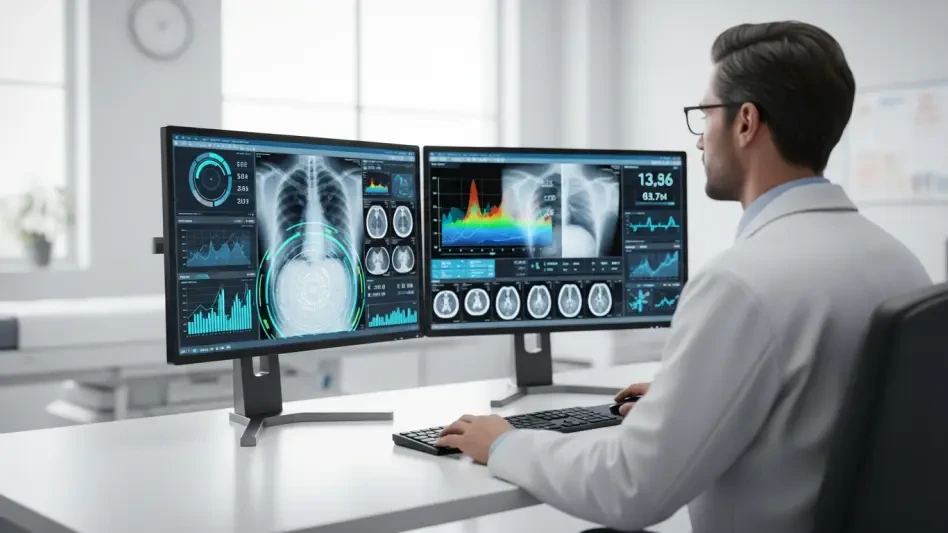

The medical industry is currently witnessing a pivotal moment as diagnostic algorithms transition from experimental novelties into recognized clinical assets that directly influence the financial health of modern hospitals. This regulatory shift ensures that the precision of machine learning is no longer just a technical luxury but a cornerstone of a sustainable healthcare business model. As the Centers for Medicare & Medicaid Services integrates these technologies into national frameworks, the role of the radiologist is being redefined by the economic potential of the data they manage.
The Shift Toward Standardized AI Reimbursement Models
Data-Driven Validation: The Impact of HCPCS Code G0680
The introduction of HCPCS code G0680 represents a watershed moment for medical software in the United States. By explicitly defining the detection and quantification of coronary and aortic valve calcification as billable events, the Outpatient Prospective Payment System has validated AI as a standalone medical service. This change empowers facilities to claim compensation for work that was previously bundled into broader scans, effectively monetizing the silent data already residing within digital archives.
This formal coding provides the necessary economic incentive for widespread hospital adoption, moving AI away from the “auxiliary tool” category. When a software analysis is recognized as a distinct procedure, it allows for a clear return on investment calculation. Hospitals can now view AI not as a drain on resources, but as a primary driver of diagnostic revenue that supports long-term financial sustainability and high-tech infrastructure growth.
Real-World Application: Opportunistic Screening and Multi-Disease Analysis
Technological pioneers are capitalizing on this regulatory clarity through the lens of opportunistic screening. By analyzing existing lung cancer scans to identify hidden cardiovascular risks, clinicians can provide a more comprehensive health profile without subjecting patients to additional radiation. This approach transforms a single CT scan into a multifaceted diagnostic treasure chest, maximizing the utility of every pixel of data collected during a routine examination.
Furthermore, the rise of the “Zero-Click” workflow ensures that these sophisticated insights reach the physician without adding to an already heavy administrative burden. In a fast-paced radiology environment, the automation of these findings allows for seamless integration into the daily routine. This efficiency is critical for maintaining high patient throughput while simultaneously improving the depth of diagnostic reports, creating a rare balance between speed and clinical accuracy.
Industry Perspectives on Economic and Clinical Synergy
Healthcare administrators now view these reimbursement codes as the missing link required to justify the substantial capital investment needed for AI implementation. Previously, the cost of high-end software was often difficult to recoup through efficiency gains alone. However, with direct billing paths available, the financial case for algorithmic tools becomes undeniable, turning a high-tech expense into a predictable revenue stream that supports broader hospital operations.
Clinical leads are observing a profound change in the very nature of radiology, where the emphasis is shifting from volume-based imaging to value-based diagnostic insights. The ability to identify early-stage calcification or asymptomatic conditions allows providers to transition from reactive treatment to proactive management. This synergy between financial incentive and improved patient care demonstrates that the interests of the business office and the clinic are finally aligning toward a common goal.
Future Outlook: The Evolution of AI as Essential Healthcare Infrastructure
Looking ahead, the framework established for CT scans is expected to expand toward other imaging modalities, including MRI and ultrasound-based systems. As regulatory bodies become more comfortable with algorithmic autonomy, the industry will likely see a broader range of automated findings receiving their own distinct reimbursement codes. This expansion will solidify the role of AI as an indispensable layer of the healthcare stack, rather than an optional add-on for wealthy institutions.
Challenges remain, particularly regarding the need for constant updates to billing regulations as algorithms become increasingly complex. Stakeholders must remain vigilant to ensure that the speed of innovation does not outpace the ability of insurers to provide fair compensation. Nevertheless, the trend toward AI-driven findings suggests a future where early intervention becomes the global standard, significantly reducing the long-term societal costs of chronic disease management.
Navigating the New Era of Medical Imaging
The integration of regulatory changes successfully bridged the historical gap between technological potential and practical clinical application. Healthcare organizations that moved quickly to adopt these billing shifts positioned themselves as leaders in both diagnostic accuracy and financial performance. By embracing these standardized codes, providers ensured that their departments remained competitive in a rapidly digitizing market while delivering superior value to their patients.
Investment in versatile platforms proved to be a decisive factor in long-term success as the industry moved toward more autonomous diagnostic tools. Forward-thinking administrators recognized that the true value of AI lay not just in the software itself, but in the organizational ability to adapt workflows to new reimbursement realities. This transition marked the definitive end of the experimental phase of medical AI, ushering in a period where algorithmic precision became synonymous with fiscal responsibility and clinical excellence.