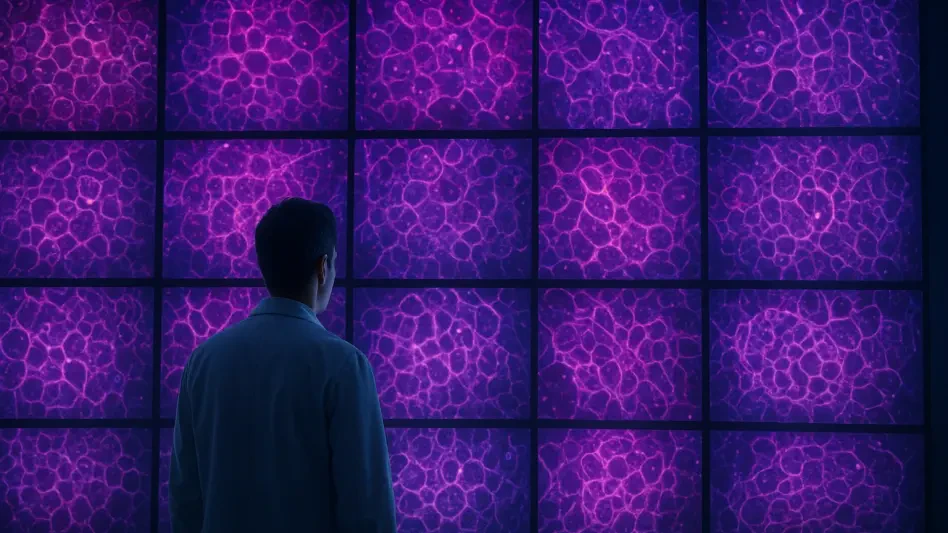

By restricting a model’s focus to the immediate local community of cells, researchers have demonstrated that restricted attention can lead to more accurate cancer detection accuracy. This pivotal finding stems from a study conducted at Nanchang University, where engineers developed a novel architecture known as Neighbor-Constrained Multiple Instance Learning, or NCMIL. In the current landscape of diagnostic medicine, the shift toward digital pathology has created a massive data management challenge. High-resolution scans of human tissue, referred to as whole-slide images, are essentially gigapixel mosaics that contain billions of individual pixels. These files are far too large for standard neural networks to process in a single pass, necessitating specialized frameworks that can digest small sections of the image while maintaining an understanding of the overall biological context. The NCMIL model represents a significant leap forward because it mimics the logical, spatial reasoning that human pathologists employ when examining a slide. By focusing on the structural relationship between cells and their neighbors, this system provides a more nuanced and accurate interpretation of complex tissue patterns, effectively bridging the gap between raw data processing and clinical insight.
Overcoming the Limitations of Traditional Digital Pathology
Identifying Core Challenges: Multiple Instance Learning
In the current era of medical technology, the standard approach to analyzing massive tissue scans involves breaking the image into thousands of small, manageable squares called tiles. This methodology, known as Multiple Instance Learning, treats the entire slide as a “bag” containing many individual “instances.” Under normal circumstances, the AI is given a single label for the entire bag, such as “malignant,” without being told exactly which specific tiles contain the diagnostic evidence. This form of weak supervision is necessary because manually labeling every tile in a gigapixel image would be an impossible task for human experts. However, this creates a significant hurdle for machine learning models, as they must determine which tiles are relevant and which are merely background noise. Standard models often treat these tiles as independent entities, ignoring the fact that cells in a biological sample are physically connected and organized into specific structures like glands or tumor nests. This lack of spatial awareness frequently results in the AI overlooking subtle but critical patterns that are essential for an accurate diagnosis, particularly in the early stages of disease.
Addressing Faults: Artifact Sensitivity and Signal Oversmoothing
The absence of spatial context in traditional models leads to two primary technical failures that the NCMIL framework specifically aims to resolve. The first is artifact sensitivity, where a model incorrectly assigns high diagnostic importance to non-biological features such as tissue folds, air bubbles, or ink marks left by clinicians. Because these models do not understand that a cancerous lesion must have a logical physical structure, they can be easily misled by these visual distractions. The second issue is signal oversmoothing, which occurs when a model attempts to aggregate information from across the entire slide too aggressively. In doing so, it may blend the distinct signals of a small, focal tumor with the surrounding healthy tissue, effectively washing out the evidence and leading to a false negative result. By failing to differentiate between local high-importance clusters and global background information, existing systems often struggle to maintain the high level of precision required for tasks such as tumor subtyping. The transition to more sophisticated, neighbor-aware architectures is therefore essential for moving beyond these elementary processing errors and achieving clinical-grade reliability in automated cancer detection.
The Dual-Path Architecture of NCMIL
Strategic Design: Balancing Global Context and Local Precision
To solve the spatial context dilemma, the NCMIL framework utilizes a sophisticated dual-path design that allows the system to view the tissue through two different lenses simultaneously. The global path employs an architecture known as a Nyströmformer, which is an efficient variant of the standard transformer model. This component is designed to maintain a bird’s-eye view of the entire tissue landscape, capturing the broad relationships between distant regions of the slide without requiring the immense computational power that a traditional transformer would demand. While the global path ensures the model understands the overall environment, the local path introduces the Neighbor-Constrained Attention mechanism. This innovation forces the AI to focus its attention on a tile’s immediate physical neighbors, creating a mathematical boundary that prevents it from looking at irrelevant data points elsewhere on the slide. This dual-path approach ensures that the model can identify large-scale architectural changes in the tissue while simultaneously detecting the minute, local variations in cell morphology that indicate the presence of a specific cancer subtype, providing a comprehensive analysis that is both broad and deep.
Technical Enhancements: Innovations for Diagnostic Fidelity
The engineering excellence behind NCMIL is further supported by several specific technical strategies that optimize how the model processes information. One of the most important features is the use of hard attention masking, which bakes the concept of spatial proximity directly into the model’s core logic. Instead of forcing the computer to learn from scratch that neighboring cells are related, the researchers pre-programmed this spatial prior, making the model significantly more efficient and faster to train than previous iterations. Additionally, the system uses similarity-weighted aggregation to refine how data is shared between neighboring tiles. In a real-world tissue sample, a cancerous cell might be located right next to a blood vessel or a pocket of fat; the NCMIL model evaluates the morphological similarity of these neighbors and suppresses the influence of tiles that look fundamentally different from the target area. This prevents the “bleeding” of unrelated data into the diagnostic signal. Finally, an adaptive fusion module dynamically adjusts the balance between the local and global paths for every unique slide, ensuring that the AI uses the most appropriate perspective for the specific biological patterns present in each patient’s sample.
Performance Benchmarks and Clinical Validation
Statistical Evidence: Proving Superiority Through Rigorous Testing
Validation of the NCMIL model involved a series of rigorous tests against four major public cancer databases, ensuring that its performance was consistent across different types of tissue and disease states. Using a five-fold cross-validation protocol, the research team compared NCMIL to several existing state-of-the-art models, including those that are currently considered the industry standard for digital pathology. The results demonstrated a clear and measurable improvement in several key metrics, most notably the Area Under the Curve and the F1 score. These metrics are critical because they measure a model’s ability to correctly rank positive cases and maintain a balance between precision and recall. In specific benchmarks, the NCMIL model outperformed its closest competitors by several percentage points, a margin that is highly significant in the field of medical AI. These gains suggest that the neighbor-constrained approach is not just a theoretical improvement but a practical advancement that leads to more reliable and trustworthy automated diagnoses. The consistency of these results across multiple datasets indicates that the framework is robust enough to handle the natural variability found in clinical environments, making it a viable candidate for widespread implementation.
Practical Impact: Bridging the Gap Between AI and Biology
Beyond the impressive statistical results, the NCMIL model holds substantial clinical promise because its reasoning aligns with the fundamental principles of biology. In a hospital or laboratory setting, a pathologist does not just look for individual sick cells; they look at the “tumor microenvironment,” which includes the relationship between cancer cells, immune cells, and the surrounding connective tissue. The density and arrangement of these elements can tell a doctor a great deal about a patient’s prognosis and how they might respond to specific treatments like immunotherapy. By forcing the AI to respect the physical structure and organization of the tissue, the NCMIL framework produces results that are much more interpretable for medical professionals. Instead of acting as a “black box” that provides a diagnosis without explanation, this model highlights biologically coherent regions of interest that a human expert can easily verify. This alignment between machine logic and biological reality is a crucial step toward building clinician trust in AI tools, as it ensures that the software is looking at the same diagnostic clues that a trained human would prioritize during a manual review.
The Future of Automated Cancer Diagnosis
Scaling Solutions: Integrating Advanced Aggregators in Modern Medicine
The current trend in computational pathology is moving toward the creation of massive “foundation models” that are trained on millions of tissue slides to extract highly detailed features. However, even the most advanced feature extractor requires an effective “aggregator” to synthesize those features into a final, actionable diagnosis. The NCMIL framework is perfectly positioned to serve as this aggregator, providing the logical structure needed to organize the vast amount of data generated by modern scanners. As medical institutions continue to digitize their archives from 2026 to 2028, the ability to process these images with high precision and low computational cost will be a primary requirement for any diagnostic software. NCMIL offers a scalable solution that can be integrated into existing hospital workflows, acting as a high-speed screening tool that flags suspicious slides for further review by a pathologist. This does not replace the human expert but rather augments their capabilities, allowing them to focus their time on the most complex and ambiguous cases while the AI handles the routine screening and subtyping of more straightforward samples with a high degree of confidence and accuracy.
Final Synthesis: Refining the Vision of Artificial Intelligence
The research into neighbor-constrained learning provided a clear roadmap for the future of AI in the medical field, emphasizing that more data is not always better if that data lacks structure. The investigators confirmed that by narrowing the focus of the attention mechanism, the resulting model achieved a higher degree of diagnostic accuracy than those with an unrestricted global view. This shift in perspective allowed the machine to ignore irrelevant artifacts while maintaining a sharp focus on the organized growth patterns characteristic of malignant tumors. The team established that the spatial context dilemma was a solvable problem through the application of dual-path architectures and hard attention masking. These findings encouraged a broader reconsideration of how spatial relationships should be encoded in medical software, moving away from purely statistical associations toward biologically inspired logic. Ultimately, the study concluded that the most effective AI tools were those that reflected the specialized knowledge and observational habits of human professionals. By successfully integrating local and global perspectives, the researchers ensured that the next generation of cancer detection tools would be more precise, more interpretable, and better prepared for the complexities of modern clinical practice.