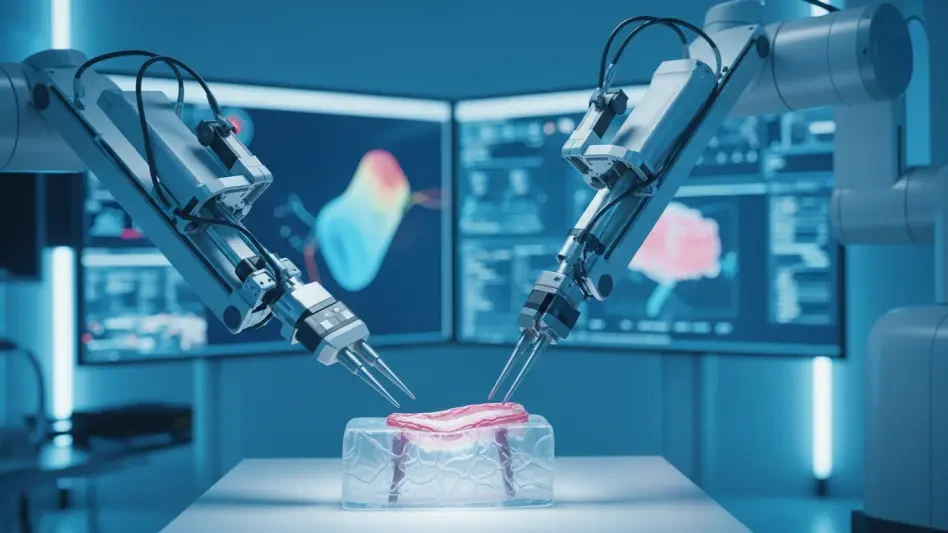

Surgeons operating at the microscopic level often rely on an intuitive sense of touch that traditional robotic systems have historically struggled to replicate with any degree of accuracy. The introduction of Nvidia’s Physical AI framework, a cornerstone of the Isaac for Healthcare platform, represents a fundamental shift away from simple automation toward embodied intelligence. By moving beyond static datasets and linguistic models, this technology enables machines to learn through simulated physical interactions and tactile feedback. These autonomous systems are now being trained to perceive force and motion in ways that were previously impossible, preparing them for the extreme complexities of real-world clinical environments. This evolution marks a transition from robots that follow rigid scripts to those that can adapt to the dynamic and unpredictable nature of human biology. As these systems move closer to hospital integration, the focus remains on bridging the gap between digital simulation and the delicate reality of patient care.
Overcoming the Data Scarcity Barrier
Addressing the Clinical Information Gap
One of the most significant roadblocks in the advancement of medical robotics has been the chronic shortage of diverse, high-quality training data required for complex procedures. Traditional AI models primarily learn from two-dimensional images or massive blocks of text, but a surgical robot requires a much more nuanced understanding of the physical world. It must comprehend the subtle resistance of different tissue types or the exact amount of pressure needed to manipulate delicate instruments without causing trauma. Because real-world surgical procedures are rare and governed by strict regulations, gathering enough physical data to train an autonomous system is a monumental task. This clinical information gap often leaves developers with insufficient edge-case scenarios, which are critical for ensuring safety. Without a rich repository of tactile experiences, robots remain limited in their ability to respond to unexpected physiological changes during an operation.
To solve this bottleneck, Nvidia’s framework effectively manufactures experience within a high-fidelity computational environment, allowing robots to undergo years of training in virtual space. By creating a digital sandbox that mimics the mechanical properties of the human body, developers can expose their algorithms to thousands of unique clinical scenarios that would take decades to witness in a hospital. This synthetic data generation allows for the exploration of rare complications and anatomical variations that are seldom seen in live operating rooms. Consequently, the robot develops a library of responses to various physical stimuli before it ever touches a piece of hardware. This approach not only accelerates the development cycle but also provides a safer environment for testing experimental maneuvers. By shifting the burden of experience from the physical world to the digital realm, the industry can bypass the ethical and logistical constraints of live clinical data collection.
Synthesizing Physical Tactility: The Role of Haptic Feedback
The development of a sophisticated sense of touch within robotic systems requires more than just high-resolution cameras; it necessitates the integration of haptic feedback loops that mirror human sensitivity. Nvidia’s framework addresses this by simulating the interaction between robotic actuators and various biological materials, from rigid bone to soft, elastic vascular tissue. This allows the AI to learn the feel of a procedure, such as the exact moment a needle pierces a vein or the resistance encountered during a delicate retraction. Without these tactile simulations, a robot might perform visually perfect movements that are physically damaging to the patient. By focusing on force-sensing and pressure distribution, the Physical AI framework ensures that every robotic interaction is governed by an understanding of physical limits. This layer of intelligence is what enables a robot to operate in environments where vision is obstructed.
By prioritizing tactile intelligence, the framework creates a more comprehensive training model that includes the mechanical properties of both the robot and the patient. This approach allows developers to test how different surgical tool designs affect the robot’s ability to perceive force, leading to more ergonomic and responsive hardware. The simulation also accounts for the wear and tear on robotic components, ensuring that the AI can compensate for slight mechanical changes over time. This focus on the physical reality of the operating room is a departure from previous models that treated surgery as a purely geometric problem. Instead, the framework treats it as a complex physical interaction where the consequences of motion are as important as the motion itself. This shift toward haptic-centered training is crucial for the next generation of robotic assistants, as it provides the sensory foundation needed for complex tasks like internal organ manipulation.
Technical Architecture and Industry Integration
Merging Physics Simulations with Generative Models
The underlying architecture of this Physical AI framework utilizes a dual-modeling approach to create highly realistic and useful training environments for medical devices. This system merges classical physics simulations, which strictly govern the mechanical rules of motion, with advanced generative AI models such as Cosmos-H Dreams. While physics engines handle the rigid mathematical certainties of how a needle moves, generative models manage the visual and biological complexities of human anatomy. This combination allows the simulation to present a wide variety of patient types, differing in size, age, and pathology, all while maintaining physical consistency. By blending these two distinct forms of intelligence, Nvidia ensures that the robot is not just reacting to visual cues but is fundamentally understanding the mechanical consequences of its actions. This synergy is vital for creating a robot that can safely navigate the body.
Efficiency and scale are the hallmarks of this new framework, as demonstrated by its ability to execute thousands of parallel training environments simultaneously across GPU clusters. This massive throughput allows developers to compress the time required for complex skill acquisition from several months of physical testing to just a few minutes of simulation. In these parallel worlds, thousands of versions of the same robot can try different techniques to solve a specific surgical task, with the successful strategies being aggregated into a single, highly refined control policy. This speed of iteration means that software updates can be tested and validated against millions of data points before a single physical prototype is ever moved. Such rapid parallelization is essential for meeting the high demands of the medical industry, where the window for innovation is narrow and the need for precision is absolute during every surgical procedure.
Collaborative Innovations and Regulatory Pathways
Several prominent industry leaders have already begun integrating Nvidia’s Physical AI technology into their core development pipelines to enhance surgical outcomes. For instance, Johnson & Johnson MedTech is leveraging high-fidelity digital twins to simulate complex urological procedures with a level of detail previously unattainable. These digital twins allow surgeons and engineers to practice kidney stone removals in a risk-free environment, perfecting the use of specialized tools before they are deployed in a clinical setting. By using simulated environments to refine surgical techniques, the company can identify potential complications early in the development process, leading to safer and more effective instruments. This collaboration highlights how Physical AI is being used not just to train robots, but to rethink the entire lifecycle of surgical planning. The ability to model the interaction between robotic hardware and tissue is a game-changer.
The implementation of the Physical AI framework established a new paradigm for how medical robotics were designed and validated within the healthcare industry. To ensure the safe adoption of these autonomous systems, developers prioritized the creation of comprehensive fail-safe mechanisms that allowed for immediate human intervention. This collaborative model ensured that the precision of AI was always tempered by the experienced judgment of a human surgeon, creating a robust safety net for complex operations. By standardizing the use of digital twins for surgical planning, hospitals successfully reduced the incidence of intraoperative complications and improved overall outcomes. Looking forward, the focus moved toward establishing universal haptic standards that allowed robots to share tactile knowledge across different surgical platforms, further accelerating the arrival of truly autonomous medical care.