
The long-standing vision of hospitals staffed by autonomous machines is finally moving away from the realm of science fiction and toward the tangible reality of clinical corridors. For several years, the narrative of artificial intelligence in the medical sector was dominated by large language models and diagnostic algorithms that existed solely behind glass screens. While these digital assistants proved invaluable for summarizing patient charts or predicting sepsis, they remained essentially passive observers, unable to influence the physical environment. Physical AI represents a departure from this limitation, merging cognitive reasoning with the mechanical capability to interact with patients, equipment, and hospital infrastructure in real time. This technological evolution arrives at a critical juncture where global healthcare systems are grappling with unprecedented labor shortages and administrative burnout that digital tools alone cannot resolve.
The defining characteristic of this shift is the emergence of embodied systems that do not just process information but also perform physical labor. By integrating robotics, advanced sensing, and computer vision, Physical AI allows a machine to perceive a three-dimensional world and execute tasks that previously required human hands. This transition is not merely about adding a robotic arm to an existing computer; it is about creating a unified architecture where the “brain” and the “body” are inextricably linked. This review will analyze the current state of these technologies, the technical frameworks that make them possible, and the logistical and clinical applications that are beginning to redefine how care is delivered within modern medical facilities.
The Transition from Digital Assistance to Physical Action
The evolution toward Physical AI marks a fundamental change in how the healthcare industry conceptualizes automation, shifting from “information processing” to “physical participation.” In the previous era, Generative AI focused on language and data, serving as a sophisticated librarian that could retrieve and reorganize clinical knowledge. However, Physical AI introduces the concept of agency, where the system is capable of navigating a crowded emergency room or handling delicate medical instruments. This move from the screen to the hallway is driven by the realization that many of the most significant bottlenecks in healthcare are physical, such as the transport of specimens, the cleaning of rooms, and the repositioning of immobile patients.
This paradigm shift relies on the integration of cognitive intelligence with robotic hardware to solve the “last mile” problem of healthcare delivery. While a digital AI might recommend a specific medication, Physical AI can autonomously retrieve that medication from a secure pharmacy and deliver it to the patient’s bedside. Consequently, the technology is moving from being a tool for the mind to becoming a tool for the physical workspace. This transition matters because it addresses the core issue of clinician exhaustion by offloading the heavy lifting and repetitive manual tasks that contribute to physical fatigue and distraction from direct patient engagement.
Key Technical Frameworks and System Components
Multimodal Models and Edge Computing Architecture
The technical foundation of Physical AI relies on multimodal systems that can interpret a diverse array of inputs, including visual, auditory, and tactile data. Unlike standard AI that might only look at a spreadsheet or an image, these systems must synthesize these different data streams to understand the context of a clinical environment. For example, a robot must distinguish between the sound of a patient calling for help and the ambient noise of a television, while simultaneously using visual data to navigate around a discarded gurney. This requires a level of contextual awareness that far exceeds the capabilities of traditional, single-mode algorithms.
To ensure these complex systems can operate safely in high-stakes environments, the industry has turned toward edge computing architecture. By processing data locally on the machine rather than sending it to a distant cloud server, edge computing reduces latency to near-zero levels. This near-instantaneous decision-making is vital for physical safety; a robot moving through a busy hospital cannot afford a two-second delay in its “stop” command if a child runs across its path. This localized processing capability represents a unique implementation of AI that prioritizes physical responsiveness and reliability over the sheer computational power of massive, remote data centers.
High-Precision Sensors and Machine Perception
High-precision sensors serve as the nervous system of Physical AI, allowing machines to “feel” and “see” with a degree of accuracy that was previously impossible. Advanced computer vision now goes beyond simple object detection to include semantic segmentation, where the AI understands the function and importance of everything in its view. In a sterile corridor, the system must differentiate between a staff member who has the right of way and an inanimate laundry cart. This level of machine perception is critical for maintaining the flow of hospital operations without creating new hazards for the human workforce.
Furthermore, the implementation of tactile sensors allows robots to interact with fragile objects or human skin with extreme sensitivity. In rehabilitative settings or surgical assistance, the machine must apply the exact amount of force required to be effective without causing injury. These sensors use haptic feedback loops to adjust pressure in real time, mimicking the fine motor skills of a human clinician. The uniqueness of this technology lies in its ability to bridge the gap between mechanical rigidity and the soft, unpredictable nature of biological systems, making it a viable partner in direct patient contact.
Closed-Loop Systems and Simulation Training
The reliability of Physical AI is maintained through a “perceive-plan-act-adjust” cycle, known as a closed-loop system. This continuous feedback loop ensures that the machine is constantly monitoring the results of its physical actions and making micro-adjustments to its trajectory or force. If a robotic arm encounters unexpected resistance while suturing, the closed-loop system detects the anomaly and pauses or alters its path faster than a human could react. This feature is what differentiates autonomous Physical AI from older, pre-programmed industrial robots that followed a fixed set of movements regardless of environmental changes.
Because training these systems in a live hospital environment would be prohibitively dangerous, developers utilize high-fidelity simulation environments to prepare the AI for the real world. These “digital twins” of hospitals allow the AI to encounter thousands of rare or dangerous scenarios, such as a power failure or a sudden patient collapse, within a safe virtual space. By the time the AI is deployed in a physical facility, it has already practiced its responses to edge cases that a human might only see once in a career. This simulation-first approach ensures that the “intelligence” of the system is grounded in physical laws and safety protocols before it ever touches a patient.
Current Advancements and Technological Convergence
A significant breakthrough in the field is the development of “world models,” where the AI can simulate the physical outcomes of its actions before it actually moves. This predictive capability allows the machine to evaluate multiple potential paths and select the one with the lowest risk of collision or error. Instead of just reacting to the environment, the AI is essentially “imagining” the immediate future to ensure its movements are as efficient and safe as possible. This convergence of reasoning and robotics is creating a unified intelligent body that acts with a level of fluidity that was previously the sole domain of living organisms.
Moreover, the industry is witnessing a shift where hospitals are no longer just experimenting with isolated pilot programs but are instead integrating Physical AI into the core of their logistics. The move toward a unified hardware-software stack means that a single AI platform can manage a fleet of robots across different departments, from the pharmacy to the surgical suite. This integration allows for a level of coordination that optimizes the entire hospital ecosystem, reducing wait times and ensuring that resources are distributed precisely where they are needed.
Real-World Applications Across the Healthcare Spectrum
Autonomous Logistics and Hospital Operations
Autonomous Mobile Robots, or AMRs, have become the most visible manifestation of Physical AI in modern hospital operations. These systems handle the “back-of-house” tasks that are essential but highly repetitive, such as delivering meals, transporting lab specimens, and managing the removal of biohazardous waste. By automating these logistical flows, hospitals can reclaim thousands of hours of staff time every month. The return on investment for these systems is not just measured in dollars but in the increased “time at the bedside” for nurses who no longer have to act as couriers for supplies.
Surgical Autonomy and Procedural Assistance
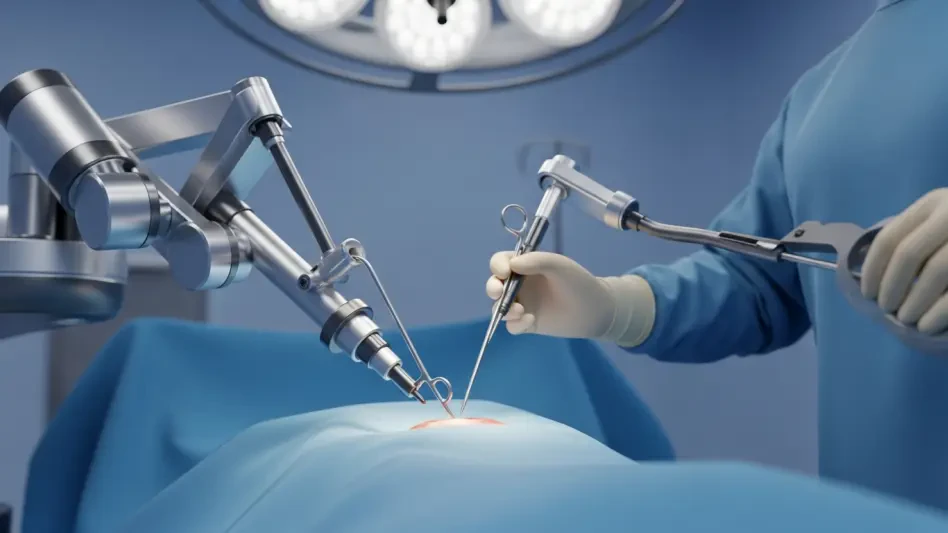
In the operating room, the role of AI is transitioning from manual teleoperation to “autonomy by task.” While surgeons still oversee the procedure, Physical AI is beginning to handle specific, high-precision segments of a surgery, such as tissue retraction or the initial stages of suturing. These systems utilize the massive amounts of data generated by surgical platforms to refine their precision, often performing these routine tasks with a level of consistency that exceeds human capability. This does not replace the surgeon but rather serves as a force multiplier, reducing the cognitive load and physical strain of long, complex procedures.
Social Robotics and Rehabilitative Support
Socially assistive robots represent a unique branch of Physical AI that focuses on the emotional and rehabilitative needs of patients. Systems designed for pediatric care use non-threatening physical forms and AI-driven social cues to distract children during painful procedures or to encourage them during long hospital stays. In the geriatric and physical therapy sectors, Physical AI assists patients with mobility exercises, providing the physical support needed to walk while using sensors to track progress and prevent falls. This implementation is unique because it combines mechanical support with the “soft” skills of social interaction, addressing both the physical and psychological components of recovery.
Security, Safety, and Regulatory Obstacles
The introduction of autonomous physical entities into a shared human environment brings a unique set of security and safety challenges. Unlike a software glitch that might corrupt a file, a malfunction in a Physical AI system could result in physical impact or injury. Ensuring “functional safety”—where the machine is guaranteed to fail in a safe state—is the primary technical hurdle. This requires redundant sensor systems and physical “kill switches” that can bypass the AI entirely if a problem is detected. Furthermore, as these machines are connected to the hospital’s network, they represent a new surface area for cybersecurity attacks that could potentially lead to physical harm if compromised.
From a regulatory standpoint, Physical AI complicates the traditional understanding of liability. If an autonomous system makes a physical error during a procedure, determining whether the fault lies with the software developer, the hardware manufacturer, or the supervising clinician remains a legal gray area. Current frameworks are struggling to keep pace with the “closed-loop” nature of these systems, where the machine is making real-time decisions without direct human input for every movement. Establishing clear protocols for oversight and accountability is essential for the long-term adoption of these technologies in clinical settings.
Future Outlook: The Next Wave of Medical Automation
The trajectory of Physical AI points toward a future where hospital architecture itself will be redesigned to accommodate autonomous systems. We are likely to see the emergence of specialized corridors and charging hubs integrated into the walls, as well as smart elevators that communicate directly with robotic fleets. Beyond logistics, the next wave of automation will likely involve miniaturized Physical AI for internal medicine, such as steerable catheters or ingestible robots that can perform targeted drug delivery or biopsies from within the body. These breakthroughs will require further advancements in haptic feedback and energy-efficient actuators to operate within the constraints of the human anatomy.
The long-term impact on the healthcare workforce will be a significant restructuring of clinical roles rather than a wholesale replacement of human workers. Nurses and doctors will transition into roles that focus on high-level strategy, complex emotional support, and the management of the AI systems themselves. This shift will require a new type of medical education that includes technical literacy and the ability to work alongside autonomous physical partners. Ultimately, the successful integration of Physical AI will be defined by its ability to fade into the background of hospital life, becoming a reliable, invisible infrastructure that supports the human-to-human connection at the heart of healthcare.
Concluding Summary of the Physical AI Revolution
The review evaluated the profound shift from digital information systems to embodied physical agents within the healthcare landscape. The analysis demonstrated that the convergence of multimodal AI models, high-precision sensors, and edge computing created a viable framework for machines to participate actively in care delivery. This investigation highlighted that the most immediate value was found in autonomous logistics, where machines relieved human staff of repetitive manual tasks, thereby improving operational efficiency. Furthermore, the data indicated that while surgical and rehabilitative applications showed immense promise for clinical precision, they also introduced new complexities regarding functional safety and liability.
The transition toward Physical AI was presented not as an optional technological upgrade but as a necessary response to the global healthcare workforce crisis. The findings suggested that as hospitals moved beyond digital assistants, the physical environment became an extension of the intelligent ecosystem. It was concluded that the successful deployment of these systems depended on a balance between mechanical autonomy and rigorous human oversight. Ultimately, the review established that Physical AI transformed the hospital from a place of manual labor into a sophisticated, automated environment where clinicians could focus exclusively on high-value patient care. Future medical infrastructure will undoubtedly be built around these autonomous physical partners.