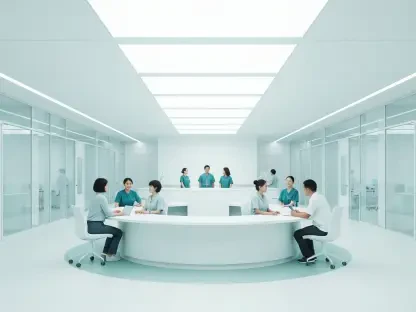

As the long-term care sector grapples with an escalating staffing crisis and the growing complexity of patient needs, the search for innovative training solutions that can produce resilient and compassionate professionals has become more urgent than ever before. In response, a transformative educational model known as the “living classroom” is gaining significant traction, bridging the persistent gap between academic theory and the realities of practical, person-centered care. This model embeds students directly within healthcare facilities, creating a fully immersive learning environment. This analysis will explore the rise of the living classroom trend, examine its real-world application through a pioneering partnership, validate its effectiveness with insights from industry leaders, and consider its future implications for the broader healthcare sector.
The Rise of Immersive Healthcare Education
A Data Driven Response to Industry Needs
The demand for better-trained healthcare professionals is not arbitrary; it is a direct consequence of two converging societal pressures: a rapidly aging population and the increasing complexity of health conditions among older adults. This demographic shift places unprecedented strain on the long-term care system, requiring a workforce equipped with not only advanced clinical skills but also a deep capacity for empathy and adaptability. Traditional classroom-based learning, while foundational, often falls short of preparing students for the nuanced and dynamic environment of senior care.
This growing recognition of a training gap is now validated by significant government and institutional investment, signaling a systemic shift toward more experiential educational models. The trend is powerfully underscored by a recent $1.98 million grant from the Ministry of Health’s Models of Care Innovation Fund, specifically designated for establishing centers of excellence for specialized clinical training. Further support, including a $75,000 grant from The Schlegel-UW Research Institute for Aging, confirms a broader consensus that hands-on, integrated learning is a critical strategy for building workforce capacity and ensuring graduates are ready to meet the challenges of the sector from day one.
Case Study The Mohawk St Josephs Partnership
A leading example of this trend in action is the collaborative venture between Mohawk College, St. Joseph’s Villa, and St. Joseph’s Healthcare Hamilton. This partnership has established a living classroom directly within a long-term care facility, moving education out of the lecture hall and into the very heart of the clinical environment. This initiative provides students with unparalleled immersion into the daily operations of senior care, creating a seamless connection between their formal curriculum and the lived experiences of residents.
By learning alongside residents, their families, and seasoned clinical teams, students gain direct exposure to the complexities of long-term care in real time. They participate in care planning, witness interprofessional collaboration, and develop communication skills through authentic interactions. This model transforms residents from passive recipients of care into active participants in the educational process. Consequently, the initiative serves as a tangible and highly effective blueprint for how academic institutions and healthcare providers can partner to create a direct pipeline of skilled, confident, and compassionate graduates who are truly prepared for the demands of their profession.
Insights from Academic and Healthcare Leaders
Expert validation for the living classroom model comes from leaders across both the academic and healthcare sectors, who see it as a fundamental step forward in professional training. Dr. Azim Gangji, Vice President Academic at St. Joseph’s Health System, emphasizes the unique value of student immersion. He notes that by learning in the actual context of senior care, students cultivate not only their clinical competencies but also a profound understanding of compassionate, person-centered care, which is the cornerstone of quality in the long-term care setting.
This sentiment is echoed by Paul Armstrong, President of Mohawk College, who highlights the invaluable role that residents play in this educational ecosystem. Armstrong points out that residents contribute directly to shaping the next generation of caregivers, offering insights and perspectives that cannot be replicated in a simulated environment. This direct interaction makes the educational experience more humanistic and impactful, fostering a deeper sense of purpose and connection in students.
From a strategic standpoint, Mike Heenan, President and CEO of St. Joseph’s Health System, frames the living classroom as a critical component of building a resilient regional workforce. He underscores the model’s importance in increasing the number of qualified healthcare graduates who are prepared to meet the future demands of the community. This collaborative approach is viewed not merely as a training program but as a foundational strategy for ensuring the long-term sustainability and quality of senior care in the region.
The Future of Clinical Training A Multi Stakeholder Win
Redefining Workforce Development and Recruitment
The living classroom model presents clear and compelling benefits for every stakeholder involved, creating a synergistic cycle of improvement. For students, the deep immersion into daily clinical operations translates into enhanced skills, greater confidence, and superior job readiness upon graduation. They enter the workforce already familiar with the environment, culture, and unique needs of the long-term care population, significantly reducing the typical transition period from student to practitioner.
For healthcare facilities, the advantages are equally significant. The model establishes a direct talent pipeline, connecting providers with motivated graduates who have already been oriented to their specific setting. This integration improves both staff recruitment and retention, as graduates are more likely to seek employment in an environment where they feel competent and supported. Moreover, it creates valuable mentorship opportunities for existing staff, fostering a culture of continuous learning and professional development that elevates the entire care team.
Perhaps most importantly, residents of the long-term care facility benefit directly from this innovative approach. They become active partners in the educational process, sharing their life experiences and contributing to the development of a more empathetic and well-prepared workforce. This engagement not only enriches the students’ learning but also enhances the residents’ sense of community and purpose. Ultimately, they receive a higher quality of care from professionals who have been trained from the outset to be responsive, compassionate, and person-centered.
Scaling the Living Classroom Model
The success of this pilot initiative has already sparked plans for expansion, indicating a broader, province-wide strategy for workforce enhancement. The extension of living classrooms to other facilities within the St. Joseph’s Health System suggests that this model is viewed as a scalable and replicable solution to systemic challenges. This momentum points toward a future where integrated learning environments become a standard feature of healthcare education.
However, scaling this model is not without its challenges. Securing sustainable, long-term funding beyond initial grants will be crucial for its viability. Forging effective and trusting partnerships between academic institutions and clinical providers requires significant coordination and shared vision. Furthermore, ensuring a standardized level of quality and consistency across diverse settings will be essential to maintaining the model’s integrity and effectiveness as it grows.
Despite these hurdles, the long-term vision is clear: to establish the integrated living classroom as a new gold standard in healthcare education, particularly for the senior care sector. By breaking down the traditional silos between learning and practice, this model holds the potential to fundamentally reshape how healthcare professionals are trained, creating a workforce that is not only clinically proficient but also deeply attuned to the human needs of those they serve.
Conclusion Building a Sustainable Future for Senior Care
The analysis of the living classroom trend revealed that it is a proven and highly effective response to the critical workforce shortages and training gaps in long-term care. By embedding education directly within the clinical environment, the model successfully accelerated the development of job-ready professionals who possess both the technical skills and the compassionate mindset required for high-quality senior care.
The success of the Mohawk-St. Joseph’s collaboration demonstrated the immense power of synergistic partnerships in transforming healthcare education. The initiative showcased how academic institutions and healthcare providers could unite to build a direct talent pipeline, creating a multi-stakeholder victory that benefited students, staff, and residents alike.
Ultimately, this pioneering work offered a clear and compelling call to action. It challenged other educational and healthcare organizations to explore and adopt similar immersive training models. By embracing this shift toward experiential learning, the broader healthcare system took a decisive step toward building a more compassionate, competent, and resilient workforce capable of meeting the complex needs of an aging population for generations to come.