
The convergence of computational power and biological science has created a pivotal moment for the healthcare industry, where recent landmark collaborations and technological advancements are actively reshaping the very foundation of medicine. This landscape is being defined not by incremental changes but by bold, multi-billion-dollar ventures and the pervasive integration of artificial intelligence, from the earliest stages of drug discovery to the point of patient care. These developments signal a definitive shift toward a future where data-driven insights and strategic partnerships are the primary currencies of medical innovation. This evolving paradigm suggests that the most profound breakthroughs will no longer emerge from isolated labs but from the intersection of deep domain expertise and sophisticated AI, promising to accelerate the development of new therapies and streamline clinical operations on an unprecedented scale.
The Dawn of AI-Powered Drug Discovery
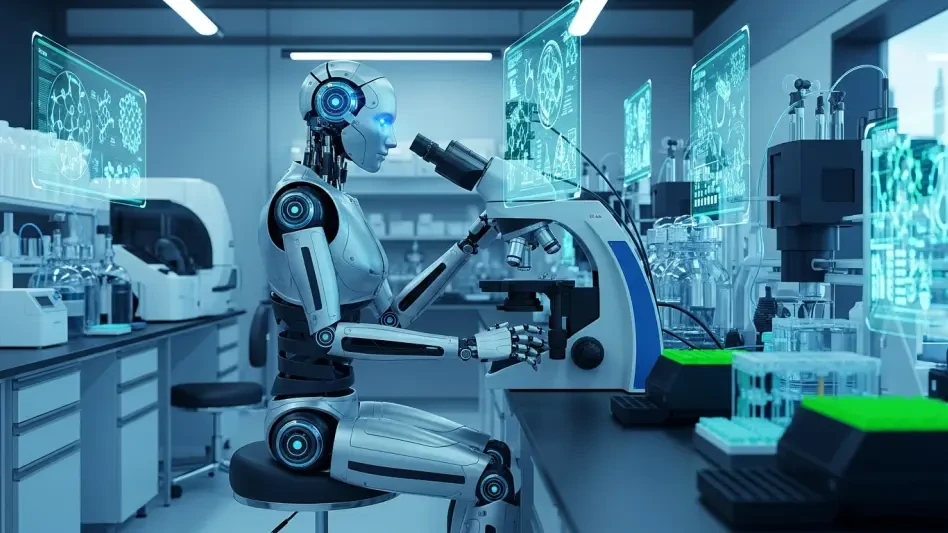
A defining trend in modern biopharma is the strategic fusion of artificial intelligence with traditional research and development, a movement powerfully illustrated by the recent five-year, $1 billion joint innovation lab established by Nvidia and Eli Lilly. This collaboration is far more than a simple technology licensing agreement; it represents a foundational effort to intertwine Lilly’s extensive biological expertise with Nvidia’s elite AI engineering capabilities. The central ambition is to construct a “continuous learning system” designed to operate around the clock, perpetually enhancing research models and expediting the identification of novel drug molecules. By leveraging advanced computational power, the partnership aims to dramatically shorten the timeline for discovering viable therapeutic candidates. This initiative reflects a broader industry recognition that AI is becoming an indispensable tool capable of navigating the immense complexity of biological data to uncover patterns and possibilities that would remain hidden from human researchers alone.
High-Stakes Alliances in Critical Disease Areas
While AI revolutionizes the discovery process, the industry is simultaneously being shaped by high-value strategic partnerships aimed at conquering some of the most challenging medical conditions. A prime example is Novartis’s nearly $1.7 billion licensing agreement with SciNeuro Pharmaceuticals to co-develop antibody treatments for Alzheimer’s disease. This deal hinges on SciNeuro’s innovative technology, which promises enhanced drug delivery to the brain—a long-standing obstacle in treating neurological disorders. In a similar vein, the oncology sector is witnessing a surge in global collaboration, as seen in AbbVie’s upfront investment of $650 million to license a promising clinical-stage cancer drug from the Chinese biotech firm RemeGen. These alliances underscore a crucial trend: established pharmaceutical giants are increasingly turning to agile, specialized biotechs across the globe to infuse their pipelines with cutting-edge therapies, signaling a more interconnected and globally sourced approach to medical innovation.
Streamlining Care from the Lab to the Bedside
Beyond the high-stakes world of drug development, significant investments are also being directed toward technologies that enhance the efficiency and safety of direct patient care. VieCure, an oncology software startup, recently secured $43 million in funding to expand its clinical decision support platform. This system is designed to empower clinicians, particularly those in community-based practices, by providing sophisticated tools to create highly personalized cancer treatment plans based on the latest evidence and patient-specific data. This focus on workflow optimization extends to the physical hospital environment, as demonstrated by Baxter’s introduction of a new smart stretcher. Engineered to reduce the need for patient transfers, this innovation directly addresses the physical strain on care teams while simultaneously improving patient safety and operational efficiency. These developments highlight a critical understanding that true advancement in healthcare requires improving not only the treatments available but also the processes by which they are delivered.
A Blueprint for Tomorrow’s Medicine
The developments showcased across the industry provide a clear blueprint for the future of healthcare, one built on the pillars of computational science and strategic synergy. The massive investments in AI for drug discovery are not just financial endorsements but declarations of a new research paradigm. Similarly, the multi-billion-dollar deals in oncology and neurology confirm that collaboration, often crossing international borders, has become the primary vehicle for tackling complex diseases. Innovations aimed at refining clinical workflows further illustrate a commitment to translating high-level scientific progress into tangible benefits for both patients and providers. It has become evident that the path forward is one of integration, where discrete advancements in technology, biology, and logistics are woven together to create a more efficient, intelligent, and responsive healthcare ecosystem.