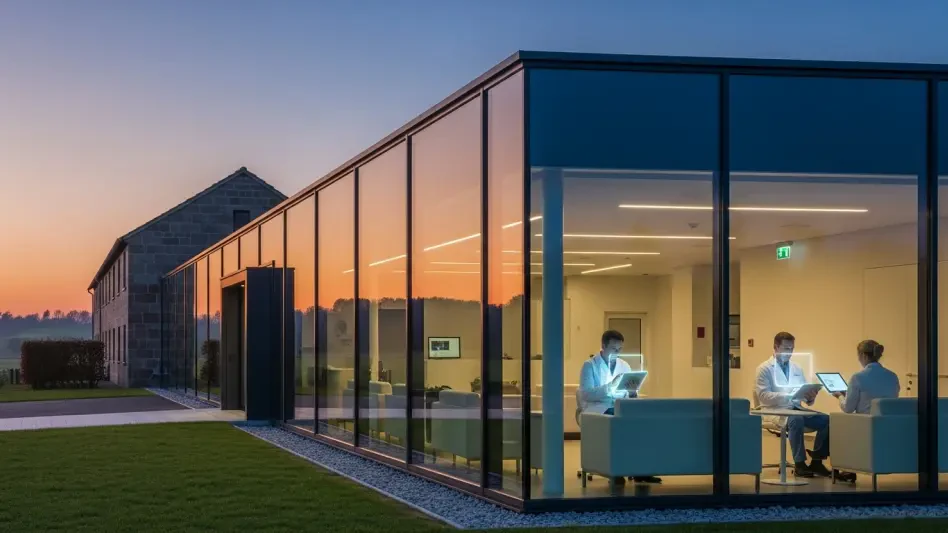

Rural healthcare providers currently stand at a pivotal crossroads where a massive infusion of fifty billion dollars in federal funding meets a landscape defined by chronic staffing shortages and archaic manual workflows. This unprecedented financial support, primarily distributed through the Centers for Medicare & Medicaid Services (CMS), arrives at a moment when nearly 40% of rural hospitals are operating at a financial loss. In such a resource-constrained environment, digital transformation has moved beyond the realm of elective upgrades. It has become a fundamental survival strategy for facilities that are often the sole providers of care for thousands of residents.
The shift occurring today represents a move away from high-concept technological fantasies toward pragmatic, invisible automation. For years, the industry was captivated by flashy demonstrations of artificial intelligence that ultimately failed to account for the operational realities of small-town clinics. Now, the focus has shifted to bridging infrastructure gaps and addressing the persistent reliance on legacy communication. By prioritizing efficiency over novelty, rural health systems are beginning to rebuild themselves into sustainable, modern entities capable of serving their communities for decades to come.
The Pragmatic Shift in Rural Health Systems
The influx of capital through Rural Health Transformation awards has created a unique opportunity to modernize facilities that were previously left behind by the digital revolution. However, the sheer volume of funding does not automatically translate to success. Leaders in these regions are increasingly aware that every dollar spent on technology must yield a direct reduction in administrative burden. This pragmatic approach is a reaction to years of underfunding and the sobering reality that over 400 rural facilities remain at risk of closure. For these institutions, the goal of modernization is to stabilize the workforce and secure the bottom line.
Digital transformation in this context is less about replacing physicians with machines and more about removing the friction that prevents doctors from doing their jobs. While urban centers might experiment with experimental diagnostic tools, rural systems are finding more value in refining the mundane. This includes streamlining the way patient data moves from one department to another and ensuring that existing infrastructure can handle the increased demands of modern software. The shift is subtle but profound, marking a transition from digital aspiration to operational necessity.
Market Drivers and the Economic Landscape
The current economic landscape is shaped by a phenomenon known as professional scarcity, where the lack of qualified administrative and clinical staff makes manual processes unsustainable. With fewer people available to manage the intake of patients and the processing of records, rural hospitals are forced to automate or face total operational paralysis. The financial fragility of these institutions means that any investment in technology must provide a clear return on investment, often by reducing the need for expensive contract labor or by improving the accuracy of billing cycles to prevent revenue leakage.
Despite the widespread adoption of Electronic Health Records (EHR), a significant gap persists between digital storage and digital communication. Adoption statistics suggest that while most clinics have moved away from paper charts, the methods they use to share those charts with outside specialists remain stuck in the past. This disconnect creates a bottleneck where high-tech systems are fed by low-tech inputs. The market is now responding with solutions specifically designed to bridge this gap, focusing on interoperability and the seamless movement of data across disparate networks.
Real-World Applications: From Faxes to Intelligent Automation
One of the most persistent hurdles in rural medicine is the fax paradox, a situation where the most reliable form of communication is also the most inefficient. Because faxes are universally compatible and require minimal IT overhead, they remain the primary driver of data exchange. However, they arrive as unstructured images that require staff to manually type information into the EHR. This repetitive task is a leading contributor to caregiver burnout, as highly trained professionals spend hours every week performing clerical data entry rather than tending to patients.
To solve this, many clinics are implementing Intelligent Document Processing (IDP) to act as a bridge between the old and the new. Unlike the flashy but often impractical AI applications seen in previous years, IDP integrates directly into the existing administrative workflow. It uses machine learning to “read” incoming faxes, extract the relevant clinical data, and populate the correct fields in the patient’s digital record. By converting unstructured images into actionable data without human intervention, rural providers are reclaiming hundreds of hours of staff time every month.
Expert Perspectives on Operational Reality
Industry experts emphasize that the most successful technological deployments in rural settings are those that remain “invisible” to the end user. When a platform requires a high learning curve or forces a complete overhaul of established routines, it often fails due to a lack of adoption. Leaders in the field suggest that technology should work in the background, quietly enhancing the capabilities of the current staff rather than demanding their constant attention. This philosophy of non-disruptive integration is becoming the gold standard for software vendors targeting the rural market.
Furthermore, there is a growing consensus on the importance of data integrity and privacy, particularly when training the models that power these automated systems. Experts advocate for the use of synthetic data—artificially created information that mimics real patient patterns—to train algorithms. This approach allows developers to improve the accuracy of machine learning without ever exposing actual Protected Health Information (PHI). For small clinics, maintaining this level of security is essential to achieving regulatory parity with large urban hospitals while protecting the trust of their local patient populations.
The Future of Rural Clinical Infrastructure
Looking toward the coming years, the evolution of clinical infrastructure will likely see the expansion of administrative assistants powered by artificial intelligence. These tools will move beyond simple data extraction to handle complex tasks such as predictive scheduling, automated compliance auditing, and sophisticated billing resolution. By taking over these high-stakes administrative functions, technology will allow the rural workforce to focus entirely on patient outcomes. This shift is expected to stabilize the talent pool by making rural practice more attractive and less burdensome for new clinicians.
However, several challenges remain on the horizon, particularly regarding the ethical implications of data training and the persistent limitations of broadband access. While software can be improved, the physical reality of limited connectivity in remote areas still hinders the deployment of cloud-dependent tools. The successful models of the future will likely be those that can operate effectively in low-bandwidth environments or utilize edge computing to process data locally. Addressing these ethical and physical barriers will be crucial for ensuring that the benefits of digital transformation are shared equally across all geographic regions.
Conclusion: A Reality-Based Roadmap for Modernization
The strategic deployment of federal grants required a shift in focus from experimental innovation to the practical integration of secure, automated systems. Healthcare administrators moved away from “AI demo candy” and instead prioritized tools like Intelligent Document Processing, which addressed the immediate drain on human resources. By securing systems with SOC 2 and HITRUST certifications and utilizing synthetic data for training, these facilities proved that small-scale clinics could match the security standards of major metropolitan medical centers. This methodical approach ensured that the modernization efforts were not just temporary upgrades but long-term investments in the community’s health infrastructure.
Moving forward, the primary objective for rural providers shifted toward establishing a sustainable cycle of incremental automation that grew alongside their specific needs. Leaders began to view technology as a supportive layer that functioned autonomously, allowing clinicians to return to the bedside. Future considerations now involve the expansion of these tools into holistic administrative assistants that manage the entire lifecycle of a patient visit. By solving the mundane problems of data entry and communication today, rural healthcare systems effectively built a resilient foundation that turned a period of financial crisis into a landmark era of operational stability.