
As the need for specialized pregnancy care grows and the number of maternal-fetal medicine (MFM) specialists remains critically low, telehealth is emerging as a powerful solution to bridge the gap. We sat down with Dr. Blake Porter, a double board-certified OB-GYN and MFM specialist who serves as the Chief of Maternal-Fetal Medicine with Access TeleCare, to explore this vital intersection. He brings a unique perspective on equipping virtual MFM teams to deliver high-quality care to patients in underserved communities across the country.
Our conversation delves into the real-world impact of virtual subspecialty support on rural physicians and their high-risk patients. We explore the patient’s journey from a local ultrasound to an expert virtual analysis that can fundamentally change their care plan. Dr. Porter also gives us a look behind the curtain at the technology designed to foster human connection, the logistical intricacies of integrating into a hospital’s existing workflow, and the collaborative approach to managing the complex interplay between maternal mental and physical health. Finally, we look to the future, forecasting how technology and new funding initiatives could transform America’s maternity care deserts.
You mentioned that only about 150 new MFM physicians enter the workforce annually, mostly in urban centers. How does this shortage directly impact local OBGYNs, and can you share an experience of how your team provided critical, real-time support to a rural physician managing a complex case?
That shortage places an immense burden on local OBGYNs. They are on the front lines, managing increasingly complex pregnancies that they might not see every day, and they often feel like they’re on an island. We essentially become their immediate backup, a sounding board and a comfort blanket. I recall a case with a physician in a small community hospital who was managing a patient with unexpected, severe complications. You could feel the stress in his voice. He had a solid plan but was second-guessing himself because the stakes were so high. Our role wasn’t to take over, but to come alongside him virtually. We reviewed the case, affirmed that his instincts were correct, and helped him fine-tune the plan using our experience from seeing these rare situations frequently. We helped him determine that his hospital did, in fact, have the resources to manage her locally. That support kept the patient from a stressful, multi-hour transfer, allowing her to deliver safely in her own community, with her family right there. It’s about empowering that local doctor to feel confident and capable, which in turn strengthens the entire local healthcare system.
Your advanced practice sonographers help identify an additional 8% of abnormalities. Can you walk me through the patient’s journey, from their initial local ultrasound to your team’s virtual analysis, and describe how this enhanced detection specifically alters the care plan for the family?
Of course. The journey begins in a familiar place for the patient: her local clinic. She goes in for a routine ultrasound, performed by the local team. Those images are then securely sent to us, where our advanced practice sonographers—who are incredibly experienced in high-risk pregnancies—do an initial review. They work hand-in-hand with our MFM physicians, and together, that combined expertise is how we identify that additional 8% of abnormalities that might otherwise be missed. When we find something, the journey shifts from routine to focused. We schedule a virtual consultation, often with the patient and her partner at their local hospital. Instead of just getting a confusing report, they sit face-to-face with one of our MFM specialists on a life-sized screen. We walk them through the findings, explain what a potential birth defect or complication means for their baby and their pregnancy, and collaboratively develop a plan. This early, expert detection completely alters the landscape. It gives the family time to process, to ask questions, and to prepare emotionally and logistically, while allowing the local care team to coordinate any necessary resources for the delivery. It transforms uncertainty into a clear, manageable path forward.
You described the Telemed IQ platform and proprietary carts designed to make virtual providers feel life-sized. Beyond the technical specs, how do these tools help your physicians “break through the screen” to build patient trust? Please detail a specific feature that makes the virtual experience more effective.
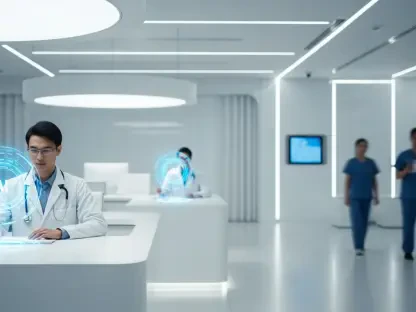
The technology is really about facilitating human connection. When you’re discussing a high-risk pregnancy, you can’t just be a face on a tiny laptop screen. Our carts are intentionally designed to counter that. The large screen presents us at life-size, and the high-definition camera isn’t static; it can zoom and tilt. That single feature is a game-changer for building trust. It allows me, as the physician, to read the room. I can pan to make eye contact with the patient’s partner, zoom in slightly to see the patient’s expression more clearly when I’m explaining something complex, and create a sense of shared space. It breaks down the digital barrier and lets me feel present with them. This isn’t just a video call; it’s a consultation. It’s that ability to engage dynamically, to react to non-verbal cues, that helps us “break through the screen” and build the genuine rapport and trust that are absolutely essential for these sensitive and critical conversations.
When partnering with a new hospital, you emphasized integrating directly into its existing EMR and workflows. What are the first steps your team takes to achieve this seamless integration, and how does it practically shorten the time to medical decision-making for the local providers?
Our goal is to feel like an extension of their own staff, not some third-party service they have to chase down. So, the first steps are entirely focused on assimilation. We go through the same credentialing and privileging process as any physician who would work on-site. Then, our technical teams work directly with the hospital’s IT department to gain access to their systems. We don’t ask them to change what they’re doing or log into a separate portal to find our recommendations. Our consultation notes are written directly into their EMR, and our ultrasound reports are filed in their native imaging software. This seamlessness is what collapses the timeline for decision-making. A local OBGYN doesn’t have to download a PDF from an email or hunt through an unfamiliar portal. Our expert opinion appears in the patient’s chart exactly where and how they expect to see it. This removes friction and delay, meaning our insights can be acted upon almost instantly, which is absolutely critical when minutes matter in obstetrics.
Given the significant burden of mental health on pregnancy outcomes, how does your MFM team collaborate with Access TeleCare’s behavioral health unit? Could you describe the communication process between specialists when developing a unified care plan for a high-risk patient with co-occurring conditions?
The connection between mental and physical health in pregnancy is undeniable, and you simply cannot treat one without considering the other. Within Access TeleCare, when a partner hospital utilizes both our MFM and behavioral health services, we operate as a truly collaborative team. The communication is very fluid. For instance, if I’m managing a patient with a complex medical condition who also has chronic depression, I can easily connect with our behavioral health specialists. We’re often bouncing ideas and evidence-based recommendations back and forth to create a holistic plan. We’ll discuss medication management from both angles: what is most effective for her mental health, and what has the safest profile for her developing baby? It’s not two separate consultations; it’s a unified strategy. This ensures we are optimizing her maternal health, reducing fetal exposure to medications where possible, and providing a cohesive plan that supports her through the immense physical and emotional challenges of a high-risk pregnancy.
What is your forecast for virtual maternal-fetal medicine? Looking ahead five years, how will technology and programs like the Rural Health Transformation Fund change the landscape for the “maternity care deserts” across the country?
My forecast is that virtual MFM will become an indispensable standard of care, fundamentally reshaping the map of these maternity care deserts. Right now, we know nearly half of rural U.S. counties lack adequate maternal care, leading to tragically worse outcomes. In five years, I see this changing dramatically. Technology will become even more sophisticated and integrated, but the real catalyst will be dedicated funding like the Rural Health Transformation Fund. This will empower smaller, rural hospitals to invest in the infrastructure and partnerships needed to bring subspecialty expertise like ours to their communities. This isn’t just about providing consults; it’s about rebuilding local healthcare ecosystems. By giving local OBGYNs the specialist backup they need, these hospitals will be better able to attract and retain physicians, keeping their labor and delivery units open and financially viable. The landscape will shift from isolated deserts to a connected network of care, ensuring that a patient’s zip code no longer dictates the quality of her pregnancy care.