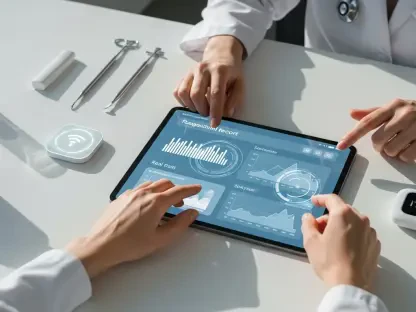

With the healthcare industry buzzing about AI-driven solutions, a quieter, more pragmatic evolution is taking place. While big-box retailers have stumbled in their attempts to conquer primary care, a new wave of hybrid companies is finding success by blending virtual services with targeted, in-person clinics. To understand this shift, we sat down with Faisal Zain, a veteran expert in medical technology whose work in manufacturing diagnostic and treatment devices gives him a unique ground-level perspective on what it takes to deliver care effectively. Our conversation explores why this “click and mortar” approach is gaining traction, delving into the operational hurdles of building such a model, the art of forging partnerships with established health systems, and the strategy for winning over investors in a market captivated by pure-tech plays. We also examine how policy is creating new tailwinds for innovation, particularly in underserved rural communities.
The article contrasts the struggles of broad primary care ventures with the rise of specialized companies like Knownwell. What specific pain points does this targeted, “cohort-focused” approach solve for payers, and what key metrics best demonstrate the ROI that convinces them to partner with you?
It’s a fantastic question because it gets right to the heart of why models like Walmart Health ultimately couldn’t make the numbers work, while more focused players are thriving. Payers are absolutely hemorrhaging money on a few specific, high-cost areas—think metabolic health, obesity, and complex maternal care. A broad, one-size-fits-all primary care model doesn’t effectively tackle these deep, expensive problems. It just spreads resources thinly. A cohort-focused company, on the other hand, walks into a negotiation with a payer and says, “We are experts in managing your costliest patients. We have a dedicated, integrated system for them.” This solves a massive pain point because it promises control over runaway spending.
To prove it, they don’t just show engagement stats. They bring hard data. We’re talking about metrics like Knownwell’s 91% one-year patient retention, which is unheard of in many primary care settings. For a payer, that retention means predictable, long-term management of chronic conditions, preventing costly hospitalizations down the line. Similarly, when Millie can demonstrate a 67% better preterm birth rate, that’s a direct, multi-million-dollar saving for a health plan. It’s that ability to present a clear, compelling ROI on a specific, high-cost population that makes payers not just listen, but eagerly sign on.
Anu Sharma of Millie called building a hybrid model “extremely difficult.” Can you walk us through the initial steps of integrating the virtual and in-person components? Please share an operational challenge you faced and how you ensured a seamless patient experience across both channels.
Anu Sharma is absolutely right; it is profoundly difficult because you’re essentially building two distinct businesses with entirely different operational rhythms and then forcing them to act as one seamless entity. The initial step isn’t just to build a website and lease a clinic space. It starts with mapping the patient’s entire journey, identifying every potential touchpoint, and designing the technology and clinical workflows to feel like a single, continuous conversation. You have to decide from day one: When does a virtual visit escalate to an in-person appointment? How does a note from a telehealth nurse instantly appear with the right context for the in-clinic midwife? It’s about building the connective tissue from the ground up.
A common and significant operational challenge is data fragmentation. Imagine a patient has a virtual consultation on Monday and an in-person follow-up on Wednesday. If the provider on Wednesday doesn’t have the full, nuanced context of that virtual chat, the patient is forced to repeat their story. Trust is immediately eroded. The solution is a unified electronic health record and communication platform where every interaction, whether via text, video, or in-person, is logged in a single, accessible patient file. We had to ensure that our platform wasn’t just a repository of data but a tool for collaborative care, so a doctor could see notes from a nutritionist and a behavioral health specialist in real-time. That seamless flow of information is what makes the experience feel truly integrated and patient-centered, rather than disjointed.
The text highlights partnerships between startups like Millie and large health systems. How do you convince an established hospital, which faces its own high operating costs, to form a strategic partnership? Please detail your value proposition and a key step in that integration process.
Convincing a large, established hospital is a delicate dance, but the timing is perfect because these health systems are under immense financial pressure. Many are seeing their margins shrink, and they often struggle with access and efficiency in specialized areas. I remember a primary care leader admitting he felt they were “failing our patients with obesity every day.” That’s a cry for help. Our value proposition isn’t about competing; it’s about being a synergistic partner that solves their most painful problems. We tell them, “You are excellent at acute, inpatient care, but you’re not structured for the kind of high-touch, tech-enabled, longitudinal management that prevents readmissions and improves outcomes. Let us be that extension of your system.”
For a service like maternal care, a partnership with a company like Millie helps the hospital maintain a steady volume of patients for labor and delivery, making their high-cost infrastructure more profitable. The key first step in that integration process is proving your model works before you even walk in the door. You can’t approach a major system like Sutter Health or HCA with just an idea. You need to arrive with a proven track record, showing them your superior outcomes and patient satisfaction scores. Once they see you can deliver better results and a reliable patient pipeline, the conversation shifts from “Why should we partner?” to “How quickly can we integrate?”
Knownwell’s CEO noted that pitching a “click and mortar” model isn’t as “sexy” as pure AI. When you approach investors, how do you frame the unit economics to prove scalability? What patient outcomes, like Knownwell’s 91% retention, make the most compelling financial case?
It’s true, “click and mortar” doesn’t have the same futuristic sizzle as a pitch for a fully autonomous AI doctor. Investors are often chasing the dream of infinite, low-cost scalability that pure software promises. To counter this, you have to frame the conversation around something investors understand even better than hype: durable, defensible unit economics and long-term value. We show them that while a physical footprint requires capital, it creates a powerful, sticky patient relationship that pure-virtual models struggle to replicate. You can’t build the same level of trust through an app as you can with a combination of virtual check-ins and a reassuring in-person physical exam.
The financial case hinges on metrics that demonstrate that stickiness. Knownwell’s 91% one-year patient retention is the gold standard. When I put that number in a deck, I frame it as a powerful reduction in customer acquisition cost and a massive increase in lifetime value. An average patient who is 49 years old with two comorbidities is not a one-time transaction; they are a decade-long relationship. We prove scalability not by promising to build a thousand clinics overnight, but by showing how our model allows each clinic to serve as a hub, managing a vast number of patients virtually—80% of visits—while the physical presence anchors the relationship and enables higher-value services like clinical trials. It’s a capital-efficient story, but one grounded in the reality of what patients actually need.
Homeward Health’s model is aided by the Rural Health Transformation Program. Beyond funding, how does this policy practically enable your deployment of mobile clinics and virtual care? Could you share an early “lesson learned” from your work that has since shaped your strategy in rural communities?
The Rural Health Transformation Program is a game-changer, and its impact goes far beyond just the dollar amount. The funding is critical, of course, but what it really does is create market certainty and act as a powerful catalyst for adoption. Practically, it means that when we approach a rural health system, we’re not just another vendor with a new idea. We’re bringing a solution that aligns directly with a major, funded federal initiative. This opens doors and turns hesitant potential partners into enthusiastic collaborators because they now have a clear mechanism to pay for these innovative services. It de-risks the investment for everyone involved and allows us to deploy our mobile clinics and virtual platforms into a receptive ecosystem.
A huge early lesson—one that left some scars, as Jennifer Schneider would say—was that you cannot simply airdrop technology into a rural community and expect it to work. We learned that innovation has to be delivered without friction. In one of our early deployments, we offered a fantastic new tech platform, but the local providers were too overwhelmed with their existing administrative burdens to even consider adopting it. We realized we had to solve their immediate problems first. So now, we often lead by offering to help with things like revenue cycle management. By unbundling our technology to help modernize their back-office functions, we build trust and demonstrate value. Only then can we effectively introduce new models of care, because we’ve become a true partner in strengthening their entire practice, not just another piece of software.
What is your forecast for the evolution of hybrid care models by 2030?
By 2030, I believe the term “hybrid care” will largely become redundant, because the most successful care delivery models will all inherently be hybrid. The artificial wall between virtual and in-person will have crumbled, and care will be delivered in a truly channel-agnostic way, seamlessly meeting patients where they are—at home, in a mobile clinic, at a retail location, or in a traditional hospital setting. We will see this model expand far beyond primary care and maternal health into highly specialized fields like oncology, post-surgical recovery, and chronic cardiology management, where continuous monitoring and timely interventions are critical.
The technology powering this will be far more integrated, with ambient AI capturing data from both virtual and in-person encounters to create a single, cohesive patient narrative. However, the winning companies will be those who remember the lesson that technology is an enabler, not the destination. The human element—the trust built with a clinician who knows your history, who you can see face-to-face when you need to—will remain the anchor of the entire system. The future isn’t about replacing doctors with bots; it’s about supercharging them with technology to deliver more proactive, personalized, and humane care than ever before.