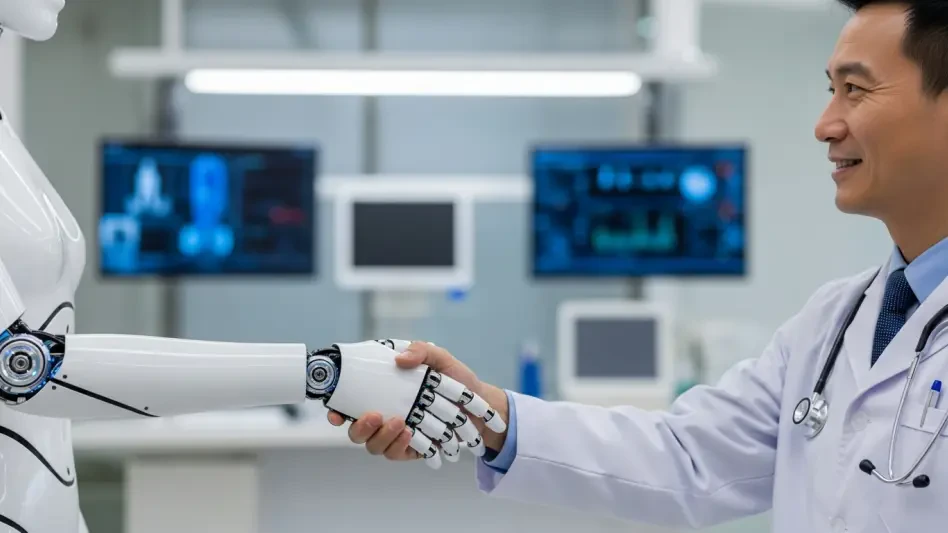

A powerful convergence of government ambition and technological innovation is fundamentally reshaping China’s healthcare industry, positioning artificial intelligence not just as a futuristic concept but as an increasingly integrated and commercially viable reality. This transformation is creating a fertile ground for growth, attracting significant investment, and setting a new precedent for how medical care is delivered and managed.
The Dawn of a New Era: China’s AI Healthcare Landscape
The market has now reached a significant scale, valued at approximately 106 billion yuan, signaling its transition from a nascent sector to a maturing industry. This development is not isolated but is part of a broader trend where advanced AI algorithms and intelligent hardware are becoming foundational elements of the modern healthcare infrastructure. This maturity reflects a deeper integration of technology beyond simple applications, pointing toward a more sophisticated and capable ecosystem.
Growth is being propelled by several key segments, each representing a critical facet of the healthcare value chain. Clinical diagnostics, for instance, leverage AI to improve the accuracy and speed of disease detection. Concurrently, AI-powered patient services are enhancing the user experience and access to care, while applications in medical research are accelerating drug discovery and development. Furthermore, AI is streamlining operational management within hospitals, optimizing workflows and resource allocation for greater efficiency.
Charting the Trajectory: Market Dynamics and Growth Projections
Catalysts for Change: Key Trends Shaping the Market
A notable shift is underway as the industry moves toward high-value AI applications with demonstrable clinical and economic benefits. Areas such as AI-assisted tumor screening and the management of chronic diseases are emerging as powerful growth engines. These applications address critical healthcare challenges, offering the potential for early intervention and improved long-term patient outcomes, which in turn justifies their adoption and investment.
The acceleration of commercialization is directly linked to the development of clearer monetization strategies. For years, the path to profitability was ambiguous, but now, with defined payment mechanisms and identifiable payers, companies have a more direct route to revenue. This clarity is reducing investment risk and encouraging more players to enter the market, creating a more dynamic and competitive environment.
Mapping the Future: Market Data and Financial Horizons
Current market performance indicators reveal a sector on the cusp of rapid expansion. Driven by strong policy tailwinds and sustained investment inflows, the AI healthcare market is projected to experience accelerated growth over the next three years. This outlook is supported by a growing number of successful use cases and an increasing willingness among healthcare providers to adopt AI-driven solutions.
Looking ahead, the industry’s path to sustained commercial viability appears more secure than ever. The alignment of technological readiness with clear market needs and supportive government frameworks creates a self-reinforcing cycle of innovation and adoption. This positive feedback loop is expected to solidify the market’s financial foundations and ensure its long-term growth trajectory.
Navigating the Hurdles: Overcoming Integration and Scaling Challenges
Despite the promising outlook, significant challenges remain in integrating AI solutions into complex, pre-existing healthcare workflows. Clinicians and hospital administrators often face a steep learning curve, and the seamless incorporation of new technologies requires substantial changes to established protocols and IT infrastructure. Overcoming this inertia is crucial for moving AI from the lab to the bedside.
Furthermore, obstacles related to data security, patient privacy, and data standardization present formidable hurdles. The effectiveness of AI models depends on access to large, high-quality datasets, yet concerns over data governance and interoperability between different systems can impede progress. Establishing robust frameworks for data sharing and protection is therefore a critical prerequisite for industry-wide advancement.
The Policy Push: How the Government is Architecting the AI Healthcare Boom
The central government is actively architecting this boom through ambitious national strategies. A key objective is to establish over 100 digital intelligence application scenarios within the pharmaceutical industry by 2027. This top-down directive provides a clear roadmap for development and signals strong state support, encouraging both public and private sector participation.
This national vision is complemented by proactive local initiatives. Beijing, for example, has unveiled a plan for widespread AI adoption across its medical institutions by 2027, setting a benchmark for other regions to follow. Such localized policies are essential for translating broad national goals into tangible, on-the-ground implementation.
Perhaps the most impactful policy development has been the decision by the National Healthcare Security Administration to include AI-assisted diagnostics in the national pricing framework. This landmark move allows for direct reimbursement through public medical insurance, finally providing a clear and sustainable revenue stream for AI solution providers and unlocking immense commercial potential.
Investment Frontiers: Where Capital and Innovation are Converging
This favorable policy and market environment is attracting significant capital, with investors focusing on five particularly promising frontiers.These include AI-driven medicine development, AI solutions for grassroots healthcare, secure medical data circulation platforms, AI-assisted pathology diagnostics, and the expansion of AI models into consumer-facing health applications.
Venture capital and corporate investment are serving as the primary fuel for technological advancement in these areas. This influx of capital is enabling startups and established firms alike to push the boundaries of what is possible, from accelerating clinical trials to delivering personalized health advice directly to consumers.
A Prescription for Growth: Synthesizing the Path Forward
The powerful synergy between proactive government policy, rapid technological innovation, and newly established payment mechanisms creates a virtuous cycle that is propelling the industry forward. This alignment of critical success factors provides a solid foundation for sustainable growth and positions China as a global leader in the AI healthcare space. This report found that a confluence of strategic government actions and market-driven innovation has laid the groundwork for a transformative period.
The industry’s potential to fundamentally reshape healthcare delivery in China is now more apparent than ever. By enhancing diagnostic accuracy, personalizing treatment plans, and improving operational efficiency, AI stands to improve patient outcomes and create a more resilient healthcare system. The findings indicate that the integration of these technologies could address some of the nation’s most pressing healthcare challenges.
For stakeholders, the key to capitalizing on this momentum lies in navigating the evolving regulatory landscape while focusing on solutions that deliver clear clinical and economic value. The analysis suggests that successful players will be those who can effectively bridge the gap between technological capability and practical clinical needs, ultimately contributing to a healthier future.