
The digital records detailing the most intimate aspects of a person’s health journey contain the very clues that could unlock the next generation of medical cures, creating a profound modern paradox between personal privacy and public progress. This intricate challenge is not theoretical for institutions like Mayo Clinic, which serves as the steward for over 100 petabytes of clinical data, a digital library vast enough to hold the key to untold medical breakthroughs. Navigating this new landscape requires more than just adherence to old rules; it demands a fundamental reimagining of how sensitive information is protected, shared, and utilized for the greater good. The central question facing the healthcare industry is how to leverage this immense resource to accelerate research and development without ever compromising the trust of the patients who provide the data.
The Digital Double-Edged Sword: Can Lifesaving Data Be Both Useful and Private?
The proliferation of electronic health records presents a dual reality for modern medicine. On one hand, these comprehensive digital histories offer an unprecedented opportunity to understand disease, evaluate treatments, and predict outcomes on a massive scale. Researchers and innovators can tap into this real-world evidence to move beyond the confines of traditional, limited studies. On the other hand, this same data concentration creates a substantial ethical and security obligation. The fundamental right of a patient to privacy stands as a critical pillar of medical ethics, and any system designed to use this data must treat its protection as a non-negotiable starting point.
The scale of this responsibility is immense. Mayo Clinic’s stewardship of its massive data repository highlights the sheer volume of information at play. This is not merely a collection of lab results and prescriptions; it is a rich tapestry of longitudinal patient journeys, including physician notes, genomic data, and imaging scans. Managing this resource means building a framework that can simultaneously unlock its scientific value for vetted partners while constructing an impenetrable fortress around the identities of the individuals contained within. It is a balancing act where a single misstep could have profound consequences for both patient trust and medical progress.
The Cracks in the Armor: Why Standard Data Anonymization Is Failing
For years, the healthcare industry has relied on a standard protocol for data de-identification known as the HIPAA Safe Harbor method. This conventional approach involves systematically scrubbing a list of 18 specific personal identifiers—such as names, addresses, and social security numbers—from patient records. While this process renders the data legally distinct from protected health information, it operates on a principle that is becoming dangerously outdated in an era of big data and sophisticated computational power.
Maneesh Goyal, Chief Operating Officer of Mayo Clinic Platform, argues that this traditional method is no longer sufficient to guarantee anonymity. The core vulnerability lies in the fact that even after scrubbing direct identifiers, the remaining clinical data can form a unique “fingerprint.” With enough external data and advanced algorithms, motivated actors can cross-reference this supposedly anonymous information with public datasets to re-identify individuals, a risk that grows with each passing year. This potential for re-identification represents a critical failure of legacy systems and exposes a significant gap in patient privacy protections.
This issue extends beyond the boundaries of healthcare, reflecting a broader societal challenge in securing personal information in a deeply interconnected digital world. As datasets from different sources become more accessible, the mosaic of information available on any given individual becomes richer, making it easier to connect the dots. The once-robust walls of data anonymization are proving to be porous, necessitating a move from simple data scrubbing toward a more intelligent and dynamic approach to data transformation and security.
Forging a New Fort Knox: Mayo’s Two-Tiered Data Protection Strategy
In response to these vulnerabilities, Mayo Clinic Platform has developed a proprietary, multi-layered strategy that moves beyond simple redaction. The process begins by fundamentally transforming each record to create a “fictitious person.” This sophisticated method alters personal details while carefully preserving the most valuable components for research: the unstructured clinical notes. These notes, which contain a physician’s diagnostic reasoning and nuanced observations, are critical for training advanced AI models and are often lost in conventional de-identification processes.
A cornerstone of this advanced methodology is an innovative technique known as the “randomized date shift.” The entire timeline of a patient’s medical history is shifted by a random, non-uniform interval. This critical step effectively severs the link between the clinical data and any corresponding real-world events that might be publicly known, such as a reported accident or a hospital admission date. By obscuring the temporal anchors of a patient’s journey, this technique makes it virtually impossible to connect the de-identified record back to a specific individual.
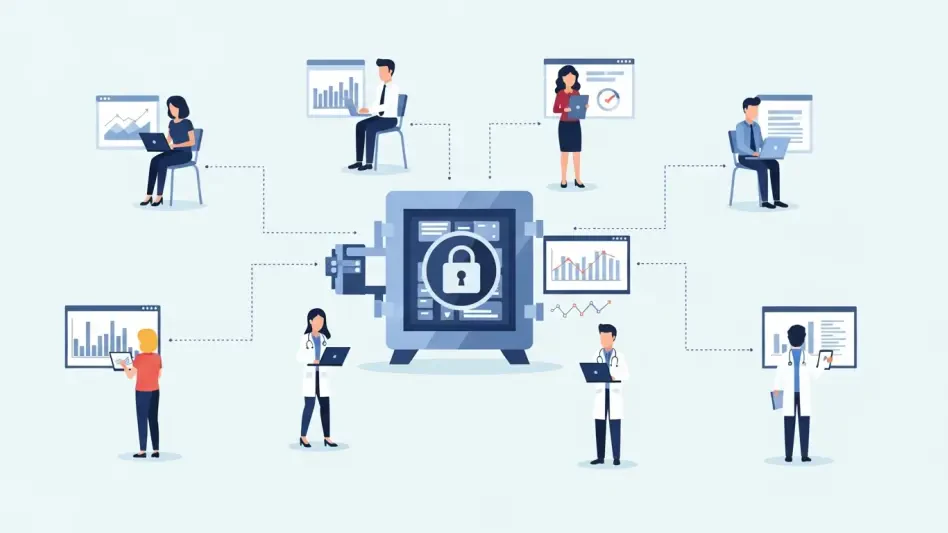
The transformed data is then housed within Mayo Clinic Platform Orchestrate, a secure “clean room” environment where a strict rule is enforced: the data never leaves. External partners, such as pharmaceutical and medtech companies, are granted access not to the data itself, but to a controlled “sandbox.” Within this digital workspace, they can run complex queries and train their algorithms on the de-identified dataset. However, they can neither view individual records nor extract any raw data. Every insight generated must pass through a rigorous vetting process to ensure it is aggregated and contains no patient-level information, creating a system that allows for powerful analysis while maintaining absolute control.
A Collaborative Blueprint for Global Privacy: The Federated Learning Model
Mayo Clinic has extended its privacy-first principles beyond its own walls through a federated learning framework, exemplified by the Mayo Clinic Platform Connect network. This model fundamentally inverts the traditional approach to data sharing. Instead of centralizing massive datasets from multiple institutions, which creates logistical and security challenges, the analytical query or AI model—the “question”—is securely sent to where the data resides. This approach is a real-world validation of keeping data secure at its source.
This collaborative blueprint is clearly illustrated by the partnership with institutions like Hospital Israelita Albert Einstein in Brazil. When a collaborative study is initiated, the analytical model travels to each partner’s secure data environment. The computation is performed locally, on the hospital’s own private data, and only the anonymous, aggregated results are returned to the central platform for consolidation. No raw patient data ever crosses institutional or national borders, and no partner, including Mayo Clinic, ever gains direct access to another’s patient information.
This decentralized framework offers a powerful solution to one of the biggest hurdles in global health research: data sovereignty. Different countries and regions have unique laws and regulations governing the use and transfer of patient data. The federated learning model elegantly sidesteps these complexities by ensuring that all data remains within its original jurisdiction, under the control of the originating institution. This enables seamless international collaboration, allowing researchers to draw insights from diverse global populations without compromising patient privacy or violating regulatory boundaries.
Unlocking Medical Innovation: A Practical Guide to the Orchestrate Platform’s Capabilities
The primary purpose of this sophisticated data infrastructure is to empower partners to accelerate medical discovery. Within the Orchestrate platform, researchers can run complex queries across vast, diverse patient populations to analyze disease progression, uncover common comorbidities, and compare the effectiveness of different treatments in specific subgroups. This ability to explore real-world evidence at scale provides insights that are often impossible to glean from traditional, narrowly focused clinical trials.
A particularly impactful application is the de-risking of clinical trials. The platform enables pharmaceutical companies to design and validate “synthetic trials” using the deep repository of historical patient data. Before committing millions of dollars and several years to a live study, researchers can test their hypotheses, refine their trial design, and confirm that a sufficient number of eligible patients actually exists for recruitment. This pre-validation step helps prevent costly trial failures caused by flawed assumptions or an inadequate patient pool, making the entire drug development process more efficient and targeted.
The platform functions as a fully integrated, end-to-end ecosystem for research and development. A hypothetical workflow for an inflammatory bowel disease (IBD) trial demonstrates its power. A partner could first use the de-identified data to identify a promising patient cohort. Working with a Mayo Clinic specialist, an official Institutional Review Board (IRB) process would be initiated to recruit consenting patients for the study. New biological samples collected from these patients could then be analyzed within Mayo’s infrastructure, with the resulting genomic or proteomic data linked back to the patients’ longitudinal records in a de-identified format. This newly enriched dataset would then become available in the secure sandbox, enabling the partner to discover new therapeutic targets in a streamlined and privacy-preserving manner.
The initiative by Mayo Clinic represented a significant step toward resolving one of the most pressing challenges in modern healthcare. By creating a system that treated patient privacy not as a barrier to innovation but as a foundational design principle, it established a new standard. This framework demonstrated that it was possible to provide researchers with high-utility, real-world data to drive medical breakthroughs while ensuring that the trust of patients remained securely at the center of the ecosystem.