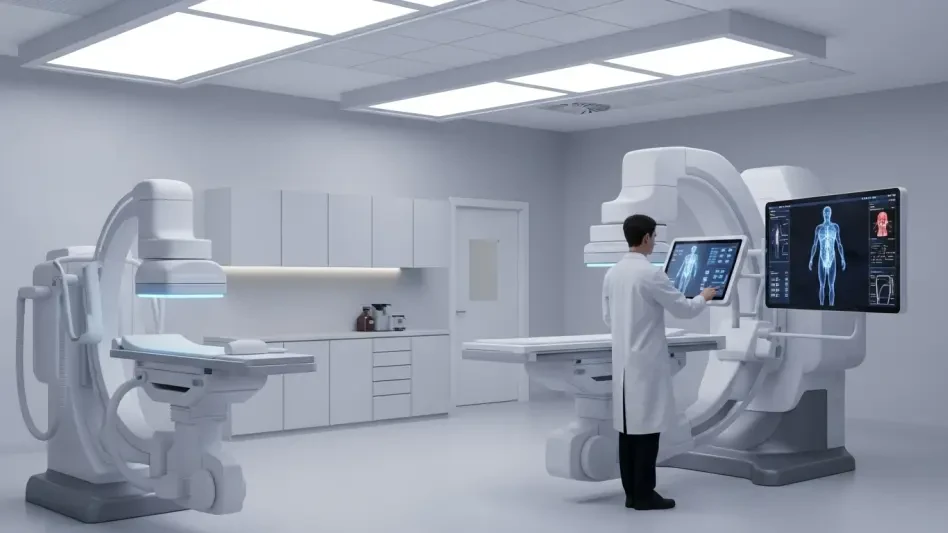

The fundamental priorities governing medical imaging are undergoing a significant re-evaluation, particularly within the specialized field of orthopedic and surgical fluoroscopy where real-time visualization is paramount. For years, the pursuit of the clearest possible image often overshadowed concerns about radiation exposure, but a pivotal shift in this paradigm is now well underway. Driven by a deeper understanding of the cumulative effects of radiation on both patients and clinical staff, healthcare providers are increasingly adopting a more balanced and safety-conscious approach. This evolution has spurred the development and adoption of advanced technologies that significantly reduce radiation dose without compromising the diagnostic clarity necessary for effective intraoperative guidance and treatment. As a result, low-dose imaging techniques are no longer a niche consideration but are rapidly becoming the new standard of care, fundamentally reshaping expectations for safety and efficacy in modern medical practice.
The Technological Shift Driving Modern Fluoroscopy
At the core of this transformation is a crucial technological departure from traditional imaging methods, specifically the move from continuous to pulsed fluoroscopy in modern mini C-arm systems. Conventional continuous fluoroscopy, a method common in older equipment, generates real-time images by producing a constant, uninterrupted X-ray beam. While this technique provides fluid visualization, its primary drawback is the inherently high cumulative radiation dose delivered over the course of a procedure. This risk is particularly pronounced during complex and lengthy surgical interventions or in clinical scenarios requiring repeated scans for guidance. Over time, this continuous exposure contributes to a significant radiation burden for both the patient on the operating table and the entire medical team in the room, making dose management a critical challenge that older technologies were ill-equipped to address effectively and consistently.
In stark contrast, pulsed fluoroscopy represents a monumental advancement in radiation safety and intelligent dose management. Instead of emitting a continuous X-ray stream, this modern approach delivers radiation in a series of short, distinct, and precisely controlled pulses at predefined intervals, effectively capturing snapshots to create a near-real-time video feed. This technique drastically lowers the total radiation output and, consequently, the cumulative dose delivered during any given procedure. The most critical aspect of this innovation is that this substantial reduction in exposure is achieved while maintaining sufficient temporal resolution and image clarity to support accurate and confident clinical decision-making. Pulsed fluoroscopy directly resolves the long-standing conflict between achieving high-quality imaging and ensuring patient and staff safety, making it an indispensable technology in dose-sensitive environments like orthopedic clinics, outpatient surgical centers, and especially in pediatric facilities where young patients are most vulnerable.
A Comprehensive Approach to System Evaluation
The process of selecting a contemporary mini C-arm has become a complex decision that extends far beyond evaluating a single feature. Healthcare institutions now recognize that a system’s true value is determined by the synergistic interplay of multiple technical and workflow-related factors. A holistic evaluation must consider how these elements function in concert to support daily operations and align with institutional safety protocols. Foundational considerations include the choice between pulsed and continuous fluoroscopy, the quality of the detector technology, and the system’s image processing speed, which impacts real-time guidance. Furthermore, the presence of specific dose control mechanisms, the physical footprint and mobility of the unit for use in constrained spaces, and its ability to integrate seamlessly with Picture Archiving and Communication Systems (PACS) and other hospital networks are all crucial for a modern, efficient, and safe clinical workflow.
This comprehensive evaluation underscores a major consensus in the field: there is no universal “best” mini C-arm solution. The optimal system is one that is meticulously aligned with the specific demands and priorities of its intended clinical environment. For instance, orthopedic and podiatric clinics often require consistently high-quality images for routine diagnostics and treatment planning, with a strong emphasis on minimizing patient exposure. In the dynamic setting of a surgical center or hospital, priorities shift toward ergonomic design for easy positioning around the sterile field and unwavering reliability during complex procedures. Emergency and trauma departments value portability and rapid deployment above all else to facilitate quick diagnostic imaging in critical situations. Meanwhile, for vulnerable pediatric populations, radiation dose reduction is the primary and often non-negotiable requirement, overriding nearly all other considerations in the decision-making process.
Enhancing Clinical Outcomes Through Workflow and Usability
Beyond the core imaging technology, the physical design and user interface of a mini C-arm system directly influence both operational efficiency and radiation safety in profound ways. Thoughtfully designed features that streamline clinical workflows can lead to significantly shorter procedure times and a reduced need for image retakes, which indirectly contributes to lower overall radiation doses by minimizing beam-on time. Key usability enhancements that foster this efficiency include intuitive touchscreen interfaces that reduce the learning curve for staff, hands-free control options that allow surgeons to manage imaging without breaking the sterile field, and smooth mechanical movement for quick and precise positioning. Compact and ergonomic designs further facilitate use in crowded operating rooms and reduce physical strain on personnel, while seamless digital integration ensures that image capture, storage, and sharing are handled efficiently, minimizing administrative delays and focusing time on patient care.
The widespread adoption of imaging platforms designed with radiation awareness at their core has provided significant and measurable long-term operational and strategic benefits. Healthcare organizations shifted their assessment criteria, evaluating equipment based on its overall clinical value rather than focusing narrowly on the initial acquisition cost. This value-based approach revealed that investing in low-dose mini C-arm technology led to enhanced occupational safety for surgeons and technicians, improved the quality and consistency of care by reducing the need for imaging retakes, and helped facilities more easily meet increasingly stringent radiation safety standards. This alignment with modern healthcare initiatives that prioritize patient and staff safety solidified these advanced systems not merely as an option, but as the new and expected standard of care in the field of orthopedic imaging.