
A single missed millimeter on a dental radiograph can be the difference between a simple filling and an invasive, costly root canal for a patient. In the high-pressure environment of modern clinical practice, where practitioners evaluate dozens of X-rays daily, the margin for human error remains a persistent challenge. Dental Artificial Intelligence (AI) has emerged not merely as a digital assistant, but as a fundamental shift in how oral pathology is identified, documented, and communicated. By leveraging advanced computer vision and machine learning, this technology transforms static grayscale images into dynamic diagnostic maps, effectively standardizing a field that has historically relied heavily on individual subjective interpretation.
The emergence of these tools marks a departure from traditional “wait and see” dentistry toward a more proactive, data-driven model. As dental service organizations (DSOs) expand and clinical workloads intensify, the need for a “second pair of eyes” has moved from a technological luxury to a professional necessity. This evolution is driven by the realization that consistency across multiple locations is nearly impossible to maintain through human oversight alone. Consequently, AI acts as a foundational layer of quality assurance that supports both the solo practitioner and the large-scale enterprise.
Introduction to Dental AI Technology
The core of modern dental AI is built upon sophisticated convolutional neural networks (CNNs) that have been trained on millions of labeled clinical images. These algorithms are designed to recognize the morphological signatures of decay, bone loss, and periapical lesions with a level of precision that matches or often exceeds that of experienced clinicians. Rather than replacing the dentist, the technology functions as a diagnostic filter, highlighting areas of concern that require closer inspection. This transition represents a significant leap in the broader medical landscape, where AI is increasingly used to reduce diagnostic fatigue.
The relevance of this technology extends beyond the clinical chair. It addresses a systemic issue in healthcare: the variability of diagnosis. Two dentists looking at the same X-ray may disagree on the depth of a cavity or the severity of periodontal disease. AI introduces an objective, calibrated benchmark that remains constant regardless of the time of day or the volume of patients. This objectivity is the cornerstone of its integration into the modern dental ecosystem, providing a reliable framework for both clinical excellence and ethical billing.
Core Components and Functional Capabilities
AI-Driven Radiologic Diagnostic Tools
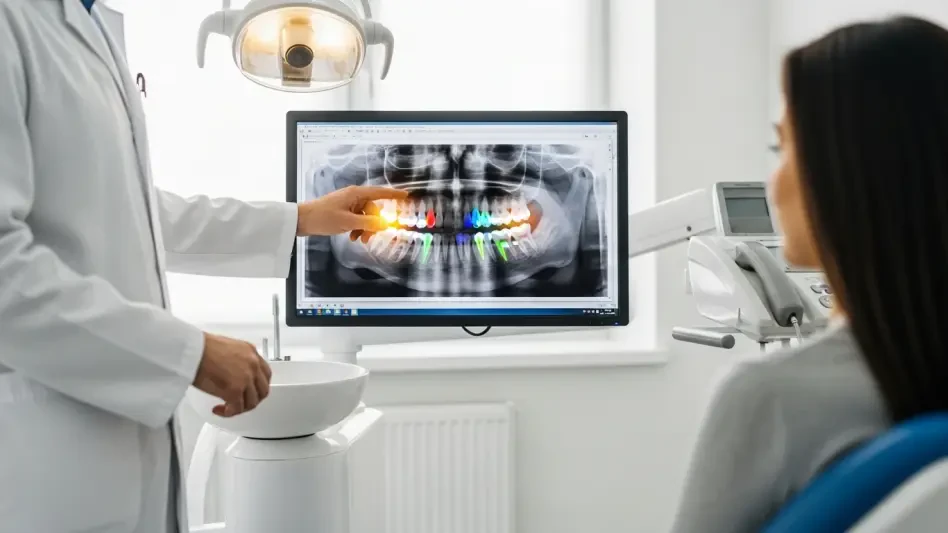
At the heart of the system lies a real-time detection engine capable of identifying a wide array of pathologies instantly. When a radiograph is uploaded, the AI scans for abnormalities such as interproximal caries, calculus, and discrepancies in crown margins. Its performance is measured not just by its sensitivity to disease, but by its ability to reduce false positives, which is critical for maintaining patient trust. By utilizing color-coded overlays, the software makes these findings visible to the human eye, translating complex anatomical data into an intuitive visual format.
The significance of these tools is most apparent during the patient consultation. For decades, dentists have struggled to explain “dark spots” on X-rays to skeptical patients. AI changes this dynamic by providing a clear, highlighted visualization that confirms the doctor’s findings. This transparency directly correlates with higher case acceptance rates, as patients feel more confident when they can clearly see the evidence supporting a proposed treatment plan.
Practice Management Software Integration
A standout feature of top-tier AI solutions, such as the Pearl platform, is the ability to write findings directly into existing practice management software (PMS). This technical synchronization is vital because it eliminates the “workflow friction” that often dooms new technology. Instead of forcing a clinician to toggle between different applications, the AI-generated data populates the patient’s digital chart automatically. This creates a seamless record where diagnostic insights, treatment plans, and insurance documentation are all aligned.
The real-world usage of this integration facilitates a high-level “always-on” monitoring system. For large dental groups, this means that clinical directors can review diagnostic trends across hundreds of offices from a single dashboard. This capability ensures that every office maintains the same standard of care, regardless of geographical location. It also simplifies the administrative burden of filing insurance claims, as the AI-supported evidence provides the clinical justification necessary to reduce claim denials.
Emerging Trends and Technological Innovations
The most recent shifts in the industry indicate a move toward predictive analytics. Beyond simply identifying current decay, newer iterations of AI are beginning to track the progression of disease over time by comparing historical radiographs with current ones. This longitudinal analysis allows dentists to identify “at-risk” areas before they require invasive intervention. Such innovations are shifting the industry’s focus from reactive repair to true preventive maintenance, which is a major trend in value-based healthcare.
Moreover, there is an increasing emphasis on multimodal AI, which combines radiologic data with other clinical inputs like periodontal probing depths and intraoral photos. This holistic approach provides a 360-degree view of patient health, allowing the AI to offer more nuanced recommendations. As consumer behavior shifts toward a preference for high-tech, transparent medical experiences, dental practices that fail to adopt these innovations risk falling behind a more technologically literate patient base.
Real-World Applications and Sector Deployment
The deployment of AI within organizations like DECA Dental Group serves as a primary example of how the technology is scaling. In these large-scale environments, AI is used to audit clinical performance and identify training needs for junior associates. By reviewing thousands of cases simultaneously, the system can pinpoint where diagnostic gaps exist and provide targeted feedback. This is a unique use case where the technology serves as a tool for professional development and continuous improvement within a corporate structure.
Outside of the massive dental service organizations, the technology is also finding a home in insurance adjudication and dental education. Insurance carriers are utilizing AI to automate the review of thousands of claims daily, speeding up the reimbursement process for both providers and patients. Meanwhile, dental schools are integrating AI into their curriculum to help students calibrate their diagnostic skills against an objective standard. These diverse applications demonstrate that AI is not just a tool for the clinic, but a structural upgrade for the entire dental sector.
Challenges and Implementation Obstacles
Despite its rapid growth, the technology faces significant hurdles, particularly regarding data privacy and regulatory compliance. Handling sensitive patient information requires robust encryption and adherence to strict healthcare laws. Furthermore, there is the technical challenge of hardware compatibility; not all older digital sensors produce the high-resolution images required for the AI to perform at its peak. These hurdles can make the initial setup daunting for smaller, legacy practices.
Another obstacle is the psychological barrier of “algorithmic bias” or over-reliance on the software. There is a risk that clinicians might become overly dependent on the AI, potentially dulling their own diagnostic instincts. Ongoing development efforts are focused on refining the user interface to ensure it remains a supportive tool rather than a replacement for human judgment. Educational initiatives are also crucial in teaching practitioners how to interpret AI findings critically while maintaining their professional autonomy.
Future Outlook and Industry Trajectory
Looking ahead, the integration of AI is expected to move deeper into the realm of automated treatment planning and personalized medicine. We are likely to see systems that can suggest specific restorative materials or surgical approaches based on a patient’s unique biological data and history. The potential for AI to bridge the gap between oral health and systemic health is also significant, as the technology may soon identify early markers of systemic conditions like osteoporosis or diabetes through routine dental imaging.
The long-term impact on society will likely be a reduction in the overall cost of dental care through earlier intervention and fewer missed diagnoses. As the technology becomes more ubiquitous, it will set a new global standard for what constitutes an “adequate” dental exam. The trajectory suggests that within a few years, performing a dental exam without AI assistance might be viewed with the same skepticism as performing one without X-rays today.
Conclusion and Final Assessment
The integration of artificial intelligence into dentistry has fundamentally altered the clinical landscape, moving the profession toward an era of unprecedented diagnostic precision. By bridging the gap between complex radiologic data and patient understanding, these tools have solved the long-standing challenge of diagnostic subjectivity. The transition from experimental pilots to full-scale organizational rollouts proved that AI is a viable, high-ROI asset that enhances clinical outcomes while streamlining the business operations of modern practices.
The successful implementation of these systems in the past several months established a blueprint for the future of the industry. Practitioners now have the means to provide a “technology-enabled” standard of care that protects both the patient and the provider through rigorous, objective documentation. As the sector moves forward, the focus should shift toward ensuring equitable access to these tools across smaller practices and developing standardized protocols for AI-human collaboration. Ultimately, this technology has matured into a reliable partner that ensures no clinical detail is left to chance.