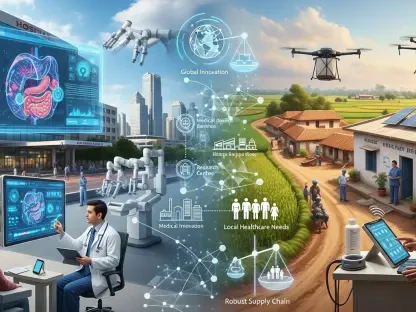

A tidal wave of patient demand, coupled with persistent workforce shortages, is pushing global health systems to a breaking point, forcing a critical examination of whether technology holds the key to their survival. The immense pressure to operate more efficiently while improving patient outcomes has created a fertile ground for innovation, positioning artificial intelligence not as a distant concept but as an immediate and necessary tool for transformation. As healthcare organizations grapple with these systemic challenges, the conversation is shifting from whether AI will be integrated into clinical workflows to how quickly and effectively it can be deployed to alleviate the strain.
The Modern Healthcare Dilemma: Overwhelmed Systems and the Promise of AI
The current healthcare landscape is defined by a paradox: while medical advancements continue to extend lifespans, the operational frameworks supporting care delivery are buckling under pressure. Escalating patient volumes and the complexity of modern medicine have stretched clinical staff thin, leading to burnout and administrative overload. This environment has made it increasingly difficult for providers to dedicate sufficient time to direct patient interaction, with a significant portion of their day consumed by documentation, data entry, and other bureaucratic tasks. This operational friction not only hampers efficiency but also poses a risk to the quality of care.
In response to this crisis, artificial intelligence has emerged as a powerful ally. Technologies such as machine learning and natural language processing are being applied to a range of clinical and administrative functions, from interpreting medical images to streamlining patient documentation. The core promise of AI in this context is not to replace human clinicians but to augment their capabilities. By automating repetitive tasks and providing rapid, data-driven insights, these tools aim to free up physicians, nurses, and administrators to focus on what they do best: providing compassionate, high-quality patient care.
Industry leaders and professional organizations alike see AI as a crucial enabler of a more sustainable healthcare model. The American Association of Nurse Practitioners, for example, anticipates that AI will assume a greater role in diagnostics, risk assessment, and administrative processes. However, they emphasize that clinicians must remain at the center of this transformation, guiding the ethical and responsible implementation of these technologies. The ultimate goal is to enhance the patient-provider relationship by making healthcare less about paperwork and more about people, thereby expanding access and improving system-wide efficiency.
AI’s Ascent: Market Momentum and Emerging Clinical Trends
Decoding Adoption: Where AI Is Making the Biggest Impact
The adoption of AI is not uniform across the healthcare sector; its impact is most pronounced where operational complexity is highest. In 2026, inpatient facilities like hospitals are projected to represent the largest end-user segment. These environments are characterized by intricate care pathways, high patient throughput, and immense documentation requirements, creating a compelling business case for AI-driven automation. By streamlining workflows in these high-pressure settings, AI solutions are demonstrating a clear return on investment.
When examining AI by function, diagnostics and results interpretation stand out as the dominant market segment. This trend is fueled by the exponential growth of clinical data, particularly from medical imaging and laboratory reports. AI algorithms can analyze this vast amount of information faster and often with greater accuracy than is humanly possible, helping to accelerate diagnosis and treatment planning. In terms of specialty, general and multi-specialty settings have captured the largest market share, underscoring the flexibility of end-to-end AI workflow solutions that can be adapted across diverse care areas, from primary care to specialized surgery.
The Bottom Line: Quantifying AI’s Explosive Growth in Healthcare
The financial trajectory for AI in clinical workflows signals a profound market shift. Projections indicate that the global market is on track to expand from approximately US$2.78 billion in 2025 to a staggering US$11.08 billion by 2030, reflecting a compound annual growth rate of 31.9%. This explosive growth is a direct result of the intersecting pressures of rising patient demand, significant workforce constraints, and the urgent need for greater operational efficiency within health systems worldwide.
Geographically, North America continues to lead the market, a position established in 2024 and maintained through 2026. This leadership is built on a foundation of mature IT infrastructure, the widespread adoption of electronic health records, and an early embrace of AI-driven clinical support tools. Furthermore, favorable economic conditions, including a systemic shift toward value-based care models and sustained investment in health technology, have created a fertile environment for innovation and adoption in the region.
Navigating the Headwinds: The Human and Technical Hurdles for AI
Despite the rapid adoption within healthcare operations, the integration of patient-facing AI tools is proceeding with far more caution. The bridge between technological capability and public trust is still under construction. A 2025 survey from Health Union revealed a significant gap, with only 18% of polled patients having used AI for health-related queries. This data suggests that while patients are beginning to experiment with AI as a preliminary research tool for symptoms or medications, they are not yet ready to accept it as a definitive source of medical guidance.
This patient hesitancy is rooted in valid concerns about accuracy, privacy, and the potential for technology to diminish the crucial human element in care. The fear that an algorithm could misinterpret symptoms or that sensitive health data could be compromised remains a major barrier. Consequently, health systems must navigate this complex landscape carefully, recognizing that the successful deployment of AI depends not only on its technical efficacy but also on its ability to earn the confidence of the very people it is designed to serve.
Balancing Innovation and Trust: The Ethical and Regulatory Gauntlet
The rapid advancement of AI in healthcare necessitates an equally rapid development of ethical and regulatory frameworks to govern its use. As algorithms become more involved in clinical decision-making, questions surrounding accountability, transparency, and data privacy become paramount. Ensuring compliance with regulations like the Health Insurance Portability and Accountability Act (HIPAA) is just the starting point. The deeper challenge lies in addressing the “black box” problem, where the inner workings of complex AI models are not easily understood, making it difficult to validate their conclusions or identify sources of error.
Moreover, the potential for algorithmic bias presents a significant ethical risk. If AI systems are trained on datasets that do not accurately represent the diversity of the patient population, they can perpetuate or even amplify existing health disparities. Building trust with both clinicians and patients requires a commitment to transparency and fairness. This involves developing clear guidelines for AI development, implementing rigorous validation processes, and establishing robust oversight mechanisms to ensure these powerful tools are used responsibly and equitably.
The Next Frontier: Envisioning a Future of AI-Augmented Care
Looking beyond the current applications in diagnostics and administrative efficiency, the next frontier for AI in healthcare promises even more transformative changes. The focus is shifting toward predictive analytics and hyper-personalized medicine. In the near future, AI systems will likely be used to forecast disease outbreaks with greater precision, allowing public health officials to intervene proactively. At the individual level, AI will enable the creation of highly customized treatment plans by analyzing a patient’s genetic makeup, lifestyle, and environmental factors in conjunction with vast clinical datasets.
This evolution points toward a future of AI-augmented care, where technology serves as an indispensable partner to human clinicians. AI-powered surgical robots will offer enhanced precision, intelligent monitoring systems will provide real-time patient insights, and virtual health assistants will deliver continuous support outside hospital walls. The overarching vision is a healthcare ecosystem where technology empowers providers, engages patients, and ultimately delivers more effective, personalized, and proactive care for all.
The Verdict: Is AI the Cure for Healthcare’s Inefficiency?
Ultimately, AI stands not as a singular cure for healthcare’s deep-seated inefficiencies but as a uniquely powerful catalyst for change. The technology itself provides the tools to streamline processes, accelerate diagnoses, and uncover insights hidden within massive datasets. However, its true value is unlocked only through thoughtful and strategic implementation. The journey toward an AI-integrated healthcare system is as much about managing human factors—such as building trust, fostering adoption, and redesigning workflows—as it is about deploying sophisticated algorithms.
The evidence suggests that AI holds the potential to fundamentally reshape care delivery for the better, making it more efficient, accessible, and personalized. Its success, however, is not guaranteed. It is contingent on a collective commitment from technologists, clinicians, regulators, and patients to navigate the complex ethical and practical challenges ahead. The final verdict is clear: while AI is not a panacea, it is an essential component of the prescription for a more sustainable and effective healthcare future.