
The heavy administrative burden placed on modern healthcare providers has reached a critical tipping point where physicians often spend twice as much time interacting with digital interfaces as they do with their patients. This systemic inefficiency has catalyzed the rise of the AI medical scribe, a sophisticated tool designed to reclaim the clinical narrative. By merging machine learning with high-fidelity acoustic processing, these systems function as invisible observers during consultations, translating spoken dialogue into professional medical documentation. This review evaluates how these tools have moved beyond simple transcription to become essential cognitive partners in the examination room.
The Evolution of Clinical Documentation: Introduction to AI Scribes
The transition from manual note-taking to automated solutions marks a definitive shift in the digital healthcare landscape. Initially, providers relied on physical scribes or post-visit dictation, both of which introduced significant delays and high operational costs. The current generation of AI scribes leverages a fusion of large language models and natural language processing to capture the nuances of a clinical encounter as it happens. This move toward ambient listening signifies a departure from the “point-and-click” era of medicine, prioritizing the natural flow of conversation over rigid data entry.
These tools are not merely software updates; they represent a fundamental modernization of the physician’s workflow. By removing the physical barrier of a computer screen, AI scribes allow for a return to a more traditional, eye-to-eye diagnostic process. This implementation is unique because it addresses the psychological aspect of healthcare, reducing the cognitive load on providers while ensuring that the digital record remains exhaustive and accurate without requiring constant manual intervention.
Core Technical Components and Functional Features
Natural Language Processing and Ambient Sensing
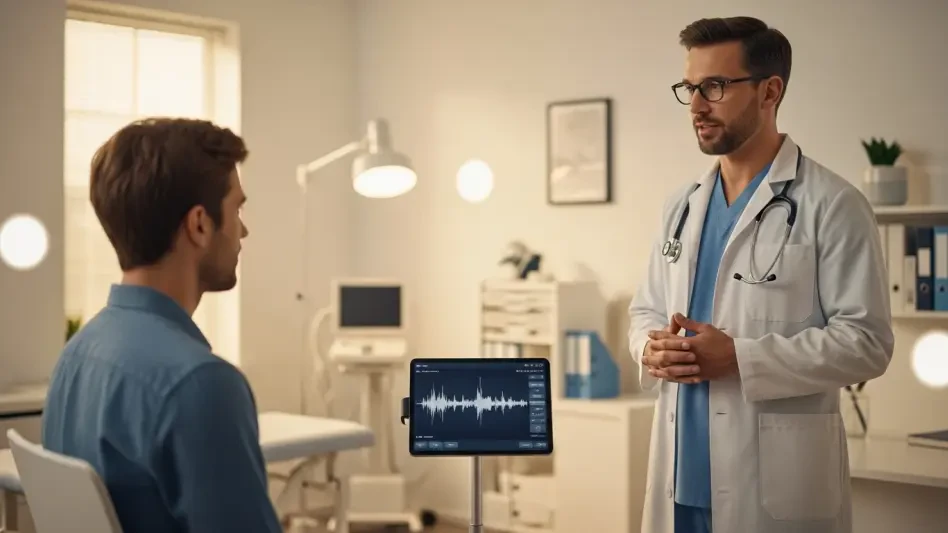
Advanced algorithms now allow these systems to distinguish between casual rapport-building and clinically relevant data with remarkable precision. Unlike standard voice-to-text applications, AI medical scribes utilize acoustic modeling that can filter out background noise, such as the hum of medical equipment or hallway activity. This ensures that the captured audio is high quality, which is vital for the underlying machine learning models to correctly interpret complex terminology and nuanced patient descriptions of symptoms.
Furthermore, ambient sensing technology operates in a non-intrusive manner, meaning the device does not require the doctor to speak directly into a microphone or use specific wake words. This allows the consultation to remain organic. The unique value of this technology lies in its ability to understand context; for instance, it can recognize that a patient’s mention of “a sharp pain” refers to a specific anatomical location discussed earlier in the session, effectively mapping the conversation into a logical medical history.
EHR Integration and Structured Data Conversion
The true utility of an AI scribe is measured by its ability to convert unstructured dialogue into the highly specific formats required by Electronic Health Records. This process involves more than just summarizing text; it requires the AI to categorize information into standardized sections like the “History of Present Illness” or “Physical Exam.” By automating this mapping, the technology ensures that data integrity is maintained while significantly reducing the time spent on after-hours charting, which has historically been a primary driver of professional fatigue.
Seamless integration is the differentiator between a helpful tool and a technical hindrance. Top-tier AI scribes provide real-time updates to the patient’s record, allowing the physician to review and sign off on notes almost immediately after the encounter ends. This high-precision conversion minimizes the risk of human error that often occurs when notes are written hours or days after the fact. Consequently, the clinical record becomes a more reliable reflection of the patient’s health status rather than a rushed summary of remembered events.
Current Trends and Innovations in Medical AI
The industry is currently moving toward real-time processing that offers immediate post-visit summaries. This shift is critical because it provides instant gratification and utility for both the provider and the patient. Moreover, there is an increasing focus on multimodal AI capable of interpreting non-verbal cues. While current systems focus primarily on audio, emerging versions are beginning to incorporate visual data to understand gestures or physical demonstrations of pain, providing a more holistic view of the patient’s condition during the diagnostic process.
Prioritizing the reduction of “clerical handcuffs” has become the central theme of 2026. This trend highlights a broader industry acknowledgment that medical software must serve the human elements of care rather than just acting as a database. By automating the most tedious aspects of the job, developers are creating a more sustainable environment. This innovation matters because it suggests a future where technology is evaluated not just by its processing speed, but by how much “human time” it can return to the user.
Real-World Applications and Benefits to Healthcare Delivery
Implementation across primary care and specialized fields has demonstrated that documentation time can be slashed by as much as 50%. In specialized medicine, where terminology is dense and coding is complex, the AI’s ability to recall specific guidelines ensures that the resulting notes are both clinically accurate and compliant with billing requirements. This efficiency translates into tangible financial benefits for practices, as providers can see more patients without increasing their total working hours or sacrificing the quality of individual care.
Beyond the metrics of time and money, the improvement in the patient-doctor relationship is the most significant qualitative benefit. Patients report feeling more heard when their doctor isn’t staring at a laptop, which fosters trust and improves adherence to treatment plans. This shift back to empathetic care is what makes AI scribes a transformative force rather than a simple utility. When the technology works well, it becomes invisible, allowing the focus to remain entirely on the clinical well-being of the individual.
Technical Hurdles and Regulatory Challenges
Despite the rapid progress, privacy concerns remain at the forefront of the discussion. Adherence to HIPAA and other data protection regulations is mandatory, requiring robust encryption and strict data-handling protocols. Patients must be assured that their most sensitive conversations are not being misused or exposed to unauthorized parties. This necessity for security can sometimes create friction in the user experience, particularly when implementing multi-factor authentication or local data processing to avoid cloud-based vulnerabilities.
Interoperability between diverse EHR infrastructures also presents a significant challenge. Because different hospitals use different software ecosystems, an AI scribe must be flexible enough to plug into various APIs without losing functionality. Furthermore, technical limitations regarding diverse accents and highly specific specialized medical terminology still exist. While the models are improving, there is still a risk of “hallucinations” or misinterpretations, which necessitates a final human review to ensure that no critical errors are introduced into the permanent medical record.
The Future Outlook for AI-Assisted Medicine
Breakthroughs in clinical reasoning are expected to redefine the role of the scribe in the coming years. Rather than just recording what happened, future systems may suggest diagnostic codes or flag potential drug interactions based on the conversation in real-time. This evolution toward a clinical decision support system will turn the scribe into an active participant in patient safety. The long-term impact on healthcare sustainability will likely be profound, as the reduction in administrative stress helps to stabilize the workforce and prevent the early retirement of skilled clinicians.
Predictions for the widespread adoption of “human-centric” AI suggest that these tools will soon be as common as stethoscopes in the exam room. As the technology matures, the focus will likely shift toward global accessibility, ensuring that even under-resourced clinics can benefit from the efficiency gains. This widespread integration will likely lead to a new standard of documentation where the medical record is no longer a chore for the doctor, but a high-fidelity, automatically generated asset that improves the entire trajectory of patient care.
Final Assessment of AI Medical Scribe Technology
The evaluation of AI medical scribe technology demonstrated a clear shift from experimental software to a vital operational asset. By effectively bridging the gap between high-volume data management and the need for empathetic, focused care, these tools proved they could significantly alleviate the administrative pressure on healthcare professionals. The analysis highlighted that while technical and regulatory hurdles remained, the operational efficiency and improvements to physician well-being were substantial enough to justify broad adoption across the industry.
The verdict on this technology was that it successfully served as a catalyst for a more sustainable healthcare model. Moving forward, the focus must shift toward refining the interoperability between these AI systems and the broader healthcare infrastructure to ensure that data flows seamlessly across all platforms. Healthcare organizations should prioritize the ethical implementation of these tools, ensuring that transparency and patient consent remain central to the process. Ultimately, the adoption of AI scribes was a necessary step in ensuring that the future of medicine remains focused on the patient rather than the paperwork.