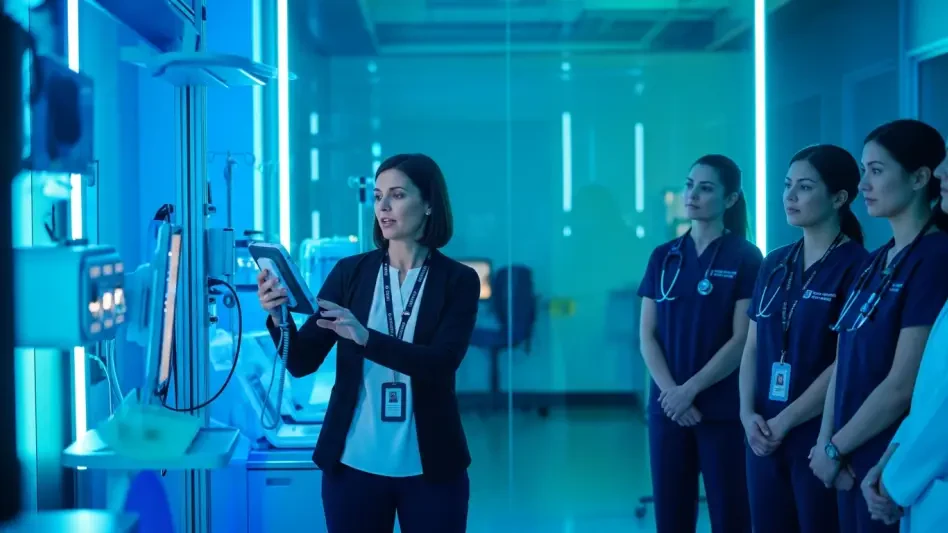

Walking through the halls of a premier metropolitan hospital today often reveals a startling contrast between gleaming, state-of-the-art virtual reality headsets and the exhausted, paper-cluttered desks of the nursing staff. Despite the astronomical sums invested in artificial intelligence and immersive simulation, many of these tools sit idle in storage rooms or serve as little more than expensive paperweights. This discrepancy highlights a fundamental disconnect between the acquisition of innovation and the reality of daily clinical workflows, where the pressure to deliver immediate patient care often outweighs the perceived benefits of learning a new interface.
The value of a sophisticated AI documentation tool or a high-fidelity VR simulation remains purely theoretical if a burnt-out clinician refuses to engage with it. For many frontline workers, new technology feels like an additional burden rather than a relief, especially when the implementation process fails to account for the physical and mental exhaustion of the staff. Transitioning beyond the “experimental pilot” phase requires more than just better software; it necessitates a systemic shift that integrates these tools into the very fabric of clinical life, ensuring they solve problems rather than creating new ones.
The High-Tech Paradox: Why Advanced Tools Stall in the Modern Clinic
The modern medical facility is often caught in a high-tech paradox where the presence of advanced machinery does not automatically equate to advanced care. While administrators prioritize the purchase of AI-driven diagnostics to improve accuracy, the actual utilization rates frequently plummet because the training provided is either too technical or too disconnected from the bedside experience. When a system is introduced without a clear path toward seamless integration, it creates a friction point that discourages even the most tech-savvy practitioners from moving away from their established, albeit slower, manual routines.
Moving toward a meaningful integration of these technologies requires a departure from the “set it and forget it” mentality that has plagued institutional upgrades for years. Success in this arena is measured not by the complexity of the algorithm but by the percentage of the workforce that feels empowered to use it effectively under pressure. Until the transition from purchase to proficiency is treated with the same urgency as the initial procurement, healthcare systems will continue to see a poor return on their digital investments, leaving clinicians stuck between the methods of the past and the unfulfilled promises of the future.
Understanding the Human Bottleneck in Digital Transformation
Healthcare’s historic conservatism is a double-edged sword, serving as a vital safeguard for patient safety while simultaneously acting as a formidable barrier to technological adoption. This innate skepticism toward rapid change is deeply rooted in a culture where “tried and true” methods are prioritized over unproven novelties. Consequently, when a facility attempts to overhaul its digital infrastructure, it encounters a psychological phenomenon known as the “Pain to Change.” This resistance is not a sign of laziness but a calculated response to the perceived risk of abandoning familiar practices for something that might disrupt a fragile equilibrium.
Analyzing this “Training Gap” reveals that the primary obstacle is rarely a technical deficiency in the software itself but rather a lack of workforce readiness. This mirrors the delayed trajectory of telehealth, which existed for years as a viable but underutilized modality until external pressures forced a reactionary adoption. Relying on crisis-driven innovation is a dangerous strategy that leaves staff feeling overwhelmed and undersupported. To avoid this cycle, organizations must recognize that digital transformation is a human-centric endeavor that requires addressing the emotional and mental hurdles inherent in learning entirely new ways of working.
The Architecture of Readiness: Identifying Barriers to Adoption
The cognitive load crisis remains one of the most significant yet overlooked barriers to the successful rollout of AI and VR in clinical settings. When understaffed teams are asked to master complex virtual reality environments or navigate AI-enhanced charting systems, they are being asked to exert mental energy that is already in short supply. Waiting for a “perfect time” to innovate is a recipe for permanent stagnation because the clinical environment is characterized by perpetual urgency. Instead, readiness must be built into the schedule, acknowledging that clinicians cannot be expected to learn during their few moments of downtime.
Furthermore, the failure of traditional change management often stems from treating training as a downstream task rather than a top-down strategic priority. To illustrate this, consider the analogy of a high-end GPS system; even the most accurate navigation technology fails if the driver does not know how to input a destination or interprets the directions incorrectly. Within a hospital, nurse educators serve as the central nervous system of this transition, acting as the bridge between technological potential and bedside practice. If these educators feel overwhelmed or lack the fluency to champion new modalities, the technology will inevitably face a “pause button” mentality that prevents it from ever reaching the patient.
Expert Perspectives on Strategic Implementation
Industry leaders increasingly argue that workforce enablement determines the ultimate return on investment far more than the underlying software code. Research into the socialization of technology suggests that the presence of “champions” within a unit—peers who are early adopters and enthusiasts—is the single most effective predictor of long-term success. These internal advocates help demystify AI and VR, translating complex benefits into relatable outcomes, such as reduced documentation time or improved procedural confidence. Without this human layer of support, technology remains an alien presence in the clinical environment.
Case studies involving VR simulations have demonstrated that providing low-risk practice environments is essential for building clinician confidence. In these controlled settings, nurses and doctors can fail, iterate, and succeed without the life-altering stakes of a real patient encounter. This immersive practice creates a level of muscle memory and psychological comfort that a standard user manual simply cannot provide. By investing in the human experience of learning, healthcare systems can ensure that when a clinician finally encounters the technology at the point of care, it feels like a familiar tool rather than a daunting obstacle.
Frameworks for Bridging the Gap: Moving from Purchase to Proficiency
Creating a protected space for learning is a non-negotiable requirement for any organization hoping to bridge the training gap. This involves budgeting not just for the technology itself, but for the dedicated educational hours required for staff to reach proficiency without increasing their burnout levels. When learning is treated as a core part of the job rather than an extracurricular activity, it sends a clear signal that the organization values the professional development of its workforce. This approach shifts the culture from one of “getting through the day” to one of continuous, high-reliability improvement.
Empowering the educator workforce also requires providing them with tools that translate the abstract advantages of AI into tangible bedside improvements. Practical steps include building tech-fluency programs specifically for training staff, allowing them to lead with confidence rather than hesitation. By moving from a reactive to a proactive adoption model, healthcare leaders can foster an environment where technology is viewed as an essential partner in care. This strategic foresight ensures that the workforce is not just reactive to the latest trends but is instead prepared to leverage innovation as a stable foundation for better patient outcomes and a more resilient clinical environment.
The transition toward a tech-enabled healthcare system required a fundamental shift in how organizations valued the human element of digital progress. Leaders eventually recognized that the most sophisticated algorithms were only as effective as the hands that operated them, leading to a renewed focus on comprehensive change management. By prioritizing nurse educators and carving out protected time for immersive training, hospitals began to see the true potential of their investments. This evolution proved that bridging the training gap was not a matter of technical upgrades, but of fostering a culture that placed the readiness of the clinician at the heart of every innovation strategy. Strategic planning transformed these once-dormant tools into vital components of a modern, efficient, and safer clinical reality.