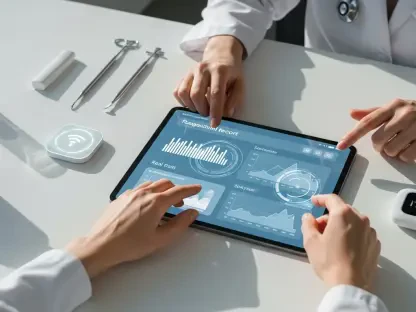

The once-distinct boundary between the clinical environment and the private home has become remarkably porous, fundamentally reshaping how individuals approach their personal health management. The integration of artificial intelligence and advanced digital technologies represents a significant advancement in the personal health sector. This review will explore the evolution of at-home wellness technology, its key features, performance metrics, and the impact it has had on transforming daily health routines. The purpose of this review is to provide a thorough understanding of the technology, its current capabilities, and its potential future development from a niche trend into a central pillar of modern healthcare.
The Dawn of the At-Home Wellness Hub
The foundational principle of modern at-home wellness technology is a radical shift in perspective—moving away from intermittent, reactive health management toward a continuous, proactive model centered within the home. This evolution is transforming residences into sophisticated “micro wellness hubs” where constant optimization and prevention are prioritized over late-stage treatment. This change is driven by a new paradigm of consumer empowerment, where individuals are no longer passive recipients of care but active participants in their own health journey.
This movement has given rise to a field best described as “Consumer Health Intelligence.” It is a domain where AI and a vast network of connected devices work in tandem to arm individuals with data-driven insights to optimize their wellbeing. A new generation of tools, including wearables, smart mirrors, and app-connected monitors, gathers continuous streams of personal data on metrics like sleep quality, activity levels, and heart rate variability. AI algorithms then process these complex datasets to identify subtle patterns that would be nearly impossible for a human to interpret, translating raw numbers into personalized and actionable recommendations.
Key Technologies and Dominant Categories
Advanced Skincare and Beauty Technology
One of the most visible frontiers for at-home wellness technology is the beauty and skincare industry, which has successfully democratized treatments once confined to professional dermatology clinics. Technologies like red light therapy, clinically studied for its benefits in supporting collagen production and improving skin appearance, have been effectively translated into user-friendly devices such as at-home masks. These tools empower consumers to integrate advanced skincare protocols into their daily routines, proactively managing skin firmness and enhancing visible texture.
This category extends beyond hardware to sophisticated software. AI-powered skin analysis applications, utilizing a smartphone’s camera, can now track dermatological changes over time with surprising accuracy. These apps assess factors like moisture levels, wrinkle depth, and pigmentation, subsequently recommending customized product regimens. While these consumer-grade devices are not substitutes for medical treatment, their performance and popularity demonstrate a clear and powerful trend toward self-directed, data-informed skincare.
Scientific Innovations in Oral Care
Oral hygiene is another domain undergoing a significant technological transformation, moving beyond the mechanics of cleaning to a scientific approach focused on the oral microbiome. The innovation here is twofold: advancements in hardware and a deeper understanding of molecular science. Smart toothbrushes, for instance, are now equipped with sensors that analyze brushing technique in real time, providing feedback on coverage, pressure, and duration to optimize effectiveness.
Concurrently, a new wave of science-backed formulations reflects a more nuanced understanding of oral health. Instead of simply relying on abrasive agents, modern dental products increasingly utilize molecular research to target plaque biofilm and enhance enamel protection at a microscopic level. This shift values clinical and research-driven foundations over traditional methods, reflecting a broader consumer demand for products that deliver measurable, scientifically validated outcomes.
Continuous Monitoring for Preventive Health
Perhaps the most impactful application of at-home wellness technology lies in its contribution to the global shift toward preventive care. Faced with the pressures of rising costs and aging populations, healthcare systems are increasingly focused on prevention over cure. Devices like smart blood pressure monitors, continuous glucose trackers, and digital thermometers now facilitate sophisticated remote patient monitoring, allowing individuals to manage chronic conditions and track vital signs from home.
The true performance enhancement comes from the integration of AI platforms that analyze the data streams from these devices. These systems can flag anomalies, identify concerning trends, and prompt early intervention before a condition becomes acute. This not inly reduces the burden on formal healthcare systems but also provides users with an unprecedented level of insight and control, making them active partners in their own preventive health strategy.
Current Trends and Industry Trajectory
The most recent developments in at-home wellness technology demonstrate a sophisticated understanding that hardware alone is not enough to drive lasting results. Consequently, platforms are increasingly integrating principles of behavioral science to foster long-term user adherence. AI-powered systems employ gamification, personalized reminders, and adaptive coaching to keep users engaged. These algorithms learn an individual’s motivational triggers and tailor prompts accordingly, creating a dynamic feedback loop that transforms health management from a chore into a rewarding habit.
Simultaneously, the lines between consumer wellness and formal healthcare systems are becoming increasingly blurred. The rise of telehealth and remote diagnostics has already built a bridge between the home and the clinic, and at-home technology now serves as a crucial data source for clinical decision-making. The industry’s trajectory points toward a future of complete convergence, where data from wellness apps and home devices seamlessly integrates with electronic health records, providing clinicians with a holistic, real-time view of a patient’s health status.
Real-World Applications and Use Cases
In practice, at-home wellness technology is enabling consumers to become the chief architects of their own health ecosystems. Users are creating unified wellness dashboards that aggregate and visualize data from a multitude of sources—integrating sleep data from a smart mattress, activity metrics from a wearable, and nutritional information from a food-logging app. This holistic view moves beyond siloed metrics to provide a comprehensive picture of how different lifestyle factors interact and influence overall wellbeing.
This integrated approach empowers individuals to take a more informed and proactive role in managing their health. For example, by correlating a poor night’s sleep with a stressful day or a particular meal, a user can make targeted adjustments to their routine. The technology facilitates a continuous cycle of measurement, analysis, and optimization, allowing for a level of personalized health management that was previously unattainable.
Challenges and Ethical Considerations
Despite its rapid advancement, the at-home wellness technology sector faces significant hurdles, with data privacy and security being the most critical. The collection of continuous, highly personal health data creates a trove of sensitive information that is an attractive target for malicious actors. Building and maintaining consumer trust, therefore, hinges on the implementation of robust security measures, end-to-end encryption, and transparent policies regarding data storage and usage.
Beyond the technical challenges, there are psychological and behavioral hurdles to overcome. While the technology provides the tools for change, fostering sustainable, long-term adherence remains a complex problem. The risk of data fatigue, where users become overwhelmed or desensitized by constant notifications and metrics, is a real concern. The industry must continue to refine its approach to ensure that technology serves as a motivator rather than a source of anxiety or disengagement.
Future Outlook and Next-Generation Innovations
Looking ahead, the trajectory of at-home wellness technology is pointed toward greater predictive power and deeper integration. The next generation of AI models is expected to move beyond identifying current patterns to anticipating future health risks by analyzing long-term lifestyle data. This could enable preemptive interventions, such as recommending dietary changes months before biomarkers indicate a pre-diabetic state or suggesting stress-reduction techniques when early signs of burnout are detected.
Furthermore, the vision for the future is a fully integrated and collaborative ecosystem of devices that communicate with one another to create a seamless, comprehensive picture of an individual’s health. In this model, a smart refrigerator might communicate with a fitness tracker to suggest post-workout meals, while environmental sensors adjust home lighting to align with a user’s circadian rhythm. This interconnected web of technology promises a future where health is not just monitored but intelligently and automatically optimized in real time.
Conclusion: A New Paradigm for Personal Health
The review of at-home wellness technology confirmed its evolution from a collection of niche gadgets into a cohesive and powerful ecosystem. The integration of AI with advanced sensors and data analytics established a new standard for personal health management, one defined by continuous monitoring, personalization, and a proactive focus on prevention. The technology successfully democratized access to sophisticated health insights and empowered consumers to take an unprecedented level of control over their wellbeing.
This movement has yielded significant benefits across the board. For consumers, it delivered a suite of tools that transformed abstract health goals into tangible, daily practices. For healthcare systems, it offered a viable path toward reducing the burden of chronic disease and shifting resources toward preventive care. The trajectory analyzed in this review demonstrated that at-home wellness technology was no longer an emerging trend but a foundational component of modern healthcare, fundamentally altering the relationship between individuals and their own health.