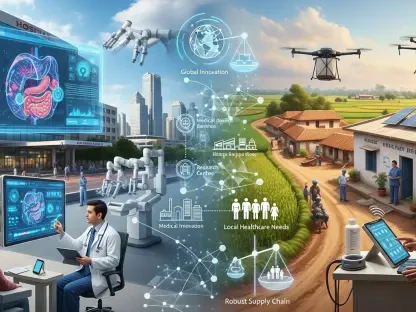

Are ERP systems that quietly reconcile invoices and payroll enough when a hospital ward fills overnight, a biologics shipment sits at a congested port, and a payer policy update threatens to choke cash flow before it shows up in the ledger? In the span of a week, a CFO can face staffing choices, liquidity strain, and audit exposure—yet the warning signs often arrive after the damage is done. The question is no longer whether ERP can record the truth; it is whether ERP can signal risk early enough to change it.
With $109.1 billion in U.S. private AI investment in 2024, expectations have shifted across boardrooms. Executives now ask for fewer dashboards and more lead time. “Are these records projecting next month’s risk or just reporting last month’s reality?” is the pointed question reframing ERP’s role. In one recent case, a hospital finance chief received an alert to add float and shift nursing coverage ahead of a regional flu spike—before claims data confirmed the surge.
Why this shift matters now
Healthcare providers face a tightening vise: chronic staff shortages, rising patient volumes, uneven reimbursement, and uncompromising audits. In this context, transactional systems that close the books and track materials help, but they do not give leaders the time to maneuver. AI changes the tempo by turning dense streams of claims, utilization, and cash data into early signals that link directly to budgets and schedules.
Life sciences organizations operate under different constraints but share the same need for foresight. Long R&D cycles, global regulatory scrutiny, expensive manufacturing, and intricate traceability turn small delays into costly setbacks. When inspections move, suppliers falter, or shipments slip, ERPs that can simulate alternatives and document chain-of-custody help teams keep trials on track and lots compliant.
The status quo has reached an inflection point as major vendors embed AI into core suites. This is not a feature race as much as a governance challenge. Gains of up to 40% in efficiency and implementation effort are plausible, but only when finance, operations, and compliance align. If those groups cannot validate, explain, and oversee models, the benefits tend to stall and audit risks grow.
How predictive ERP delivers value
Smarter forecasting and resource planning start with a simple reality: manual analysis cannot keep up with the pace and scale of claims, admissions, and cash movements. AI-enabled ERP models detect patterns in seasonal disease, payer behavior, and utilization, producing alerts that tie to staffing, budgets, and liquidity. The result is adaptive budgets, better shift alignment, and clearer cash visibility. Hospitals that rebalance schedules before flu season and drug makers that sync production budgets with expected approvals illustrate how foresight turns into dollars and hours saved.
Supply chain risk in healthcare and life sciences amplifies small disruptions into major consequences. AI extends ERP with continuous monitoring of suppliers, routes, temperatures, and geopolitical events, then runs scenario simulations to weigh cost, time, and quality. This supports faster rerouting, resilient sourcing, enhanced traceability, and easier regulatory reporting. During recent port congestion, one biologics team rerouted temperature-sensitive shipments while preserving an auditable chain-of-custody—a move that protected both product integrity and inspection readiness.
Records management is another hidden lever. Data volumes balloon while retention timelines stretch, and keeping everything “live” slows systems and inflates costs. AI-driven classification and policy enforcement move records to appropriate storage tiers, align retention with regulations, and keep high-access data close to operations. Tiered archiving of financial and clinical logs, with precise retention and on-demand retrieval, lowers infrastructure spend and speeds up the ERP without exposing the organization to compliance gaps.
Operating model alignment is where value is won or lost. Finance needs explainable forecasts and audit-ready documentation. Operations needs real-time interpretation of AI signals and the authority to act. Compliance needs validation, documented controls, and ongoing oversight to maintain regulator trust. When these roles agree on governance, predictive signals become coordinated action rather than noise.
Signals, research, and voices from the field
Market signals point in the same direction: embedded AI is becoming the default in ERP suites, lowering barriers and accelerating adoption. Executives summarize the demand crisply: “We don’t need more dashboards; we need fewer, earlier surprises.” That sentiment reflects a shift from retrospective reporting to anticipatory decision-making, where each insight must translate into a measurable lead-time advantage.
Research-aligned findings set realistic expectations. Organizations that embed AI into processes and govern it rigorously report efficiency and implementation effort improvements up to 40%. The common thread is validation and explainability—leaders can accept and scale AI recommendations when the rationale is reconstructable and aligned to audit standards. Conversely, opaque models often stall at pilot, particularly in regulated environments.
Practitioner anecdotes tell a practical story. A revenue cycle team cut manual variance analysis time by half by using AI-generated forecasts tied to payer behavior rather than relying on month-end retrospectives. A clinical manufacturing group used AI simulations to identify alternate suppliers that met both quality thresholds and lot genealogy requirements, reducing delay risks without compromising compliance. Risk leaders add a security lens: continuous monitoring, identity controls, vulnerability management, and protection against model theft or poisoning have become table stakes. Human readiness matters as well; phishing and social engineering training now extends to AI-augmented workflows.
A practical path to predictive ERP
A phased roadmap keeps ambitions grounded in outcomes. Phase 1 prioritizes high-value, high-feasibility uses—forecasting, supply risk, and archiving—and defines clear success metrics such as forecast accuracy deltas, decision lead time gained, and storage cost savings. Phase 2 stands up data pipelines, model baselines, and process pilots with human-in-the-loop checkpoints to test acceptance criteria and tune thresholds. Phase 3 scales through standardized operating procedures, retraining schedules, and cross-functional ownership that hardwires AI into daily rhythms.
Governance must be operational, not ornamental. Validation includes documented assumptions, datasets, test results, and drift monitoring aligned to audit needs. Traceability means reconstructable inputs, outputs, and rationale embedded in ERP logs so findings hold up under scrutiny. Oversight adds approval workflows for model changes and escalation paths when anomalies appear, ensuring the right eyes review the right events at the right time.
Security controls should map to ERP-AI realities. Access requires both role-based and attribute-based policies with least privilege for data and models. Monitoring brings continuous telemetry to detect exfiltration, tampering, or data poisoning. Resilience extends beyond backups to include key management and incident response plans that cover model rollback. For day-to-day decisions, a simple RACI clarifies ownership: finance holds forecast acceptance and audit trails; operations executes SLA-tied actions from alerts; compliance and IT risk own validation cadence and evidence packs; data and ML teams manage training datasets, drift detection, and versioning.
Momentum depends on metrics that leaders respect. Decision lead time gained, exception rate reduction, forecast accuracy improvement, audit cycle time, and storage savings maintain focus on value. Security adds mean time to detect and respond, privileged access violations, and model integrity incidents. When results are visible and attributable, confidence rises and adoption spreads.
In the end, the storyline was straightforward: AI made ERP predictive by offering earlier warnings, auditable reasoning, and secure operations, and the organizations that treated governance, alignment, and security as first principles were the ones that unlocked durable gains. The actionable next steps centered on selecting focused use cases, documenting validation from day one, embedding explainability into ERP logs, and rehearsing incident response that included model rollback. Those moves positioned teams to extend predictive capabilities into personalized care, flexible manufacturing, and resilient global supply networks without ceding trust or control.