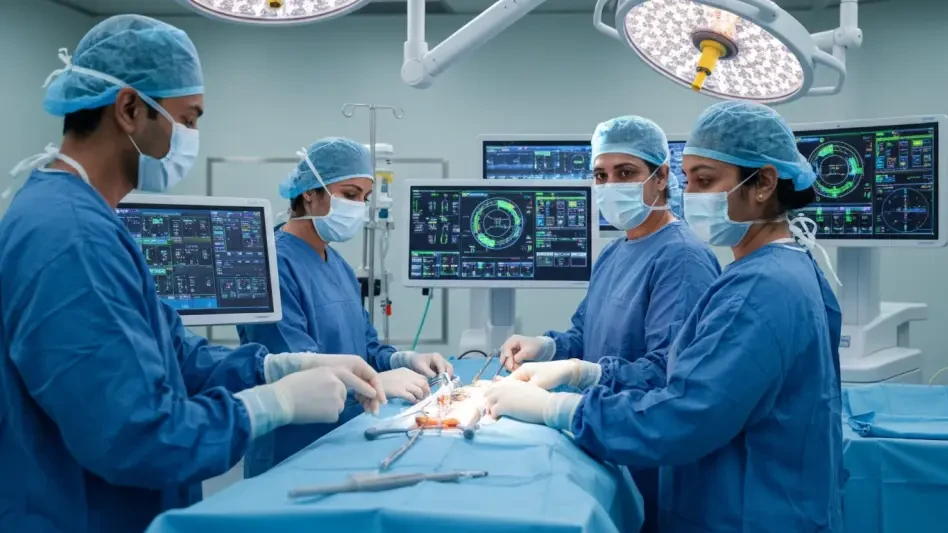

The intricate architecture of the human spine presents one of the most formidable challenges in modern surgery, where a millimeter of deviation can mean the difference between restored mobility and permanent paralysis. The integration of Artificial Intelligence into this high-stakes field represents a significant advancement, promising a future where surgical outcomes are more predictable, precise, and patient-centric. This review will explore the evolution of this technology, its key features, quantifiable performance metrics, and the impact it has had on surgical procedures and patient outcomes. The purpose is to provide a thorough understanding of the technology, its current capabilities, and its potential future development.
The Dawn of Intelligent Spine Surgery
The emergence of AI-assisted spinal surgery is a direct response to the inherent limitations of conventional methods, which have long been challenged by the complexities of spinal deformities. For an aging population increasingly affected by degenerative conditions like scoliosis, traditional surgery often relies heavily on the surgeon’s experience and intraoperative judgment, introducing a degree of variability and unpredictability. AI enters this landscape not as a replacement for surgical expertise but as a powerful augmenting tool, designed to bring a new level of data-driven objectivity to the operating room.
At its core, intelligent spine surgery integrates advanced computational power with medical practice. Key components like predictive analytics and robotics work in synergy to analyze patient-specific data and execute surgical plans with unparalleled accuracy. By processing vast amounts of information from medical imaging, the AI can model the spine’s unique geometry and predict how it will respond to surgical correction. This foundational shift allows for a more proactive and strategic approach, addressing the core difficulties of correcting complex curvatures and ensuring the stability of implants before the first incision is ever made.
The AI Surgical Toolkit Core Components and Functionality
Pre-Operative Planning and Predictive Modeling
A defining feature of this technological revolution is the extensive pre-operative planning phase, which effectively moves the most critical decision-making processes out of the high-pressure surgical environment. AI algorithms conduct an automated and exhaustive analysis of a patient’s imaging, such as X-rays and CT scans, to build a detailed digital model of the spine. This allows surgeons to visualize the deformity in three dimensions and understand the intricate relationships between vertebrae, nerves, and surrounding tissues with a clarity previously unattainable.
Building on this detailed analysis, predictive models simulate various surgical scenarios, offering a glimpse into the potential outcomes of different corrective strategies. Surgeons can virtually place screws, adjust rod curvatures, and assess the resulting spinal alignment, all within a digital environment. This process eliminates much of the guesswork inherent in traditional approaches. Furthermore, the system facilitates the design of patient-specific implants. For instance, corrective rods can be custom-bent based on the precise contours dictated by the surgical plan, ensuring a perfect fit that maximizes stability and minimizes stress on the patient’s anatomy.
Robotic-Assisted Execution and Intraoperative Guidance
Once the surgical plan is finalized and approved, the technology transitions from a planning tool to an active participant in the operating room. During the procedure, an AI-powered robotic arm serves as an extension of the surgeon’s hands, translating the digital blueprint into physical action. This system provides real-time intraoperative guidance, ensuring that every screw and implant is placed with sub-millimeter accuracy according to the pre-determined coordinates.
This robotic assistance is not autonomous; rather, it operates under the surgeon’s direct control, providing a layer of mechanical precision that is beyond the capability of the human hand alone. This synergy minimizes the risk of human error, particularly in delicate procedures where critical nerve structures are in close proximity. By ensuring that the execution perfectly matches the plan, the technology dramatically enhances the safety and reliability of the surgery, reducing the likelihood of complications such as nerve damage or implant malpositioning.
Evolving Practices and Surgical Paradigms
The adoption of AI in spinal surgery is catalyzing a fundamental paradigm shift, moving the field away from a practice based on reactive, intraoperative judgment toward one founded on proactive, data-driven strategy. Historically, surgeons relied on their tactile feel and accumulated experience to make critical adjustments during an operation. In contrast, AI-assisted procedures empower surgeons with a comprehensive, pre-validated plan, allowing them to approach the surgery with a higher degree of confidence and predictability.
This evolution redefines the surgeon’s role in the operating room. With the AI and robotic systems managing the meticulous tasks of implant placement and alignment, the surgeon can redirect their cognitive and technical expertise toward more nuanced clinical challenges. For example, a surgeon can focus on managing factors like poor bone quality in patients with osteoporosis, a condition that requires delicate handling and adjustments that an algorithm cannot yet fully address. This allows human skill to be applied where it is most valuable, complementing the precision of the machine.
Real-World Implementation and Patient Impact
The tangible benefits of this technology are powerfully demonstrated in clinical settings like Singapore’s Tan Tock Seng Hospital, where an AI-assisted spinal surgery program has been successfully implemented. Since its inception, the program has yielded remarkable, quantifiable improvements in patient outcomes. Post-operative hospital stays for patients undergoing these complex procedures have been reduced by as much as 50%, with average recovery times dropping from one to two weeks down to just three to six days. Moreover, the efficiency gained from pre-operative planning has shortened surgical durations by up to 20%, reducing patient time under anesthesia and associated risks.
The story of Madam Jenny Ee, a 74-year-old who suffered from debilitating degenerative scoliosis, provides a compelling human-centered perspective on the technology’s impact. Before her surgery, chronic pain had eroded her quality of life, making it nearly impossible to walk for more than a few minutes. Following an eight-hour, AI-assisted procedure, she experienced significant pain relief almost immediately. Her recovery was swift, and she has since returned to an active lifestyle that includes brisk walking and international travel, a testament to the life-restoring potential of this advanced surgical approach. Her case exemplifies how enhanced precision translates directly into faster recovery and a profound improvement in a patient’s daily life.
Navigating the Challenges and Financial Realities
Despite its clear clinical advantages, the widespread adoption of AI-assisted spinal surgery faces notable challenges, primarily centered on its financial implications. The sophisticated software, robotic systems, and custom-made implants contribute to a higher overall cost. Patients opting for this technology may face a pre-subsidy bill that is 5% to 10% higher than that for a conventional procedure. The main driver of this increase is often the customized hardware; for example, precisely contoured rods manufactured abroad can be 50% more expensive than their traditional counterparts.
However, the value proposition appears to outweigh the increased investment for many patients and healthcare systems. The significant reduction in complication rates, the near-elimination of revision surgeries, and shorter hospital stays can offset some of the initial costs over the long term. More importantly, patient acceptance has been strong. When presented with the potential for a safer procedure, a faster recovery, and a more predictable outcome, individuals are often willing to accept the additional expense, viewing it as a worthwhile investment in their long-term health and quality of life.
The Future Trajectory of AI in Spinal Care
The current state of AI in spinal surgery is merely the beginning of a much larger trend. The future trajectory of this technology points toward even greater integration and sophistication. As larger and more diverse datasets are collected from procedures worldwide, the predictive accuracy of AI models will continue to improve, enabling surgeons to anticipate and mitigate potential complications with even greater certainty. This will likely lead to the expansion of AI assistance to a wider range of spinal procedures, from relatively common fusions to the most complex oncological reconstructions.
In the long term, this technology is poised to standardize surgical excellence, making the highest level of precision and safety accessible beyond a few specialized centers. It also holds immense potential as a training tool for the next generation of surgeons. By allowing trainees to engage with complex cases in a simulated environment, AI platforms can accelerate the learning curve and help instill a foundation of data-driven best practices. Ultimately, AI will become an indispensable partner in the operating room, continuously refining the art and science of spinal care.
A New Standard of Precision and Care
The integration of artificial intelligence into complex spinal surgery has proven to be a transformative development. The shift from experience-based, intraoperative decision-making to data-driven, pre-operative planning marked a new era of surgical practice. By leveraging predictive modeling and robotic assistance, this technology delivered a level of precision that was previously unattainable, which directly translated into a dramatic reduction in surgical complications and the need for revision procedures.
Ultimately, this innovation established a new standard of care. The quantifiable improvements in patient outcomes, including significantly shorter recovery times and enhanced safety profiles, demonstrated its profound clinical value. The technology succeeded not by replacing the surgeon but by augmenting their skills, allowing for a synergistic partnership between human expertise and machine precision. This fusion of intelligence and technique has fundamentally elevated the quality and reliability of spinal care, offering patients a safer and more effective path back to a life of mobility and health.