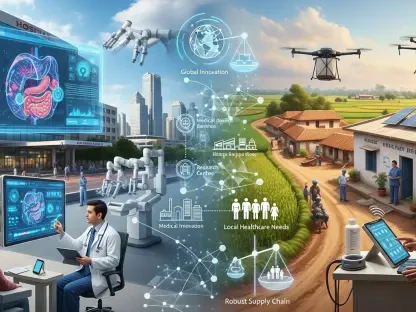

The traditional image of a crowded hospital waiting room is rapidly fading as sophisticated algorithms begin to function as the silent, digital central nervous system of modern urban medical networks. This shift marks a profound departure from the early days of digital health, where platforms acted merely as online directories or simple booking systems. Today, the industry has transitioned into a sophisticated era of Integrated AI Health Service Communities (HSC). These ecosystems represent a structural fusion of regional medical resources, ranging from primary clinics to tertiary hospitals, all synchronized by large-scale medical data modeling. Leading market players like WeDoctor and Cityblock have moved beyond the “Internet +” phase, establishing “AI +” environments that prioritize continuous health management over sporadic, reactive treatments.
By integrating digital health management with chronic disease intervention, these communities are effectively bridging the gap between clinical excellence and accessible care. The significance of this transition lies in its focus on value-based health management, where the success of a medical provider is no longer measured by the volume of patients seen but by the tangible improvement in a population’s overall health metrics. As regional medical resources become more integrated through cloud-based architectures, the emphasis has shifted toward proactive prevention. This systemic change is designed to alleviate the burden on overstretched public hospitals while ensuring that specialized care is available precisely when and where it is needed most.
The Rise of Value-Based Healthcare and the HSC Model
Emerging Trends in Intelligent Preventive Care
The current trajectory of the healthcare industry reveals a decisive move away from episodic care toward a model of continuous, life-long health monitoring. Central to this evolution is the “AI + Human” collaboration, where intelligent agents handle the heavy lifting of data analysis while human professionals provide the essential empathetic oversight. These AI agents are not just passive tools; they are evolving consumer behaviors by nudging individuals toward proactive health habits through real-time feedback and personalized interventions. This shift transforms the patient from a passive recipient of care into an active participant in their own wellness journey, fundamentally changing the dynamics of the doctor-patient relationship.
Moreover, the economic logic of this model is increasingly tied to “capitation payment” structures. In these arrangements, healthcare providers receive a fixed fee per person, creating a powerful financial incentive to keep patients healthy rather than profiting from their illnesses. Profitability in this new landscape is directly linked to medical cost savings and the successful prevention of complications. This alignment of financial interests with patient outcomes represents a radical departure from traditional fee-for-service models, fostering a sustainable environment where innovation is driven by the desire to achieve the highest possible standard of health for the lowest total expenditure.
Market Projections and the Economic Viability of AI Medicine
Economic data from the current year suggests that health management membership services are experiencing an unprecedented surge in revenue growth. As AI-enabled medical services mature, they are poised to become the primary revenue contributors for the digital health sector, often accounting for the vast majority of a firm’s valuation. The scalability of these city-level AI models is particularly noteworthy, as they demonstrate an ability to adapt to diverse geographic and demographic conditions. Whether in a high-density metropolis or a developing regional hub, the core logic of using AI to optimize resource allocation remains consistent and effective.
Forward-looking projections indicate that the integration of AI into the medical supply chain will soon be the standard rather than the exception. The rapid expansion of these services across various municipalities highlights a qualitative change in the market’s maturity. Investors and stakeholders are increasingly recognizing that the long-term viability of healthcare systems depends on their ability to process vast amounts of data to predict and prevent health crises. As these technologies scale, the cost of high-quality health management continues to drop, making premium medical oversight accessible to a much broader segment of the population than ever before.
Overcoming Structural Obstacles and Data Silos in Medicine
One of the most persistent hurdles in modern medicine has been the existence of “data islands,” where critical patient information remains trapped within the isolated systems of different clinics and hospitals. This fragmentation often leads to redundant testing, misdiagnoses, and a general waste of resources. To address this, current AI frameworks are designed to act as a unifying layer, breaking down these silos to create a singular, longitudinal view of a patient’s health history. By facilitating the seamless flow of information between primary care providers and specialized institutions, AI ensures that every stakeholder in the healthcare community is operating with the same set of facts.
Furthermore, the implementation of “intelligent controllers” is proving essential in combating the inefficiencies of the traditional fee-for-service system. These AI-driven tools are capable of monitoring insurance claims in real-time, identifying patterns of waste or potential fraud that would be impossible for human auditors to catch. Beyond mere surveillance, these systems ensure that medical interventions are evidence-based and necessary. In serious medical scenarios, the reliance on specialized clinical diagnosis data—rather than general-purpose AI models—ensures a level of accuracy that maintains public trust and protects patient safety in even the most complex clinical environments.
Navigating the Regulatory Landscape of AI Healthcare
The regulatory environment has shifted toward a more supportive stance, recognizing that “AI +” initiatives are vital for the sustainability of national medical insurance funds. Compliance is no longer seen as a hurdle but as a foundational element of the digital health ecosystem. AI systems are now being utilized to streamline medical insurance claims, significantly reducing the rates of rejection by ensuring that all submissions meet stringent regulatory standards before they are even processed. This high level of compliance benefits both the healthcare providers, who receive timely payments, and the insurers, who can operate with greater financial predictability.
Security remains a paramount concern, leading to the establishment of specialized data security ports and national filings for AI algorithms. These measures ensure that while data is shared to improve care, it is handled with the highest degree of confidentiality and integrity. Many cities have adopted specific policies that allow for a tailored approach to regulation, balancing the need for rapid technological innovation with the necessity of maintaining public safety. This localized regulatory flexibility has enabled different regions to experiment with various AI applications, from cloud pharmacies to integrated traditional medicine bases, while remaining within a robust national safety framework.
The Future Path of AI-Driven Health Communities
The transition from “disease-management” to “people-management” represents a holistic approach to the health of entire populations. In this paradigm, the goal is to manage the wellness of every individual within a community, regardless of their current health status. The emergence of the “AI General Hospital” serves as a central intelligence hub, coordinating a matrix of specialized agents—doctors, pharmacists, and health managers—to provide a 360-degree view of patient needs. This “4 + 1” agent matrix allows for a level of personalized care that was previously impossible to achieve at scale, ensuring that every citizen has access to a virtual health assistant.
Global economic trends and an aging demographic are further accelerating the demand for these cost-effective, value-based solutions. As the ratio of healthcare providers to patients becomes more strained, AI acts as a force multiplier, allowing a single health manager to oversee thousands of individuals with high precision. The integration of “Cloud Pharmacies” and traditional medicine into these digital communities further streamlines the patient experience, creating a one-stop-shop for health needs. This integrated approach ensures that the digital health ecosystem is not just a collection of apps, but a comprehensive infrastructure that supports every aspect of human longevity and wellness.
Advancing the Blueprint for Global Medical Reform
The implementation of the Health Service Community model resulted in a measurable “Two Increases and One Decrease” outcome, providing a clear blueprint for future medical reforms. By the time the data was analyzed, it was evident that core health indicators for chronic conditions had improved significantly across participating populations. Simultaneously, the capacity of primary care institutions grew as AI tools empowered local clinics to handle more complex cases, which previously would have been referred to overcrowded urban hospitals. Most importantly, the growth of medical insurance expenditures slowed, proving that proactive management is far more sustainable than reactive treatment.
AI served as a super bridge, effectively balancing the supply and demand of medical services across vast geographic areas. Stakeholders who invested early in AI infrastructure found that they could harmonize social welfare goals with commercial sustainability, creating a model where financial success was tied to public well-being. This synthesis of technology and human-centric care demonstrated that the challenges of resource scarcity and rising costs were not insurmountable. Ultimately, the industry moved toward a win-win scenario that provided governments with fiscal stability, hospitals with manageable workloads, and patients with a higher quality of life through continuous, intelligent support.