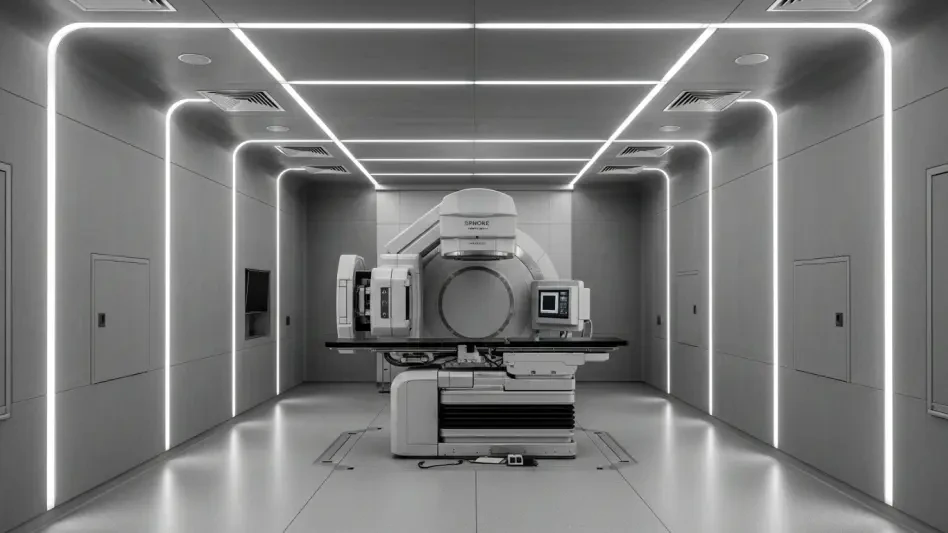

The quiet humming of a linear accelerator or the rapid click of a high-speed computed tomography scanner represents the pinnacle of modern diagnostic and therapeutic precision, yet these lifesaving technologies would be entirely unusable without the sophisticated engineering of the medical radiation shielding market. As healthcare systems globally transition toward more intensive imaging and complex particle-based therapies, the demand for containing ionizing radiation has shifted from a basic construction requirement to a high-stakes engineering discipline. This market represents the vital, though often invisible, barrier between advanced medical breakthroughs and the safety of the clinicians and patients who interact with them daily. By examining the current trajectory of this sector, one observes a profound evolution from simple lead-lined rooms to precision-calibrated environments that utilize advanced material science to neutralize high-energy particles and electromagnetic waves.
The essential role of shielding in modern healthcare cannot be overstated, as the proliferation of X-rays and gamma rays into every corner of clinical practice necessitates increasingly rigorous containment strategies. This analysis explores how the market is responding to heightened safety mandates and the push for technological leaps that are redefining the industry’s standards. It is no longer sufficient to provide a mere physical barrier; modern solutions must integrate seamlessly into the workflow of a high-traffic hospital while meeting environmental and structural criteria that were unimagined only a few decades ago. As we look at the current landscape, the industry stands at a crossroads where traditional methods meet the digital and ecological demands of the twenty-first century.
Historical Foundations and the Shift Toward Safety
The journey of radiation protection began shortly after the discovery of X-rays, with lead quickly becoming the undisputed gold standard due to its immense density and high atomic weight. For much of the twentieth century, the industry remained relatively static, focusing primarily on simple lead-lining for diagnostic rooms and dental clinics. However, the landscape shifted dramatically with the advent of high-energy oncology treatments and the widespread adoption of advanced imaging like CT and PET scans. These developments necessitated a move away from rudimentary shielding toward precision-engineered environments that can handle significantly higher energy loads without failure or degradation over time.
Understanding this evolution is crucial, as it explains why modern facilities no longer view shielding as an afterthought but as a fundamental component of architectural design and occupational health. In the past, radiation protection was often a last-minute addition to a building plan, leading to structural complications and unexpected costs. Today, the complexity of equipment such as proton therapy systems requires the shielding to be integrated into the very foundation of the building. This historical shift reflects a broader professionalization of the industry, where radiation physicists and specialized engineers play a leading role in the early stages of facility planning to ensure that safety is “baked in” rather than bolted on.
Furthermore, the transition has been accelerated by an increased public and professional awareness of the long-term biological effects of low-dose radiation exposure. As clinicians spend more time in interventional suites and diagnostic labs, the requirements for occupational safety have become more stringent. This has forced the market to innovate not just in the thickness of the walls, but in the quality of the materials used, ensuring that secondary radiation and scattering are minimized. The move toward higher safety standards has essentially turned the shielding market into a specialized branch of the medical technology sector, focused as much on the physics of particle attenuation as on the logistics of construction.
Navigating the Competitive and Material Landscape
The Transition from Lead to Eco-Friendly Composites
While lead has historically dominated the market, a significant shift toward “green” shielding is currently underway across the global healthcare landscape. Environmental concerns and the health risks associated with lead toxicity have spurred the development of lead-free alternatives that offer comparable protection without the ecological baggage. Modern composites—utilizing elements like bismuth, tungsten, and tin—are gaining significant traction because they provide equivalent attenuation levels at a lower weight and without the toxic footprint. This transition is not merely an environmental choice; it is a strategic response to the logistical challenges of disposing of hazardous materials and the need for lighter, more versatile shielding in mobile or modular medical units.
The adoption of these non-lead materials is also driven by the practical needs of modern hospital construction, where weight limits on upper floors often restrict the use of massive lead slabs. Composite materials can be molded into various shapes and integrated into textiles or flexible panels, providing a level of versatility that traditional lead simply cannot match. This flexibility allows for the creation of ergonomic protective gear for staff and more aesthetically pleasing diagnostic environments for patients. Consequently, the market is seeing a surge in research and development focused on optimizing these polymer-metal composites to ensure they meet the rigorous testing standards of global health authorities.
The Surge in High-Energy Oncology Applications
The global rise in chronic diseases, particularly cancer, acts as a primary driver of market expansion and technical complexity. The installation of linear accelerators and the growing adoption of proton therapy have created a demand for high-density shielding that far exceeds the requirements of traditional X-ray rooms. Unlike standard diagnostic spaces, proton therapy vaults require massive concrete barriers, often several feet thick, and specialized neutron absorbers to manage the unique secondary radiation produced by particle acceleration. This segment of the market requires intense technical consulting and specialized engineering, shifting the industry focus from simple material supply to comprehensive, expert-led safety solutions.
As radiotherapy becomes more targeted and powerful, the margins for error in shielding design have narrowed significantly. Designers must account for the specific energy spectrum of the machines, the orientation of the primary beam, and the potential for leakage through structural joints. This has led to the rise of specialized firms that provide end-to-end services, from the initial physics calculations to the final pouring of high-density concrete. This high-energy niche is currently one of the most profitable and fastest-growing segments of the market, as the global backlog of cancer patients drives the construction of new treatment centers in both developed and emerging economies.
Regional Growth Dynamics and Regulatory Influence
Market activity is heavily influenced by regional healthcare investments and the strict regulatory frameworks that govern radiation safety. North America remains a dominant force due to its mature infrastructure and the rigorous safety protocols enforced by bodies such as the Nuclear Regulatory Commission. In this region, the focus is largely on retrofitting existing facilities with modern materials and upgrading diagnostic centers to accommodate the latest imaging technologies. The high cost of healthcare delivery in the United States and Canada also supports a market for premium, high-performance shielding products that prioritize longevity and minimal maintenance.
Conversely, the Asia-Pacific region is emerging as the fastest-growing market in the current global landscape. Rapid urbanization and massive government investments in healthcare across China and India are creating a surge in new hospital construction that requires immediate and large-scale shielding solutions. These regional differences highlight a global trend where the West focuses on specialized materials and precision retrofitting, while the East drives volume through massive infrastructure expansion. Moreover, as international safety standards become more harmonized, the demand for high-quality, certified shielding materials in developing nations is rising, creating significant opportunities for global manufacturers to expand their reach.
Innovations Shaping the Future of Radiation Protection
The future of the industry is being defined by modularity and digital integration, moving away from permanent, static structures toward more adaptable solutions. We are witnessing a move toward pre-fabricated shielding systems that allow for rapid installation and easy reconfiguration—a vital feature for multi-functional hospital spaces that must evolve with changing technology. These modular systems can be assembled on-site with minimal disruption to hospital operations, making them an attractive option for facilities that cannot afford long periods of downtime for construction.
Furthermore, the use of 3D modeling and digital simulation during the architectural phase is becoming standard practice, allowing designers to predict radiation leakage with pinpoint accuracy before a single brick is laid. This “digital twin” approach reduces material waste and ensures that every square inch of the facility is optimized for safety. Experts predict that the next frontier will involve “smart” shielding, including lightweight wearable materials for interventional radiologists and integrated sensors that provide real-time monitoring of radiation levels within clinical zones. Such innovations will not only improve safety but also provide valuable data for hospital administrators to optimize staff rotations and equipment usage.
Another area of intense development is the refinement of transparent shielding. Lead glass has long been a staple in diagnostic control rooms, but researchers are now working on advanced transparent polymers and ceramics that offer better clarity and higher impact resistance. These materials allow for better visual communication between the patient and the clinician, reducing patient anxiety during procedures like MRIs or PET scans. By improving the patient experience while maintaining absolute safety, the industry is aligning itself with the broader trend of patient-centered care, demonstrating that radiation protection does not have to be cold or clinical.
Strategic Takeaways for Industry Stakeholders
For healthcare providers and developers, the key to navigating this complex market lies in early-stage integration and long-term planning. Involving shielding experts during the initial design phase can significantly reduce long-term costs and ensure 100% compliance with evolving safety mandates. Businesses should prioritize “turnkey” solution providers who offer end-to-end services, from radiation physics consultation to final installation and certification. This holistic approach minimizes the risk of structural failures or regulatory hurdles that can delay the opening of a new facility.
Additionally, adopting non-lead, sustainable materials is no longer just an environmental trend but a best practice that aligns with the global movement toward “green hospitals.” By choosing eco-friendly composites, facilities can reduce their future liability, simplify the decommissioning of old rooms, and improve the overall air quality and safety for their staff. Investment in modular and “smart” technologies should also be a priority, as these solutions provide the flexibility needed to adapt to future medical breakthroughs without the need for expensive structural overhauls. Strategic alignment with reputable manufacturers who provide documented evidence of material performance is essential for maintaining high standards of care.
Furthermore, stakeholders must remain vigilant regarding the shifting regulatory landscape. As the understanding of radiation biology improves, it is likely that exposure limits will become even more stringent. Investing in shielding that exceeds current requirements—”future-proofing”—can save significant costs in the long run by avoiding the need for premature upgrades. Collaboration between architects, physicists, and medical staff is the most effective way to ensure that the shielding solutions of today are capable of meeting the demands of the next generation of medical technology.
Sustaining Safety in a High-Tech Medical Era
The global medical radiation shielding market underwent a profound transformation, proving itself as a dynamic and indispensable sector of modern healthcare infrastructure. The industry successfully transitioned from a reliance on traditional lead-based materials toward a more sophisticated ecosystem of eco-friendly composites and precision-engineered polymers. Stakeholders recognized that shielding was not merely a construction requirement but a critical safety protocol that enabled the safe deployment of high-energy diagnostics and therapeutics. This shift ensured that the benefits of advanced oncology and imaging technologies were delivered without compromising the health of the workforce or the integrity of the environment.
Innovation remained the cornerstone of progress, as the industry adopted 3D modeling and modular installation techniques to streamline the development of new clinical spaces. The rise of proton therapy and other high-energy treatments pushed the boundaries of material science, forcing a move toward specialized, high-density solutions that addressed unique neutron-shielding challenges. By prioritizing technical consulting and turnkey services, the market provided healthcare facilities with the tools necessary to navigate an increasingly complex regulatory landscape. These advancements reflected a universal commitment to safety, efficiency, and long-term sustainability in medical facility design.
Ultimately, the sector demonstrated that the future of radiation protection resided in the integration of smart technologies and sustainable practices. The focus moved toward wearable protection and real-time monitoring, providing a more comprehensive safety net for those on the front lines of medicine. As the industry looked ahead, the lessons learned from this era of rapid evolution provided a blueprint for future-proofing medical infrastructure. The market’s ability to balance performance with ecological responsibility ensured that it remained a permanent and evolving fixture of the global healthcare landscape, dedicated to the preservation of life through the mastery of containment.