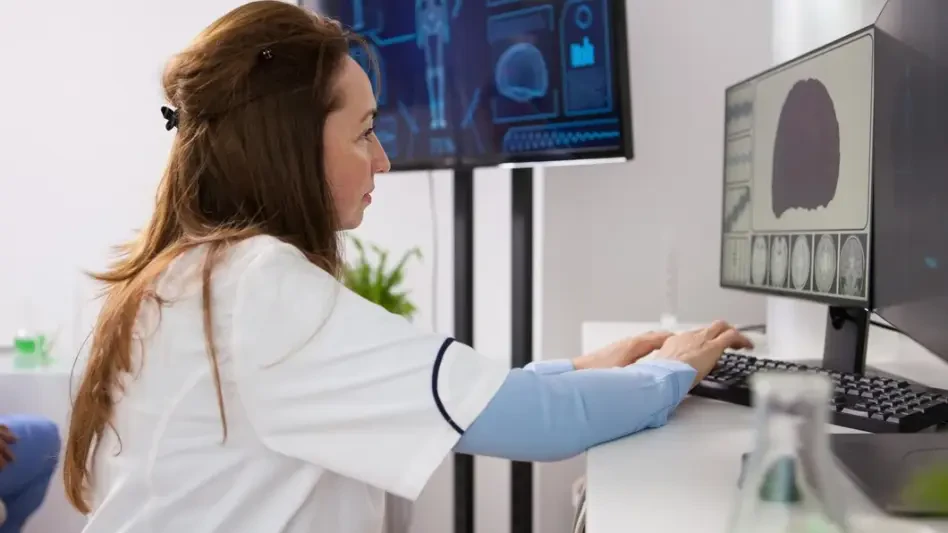

Diving into the world of healthcare technology, I had the privilege of speaking with Faisal Zain, a seasoned expert in medical technology with a deep background in manufacturing diagnostic and treatment devices. His insights into how innovation is shaped by clinical needs offer a fascinating glimpse into the future of medical imaging and workflow solutions. Our conversation explored the critical role of clinician feedback in enhancing visualization tools, the push for flexible workspaces in radiology, cost-effective manufacturing strategies, seamless integration with hospital systems, and the exciting prototypes on the horizon that promise to redefine diagnostics.
How has feedback from clinicians directly influenced advancements in image quality for surgical displays, and can you share a specific moment where their input led to a significant change?
Oh, clinician feedback has been absolutely pivotal in driving our advancements in image quality, especially for surgical displays. Surgeons are on the front lines, and they’ve been clear about needing sharper, more realistic visuals to make critical decisions in the operating room. I remember a particular instance when a group of surgeons approached us after using our HD displays, saying they struggled to distinguish subtle tissue variations during complex procedures. Their input pushed us to transition from HD to 4K and eventually to mini-LED technology, while also expanding our gamma and color ranges to mimic what the human eye sees inside the body. It was a game-changer—one of those surgeons later told us that during a delicate vascular surgery, the enhanced clarity helped them spot a tiny anomaly they might have missed before. Seeing their relief and renewed confidence in the technology was incredibly rewarding, and it reinforced why we prioritize those real-world insights.
What challenges did radiologists face with inconsistent systems that inspired the development of flexible, multi-system workstations, and how did your team address these issues?
Radiologists today are juggling a lot—many work across multiple hospitals, often with different picture archiving and communication systems, or PACS. This inconsistency created huge headaches; they’d have to switch between setups or deal with incompatible hardware, which slowed down their workflow and added stress. Our team tackled this by designing workstations that could handle multiple systems on a single diagnostic display, paired with lightweight laptops for mobility. We worked closely with radiologists to map out their pain points, iterating on prototypes to ensure the hardware was intuitive and portable for home or remote reading. I recall a radiologist who was splitting time between two facilities and constantly lugging heavy equipment. After switching to our solution, he shared how he could finally work from a coffee shop during a break, seamlessly reviewing scans for both hospitals—it was a small victory, but seeing his frustration turn into a smile stuck with me.
With claims of cost savings of 20–30% compared to competitors, how does manufacturing your own panels contribute to affordability for hospitals, and can you share an example of the budget impact?
Manufacturing our own panels is a cornerstone of keeping costs down, and it’s something we’ve invested heavily in to benefit hospitals. By controlling the production process, we eliminate middleman expenses and optimize materials and design for efficiency, which translates to savings of 20–30% for our clients compared to other options in the market. This is huge for large health systems that replace dozens of workstations on rotating schedules—every dollar counts. I remember working with a mid-sized hospital that was dreading a full imaging department overhaul due to budget constraints. After adopting our displays, their procurement team calculated savings that allowed them to allocate funds to other critical areas, like staff training. The relief in their voices during our follow-up call was palpable—it’s moments like that which remind us why cost efficiency matters just as much as innovation.
What motivated the decision to design IT-agnostic solutions for hospital integration, and can you walk us through how you ensure compatibility with diverse systems?
The push for IT-agnostic solutions came from seeing hospitals struggle with proprietary systems that locked them into rigid, often costly ecosystems. We wanted our technology to be a partner, not a barrier, so we committed to integrating with existing standards rather than forcing our own requirements. Our design process starts with extensive research into the diverse IT environments hospitals use—we map out common protocols and build flexibility into our software and hardware from the ground up. Then, we test relentlessly with real-world scenarios to ensure compatibility. I’ll never forget a rural hospital we worked with that had a patchwork of legacy systems and was on the brink of a failed integration with another vendor. When they switched to our displays, our plug-and-play approach had them up and running in days, not months. Hearing their IT manager say it felt like a weight lifted off their shoulders was incredibly validating for our team.
With prototypes like curved display monitors and 3D imaging tools in development, how do you prioritize which innovations to pursue, and can you share a behind-the-scenes story of one such project?
Our prototype development is heavily guided by radiologist feedback—they’re the ones telling us what they need to improve diagnostic precision. For instance, the idea for curved display monitors came from their desire for a more immersive viewing experience that reduces eye strain during long reading sessions. We prioritize innovations based on clinical impact, feasibility, and alignment with evolving patient care needs, often running focus groups with clinicians to rank potential projects. Take the 3D imaging tools we’re working on—early in the process, we had a radiologist test a rough prototype and describe how the depth perception felt like “holding the scan in their hands.” That visceral reaction pushed us to refine the tech, even though it meant months of tweaking algorithms and hardware. Seeing their excitement during testing, in a sterile lab with coffee cups strewn about, reminded us why we grind through the late nights—it’s about making their work feel more intuitive and impactful.
What is your forecast for the future of medical imaging technology in clinical workflows?
I’m incredibly optimistic about the future of medical imaging in clinical workflows, though it’s not without challenges. I believe we’ll see a rapid shift toward even more personalized, clinician-driven tools—think displays and systems that adapt in real-time to a surgeon’s or radiologist’s preferences. Integration will deepen, with AI and machine learning playing bigger roles in enhancing diagnostic precision, while maintaining human oversight. We’re also likely to see a surge in remote and hybrid setups, making lightweight, flexible tech non-negotiable. But the heart of it all will remain the same: listening to clinicians. If we keep that dialogue open, I foresee a landscape where technology doesn’t just support but truly transforms patient outcomes, making care faster, safer, and more accessible.