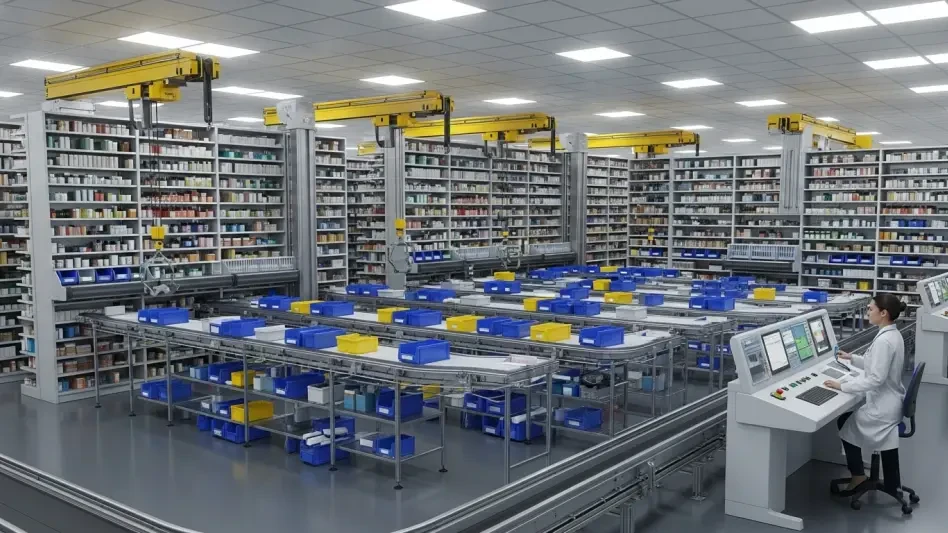

The familiar scene of a pharmacist manually counting pills is rapidly being replaced by the quiet, precise operations of robotic arms and intelligent software, heralding a profound transformation in medication management. This technological pivot is not merely about speed; it represents a fundamental rethinking of the pharmacy’s role within the healthcare ecosystem. As the demands for patient safety, operational efficiency, and complex medication administration intensify, automation is emerging as the central pillar upon which the future of pharmaceutical care will be built. The transition from a transaction-based dispensing model to a patient-focused clinical service hub is well underway, driven by systems that promise unprecedented accuracy and intelligence.
The New Pharmacy Blueprint: Automation at the Core of Medication Management
Redefining Roles: From Dispensing to Patient-Centric Care
The integration of automated systems is fundamentally reshaping the responsibilities of pharmacy professionals. By entrusting repetitive, high-volume tasks such as pill counting, packaging, and inventory management to machines, automation liberates pharmacists and technicians from the manual grind that has historically defined their workflow. This shift allows skilled human resources to be reallocated toward high-value, patient-facing activities that technology cannot replicate.
Consequently, the role of the modern pharmacist is evolving into that of a clinical expert and patient advocate. With more available time, they can focus on medication therapy management, patient counseling on adherence and side effects, and collaborative care with physicians. This elevation of professional practice not only improves patient outcomes but also enhances job satisfaction and positions the pharmacy as a critical hub for integrated healthcare services, moving beyond simple medication dispensing to holistic patient wellness.
The Technology Stack: Key Systems and Market Leaders
The technological foundation of the modern pharmacy is built upon a diverse stack of automated systems designed for specific functions. Key among these are automated dispensing cabinets (ADCs), which provide secure, decentralized medication access at the point of care, and large-scale automated storage and retrieval systems (ASRS) that manage vast central inventories with robotic precision. Additionally, automated packaging and labeling systems ensure patient-specific medications are prepared accurately, while tabletop counters offer smaller pharmacies a way to boost counting speed and accuracy.
This dynamic market is currently shaped by a handful of industry titans, including Omnicell, BD (Becton, Dickinson and Company), Baxter International, and McKesson Corporation. These companies are not only the primary providers of the hardware but also the innovators driving the software and integration solutions that make these systems effective. Their continued investment in research and development is pushing the boundaries of what is possible, making automation more accessible and powerful for a wider range of healthcare settings.
The Unstoppable Momentum of Automated Systems
Emerging Trends: The Push for Precision, Safety, and Intelligence
The most significant trend driving automation adoption is the relentless pursuit of enhanced patient safety. Manual dispensing processes are inherently vulnerable to human error, which can lead to adverse drug events. Automated systems directly confront this challenge by incorporating multiple verification steps, such as barcode scanning and photo verification, to ensure the right medication reaches the right patient at the right dose. This focus on precision is minimizing dispensing errors and reducing institutional liability.
Moreover, the industry is moving beyond simple mechanical automation toward a more intelligent, integrated framework. The incorporation of artificial intelligence (AI) and machine learning algorithms is enabling predictive analytics for inventory management, optimizing workflows, and even flagging potential medication conflicts. The seamless integration of these systems with Electronic Health Records (EHRs) creates a cohesive data ecosystem, providing a complete view of a patient’s medication journey and supporting better clinical decision-making.
By the Numbers: Market Growth, Projections, and Performance
The global pharmacy automation systems market is experiencing robust and sustained expansion, reflecting its growing indispensability in modern healthcare. Currently valued at approximately USD 6 to 7 billion, the market is on a steep upward trajectory, driven by the pressing needs for error reduction and greater workflow efficiency across both hospital and retail pharmacies.
Projections indicate this momentum will continue, with the market expected to swell to a value between USD 16 and 25 billion by the 2031-2034 timeframe. This expansion is supported by a strong compound annual growth rate (CAGR) anticipated to be between 8% and 10%. This growth is fueled by an increasing volume of prescriptions, particularly for complex specialty drugs, and a growing recognition of the significant return on investment that automation provides through labor optimization and error prevention.
Navigating the Hurdles on the Path to Automation
The Challenge of Integration: Bridging Technology and Workflow Gaps
Despite the clear benefits, the path to full automation is not without its obstacles, chief among them being the challenge of technological integration. Many healthcare facilities operate on a patchwork of legacy IT systems, and ensuring that new automation hardware and software can communicate seamlessly with existing EHRs and pharmacy management systems can be a complex and resource-intensive undertaking. A lack of interoperability can create data silos, undermining the goal of a streamlined, end-to-end medication management process.
Beyond the technical aspects, successfully implementing automation requires a comprehensive redesign of established workflows. Simply inserting a new piece of technology into an old process is unlikely to yield optimal results. Pharmacies must re-evaluate and re-engineer their entire operational model to fully leverage the capabilities of their new systems. This involves reassigning roles, retraining staff, and establishing new protocols, which demands careful planning and a deep understanding of both the technology and the clinical environment.
Addressing the Human Factor: Training, Costs, and Change Management
The financial barrier to entry remains a significant consideration for many institutions. Pharmacy automation systems represent a substantial capital investment, and the total cost of ownership—including installation, maintenance, and software licenses—must be carefully weighed against the projected return on investment. While the long-term savings from improved efficiency and error reduction are compelling, the upfront cost can be prohibitive for smaller hospitals or independent pharmacies.
Furthermore, the human element is a critical factor in any successful automation initiative. Effective change management is essential to overcome natural resistance from staff who may be apprehensive about new technologies or fear job displacement. Comprehensive training programs are required to ensure that employees are not only proficient in operating the new systems but also understand how their roles will evolve. Cultivating a culture that embraces technology as a tool for empowerment, rather than replacement, is key to a smooth and successful transition.
The Regulatory Framework: Compliance in an Automated Age
Patient Safety and Data Security: Meeting Critical Standards
In the highly regulated healthcare industry, automation systems must adhere to stringent standards governing patient safety and data security. Regulatory bodies require that these technologies demonstrate reliability and accuracy to prevent medication errors. This includes rigorous validation processes to ensure systems dispense the correct drug and dosage every time. Additionally, with the integration of patient data, these systems fall under the purview of data privacy laws like HIPAA, demanding robust cybersecurity measures to protect sensitive health information from breaches.
Manufacturers and healthcare providers share the responsibility for maintaining compliance. System developers must design their products with built-in safeguards, audit trails, and secure data protocols. Healthcare organizations, in turn, must implement these systems according to best practices, conduct regular maintenance and audits, and ensure their staff is trained on compliant usage. Navigating this complex regulatory landscape is essential for mitigating risk and maintaining patient trust.
The Impact of Policy on Technology Adoption and Innovation
Government policies and healthcare initiatives play a crucial role in shaping the adoption and innovation of pharmacy automation. Mandates focused on reducing medication errors and promoting patient safety can act as powerful catalysts, encouraging or even requiring healthcare facilities to invest in automated solutions. Similarly, value-based care models that reward providers for efficiency and positive patient outcomes create a strong financial incentive to adopt technologies that streamline workflows and improve care quality.
Conversely, an ambiguous or slow-moving regulatory environment can stifle innovation. If the approval process for new technologies is overly burdensome, it can discourage manufacturers from bringing novel solutions to market. Clear, forward-thinking policies that balance safety with the need for technological advancement are critical to fostering a vibrant and competitive market. As automation becomes more sophisticated, collaboration between regulators, innovators, and healthcare providers will be essential to ensure that the legal framework keeps pace with technological progress.
Gazing into the Future: The Next Wave of Pharmacy Innovation
The Rise of AI and Robotics in End-to-End Medication Management
The next frontier in pharmacy automation lies in the convergence of advanced robotics and artificial intelligence to create truly end-to-end solutions. Future systems will move beyond isolated tasks to manage the entire medication lifecycle, from inventory forecasting and ordering to prescription verification, compounding, dispensing, and final delivery to the patient’s bedside. AI will play a central role, optimizing every step of the process and providing predictive insights to prevent stockouts or identify high-risk patients.
This evolution will see the emergence of “dark pharmacies”—fully automated central-fill facilities that operate with minimal human intervention, preparing and shipping prescriptions with remarkable speed and accuracy. In the clinical setting, more sophisticated robots will handle complex tasks like sterile IV compounding, further reducing the risk of contamination and human error in high-stakes procedures. This hyper-automation will set a new standard for safety and efficiency in medication management.
Global Perspectives: Shifting Market Dynamics and Growth Hotspots
While North America currently leads the pharmacy automation market due to its advanced infrastructure and strong regulatory focus on safety, global dynamics are shifting. Europe is poised for significant growth, driven by its aging population and increasing healthcare expenditure. Countries with well-established national health systems are rapidly adopting automation to manage rising medication demands and control costs.
The most explosive growth, however, is projected for the Asia-Pacific region. Rapid economic development, substantial investments in healthcare infrastructure in countries like China and India, and a rising prevalence of chronic diseases are creating a massive demand for modern pharmacy solutions. As these emerging markets build out their healthcare systems, they have the opportunity to leapfrog older technologies and implement the latest in automated systems, making this region a key battleground for market leaders in the coming decade.
The Final Verdict: Strategic Imperatives for the Modern Pharmacy
Synthesizing the Revolution: Key Findings and Concluding Thoughts
The evidence gathered clearly indicates that pharmacy automation is no longer a futuristic concept but a present-day imperative. This technological revolution has successfully addressed core industry challenges, demonstrably reducing medication errors, optimizing labor, and streamlining complex workflows. The market’s robust growth trajectory, fueled by a clear return on investment and pressing clinical needs, confirms that automation is a foundational element of modern healthcare delivery. Its impact extends beyond mere efficiency, fundamentally elevating the role of the pharmacist to that of a clinical care provider.
The journey, however, has revealed critical dependencies. Successful implementation hinges not just on acquiring advanced technology, but on strategic integration with existing systems, comprehensive workflow redesign, and effective change management to empower the human workforce. The regulatory environment has also been shown to be a key influencer, capable of either accelerating adoption through safety mandates or hindering progress with bureaucratic inertia. The future promises an even deeper integration of intelligence and robotics, creating a new paradigm of precision and safety.
A Strategic Roadmap: Recommendations for a Smarter, Safer Future
To navigate this transformative landscape, healthcare organizations must adopt a forward-thinking, strategic approach. The first step is to conduct a thorough needs assessment to identify specific workflow bottlenecks and safety vulnerabilities that automation can address. Rather than pursuing technology for its own sake, the focus must be on selecting solutions that align with specific clinical and operational goals. This ensures that the significant capital investment delivers measurable value.
Furthermore, a successful automation strategy must be human-centric. It is crucial to invest heavily in staff training and development, preparing the workforce for new, more clinical roles. Creating a culture of continuous improvement and collaboration between technical, clinical, and administrative teams is essential for maximizing the benefits of these systems. Finally, healthcare leaders must stay engaged with policy developments and advocate for a regulatory framework that supports innovation while upholding the highest standards of patient safety, thereby paving the way for a smarter and safer future in medication management.