
The long-standing friction between high-quality patient care and the rigid complexity of digital record-keeping has reached a tipping point, leaving many clinicians feeling more like data entry clerks than medical experts. While the promise of the digital age was to streamline the healthcare experience, the reality often involves a labyrinth of menus and disconnected systems that contribute to widespread professional burnout. DarcyIQ, developed by Innovative Solutions, aims to dismantle this barrier by introducing a native generative AI layer directly into the heart of the most prevalent Electronic Health Record (EHR) systems. By transforming these static databases into conversational partners, the platform attempts to resolve the “administrative drowning” that has plagued the sector for over a decade.
This integration represents a strategic evolution in how healthcare professionals interact with patient data. Rather than functioning as an external tool that requires constant context-switching, DarcyIQ is designed to sit atop existing infrastructure, acting as an intelligent bridge between raw data and clinical action. The significance of this advancement lies in its ability to provide real-time, secure interactions within the native clinical environment. For a medical community exhausted by software transitions, the prospect of a tool that adapts to the human voice rather than forcing humans to adapt to a software interface is a compelling proposition.
The Emergence of Conversational Healthcare Interfaces
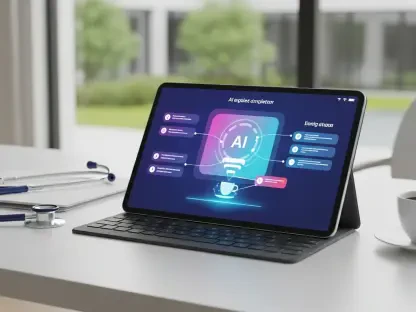
The rise of DarcyIQ marks a departure from the traditional “dashboard-heavy” approach to medical software. Historically, EHRs were built as archival tools focused on compliance and billing, which often prioritized data structure over user experience. DarcyIQ shifts this paradigm by applying Natural Language Processing (NLP) to these deep data pools. This allows a physician to query a patient’s entire history using plain English. Instead of clicking through five different screens to find a specific lab trend or a previous specialist’s note, the clinician can simply ask the system for the relevant summary.
This transition toward conversational interfaces is not merely a convenience; it is a direct response to the cognitive load issues inherent in modern medicine. When a system can understand intent and context, it reduces the mental energy required to navigate complex software. Innovative Solutions has positioned DarcyIQ as a revenue acceleration platform that uses this conversational layer to find missing information that typically leads to denied claims. By making the data accessible through dialogue, the technology ensures that both clinical insights and financial opportunities are surfaced without manual searching.
Technical Architecture and Core Capabilities
At the heart of this integration is the Model Context Protocol (MCP) server architecture, a sophisticated framework that allows the AI to “read” the EHR without compromising the underlying security. This architecture is vital because it solves the primary hurdle of generative AI in medicine: the need for absolute data privacy. The MCP server acts as a secure translator, ensuring that while the AI has enough context to be helpful, the sensitive patient information remains within the protected environment. This “grounding” of the AI prevents the common pitfall of “hallucinations” by tying every response directly to verified medical records.
The core capability of the system is its ability to perform clinical summarization in real-time. This involves scanning thousands of data points—from old encounter notes to recent vitals—and distilling them into a coherent narrative. This is fundamentally different from a standard search function; it is an interpretive process that identifies what is actually relevant to the current clinical context. Moreover, the integration is built to handle the immense scale of modern health systems, utilizing cloud compute power to ensure that queries are answered with near-zero latency, which is essential during a fast-paced patient visit.
Innovations in Revenue Cycle and Workflow Automation
The most significant innovation within DarcyIQ is the convergence of clinical documentation and the financial revenue cycle. In most traditional settings, these two worlds are siloed, leading to a gap where care provided is often not care billed correctly. DarcyIQ uses AI to bridge this divide by identifying revenue leakage at the point of care. If a clinician documents a procedure or a diagnosis that isn’t properly coded for reimbursement, the system can flag this discrepancy instantly. This proactive approach replaces the traditional, reactive method of auditing claims weeks after the patient has left the office.
Furthermore, the platform automates the tedious task of resolving underpaid claims. By analyzing the communication patterns between the EHR and insurance providers, the AI can pinpoint why a claim was rejected and suggest the specific documentation needed to fix it. This level of automation addresses the industry-wide trend of “platformization,” where AI is woven into the fabric of the daily workflow rather than being an elective add-on. For administrators, this means a significant reduction in the manual labor associated with the billing cycle, allowing staff to focus on more complex financial problem-solving.
Real-World Applications and Sector Deployment
The deployment strategies for DarcyIQ differ based on the specific needs of the ecosystem it inhabits. In large-scale enterprise environments utilizing Epic, the focus is often on managing high-level care coordination and population health. Large hospital systems use the integration to generate quality measure reports and track patient engagement through MyChart data. In this setting, the AI serves as a high-level analyst that can spot trends across thousands of patients, helping administrators manage outreach programs and proactively address appointment adherence issues before they impact the bottom line.
In contrast, the implementation within the athenahealth ecosystem is tailored for the high-volume environment of ambulatory care and private practices. Here, efficiency is the primary metric. The system is used to automate the creation of referral letters and encounter summaries, tasks that usually eat up hours of a physician’s evening. By flagging coding errors in real-time, the technology helps smaller clinics maintain financial sustainability in an era of tightening margins. This specialized deployment demonstrates the platform’s versatility in addressing both the macro-level needs of hospitals and the micro-level tasks of independent doctors.
Challenges, Regulatory Hurdles, and Market Obstacles
Despite the clear technical advantages, the integration faces significant headwind, particularly regarding user trust and regulatory compliance. Even the most advanced AI can suffer from “change fatigue” among clinical staff who have been burned by previous technological promises. There is an inherent skepticism toward any tool that claims to summarize patient data, as the cost of an error in healthcare is exceptionally high. Ensuring that the AI’s output is always accurate and verifiable is a constant technical challenge that requires ongoing refinement of the grounding mechanisms.
On the regulatory front, the landscape is shifting. Maintaining HIPAA compliance while utilizing generative models requires a level of oversight that is far more stringent than in other industries. There is also the challenge of data fragmentation; while Epic and athenahealth represent a huge portion of the market, the healthcare industry remains notoriously siloed. Achieving a truly seamless experience across different cloud environments and varied EHR versions requires a level of technical maintenance that could slow the pace of deployment for some institutions.
Final Assessment of DarcyIQ Integration
The integration of DarcyIQ into the primary workflows of the healthcare industry was a necessary pivot away from the fragmented software models of the past. The data showed a 55% reduction in administrative documentation time and a 40% improvement in the speed of billing resolutions, which provided a clear quantitative justification for the technology. By successfully embedding generative AI into the EHR, the platform moved beyond the role of a simple utility and began to function as an interpretive layer that prioritized the clinician’s time and the institution’s financial health.
Moving forward, the focus should shift toward predictive capabilities, where the system anticipates clinical needs before a query is even made. Healthcare organizations should begin by identifying their most significant documentation bottlenecks and deploying these conversational tools in a phased approach to build staff confidence. As cloud-native AI continues to mature, the goal will be to reach a state of “invisible technology,” where the software works silently in the background, allowing the medical community to return its full attention to the patient. The successful merger of intelligence and infrastructure has set a standard that will likely define the next decade of medical technology development.