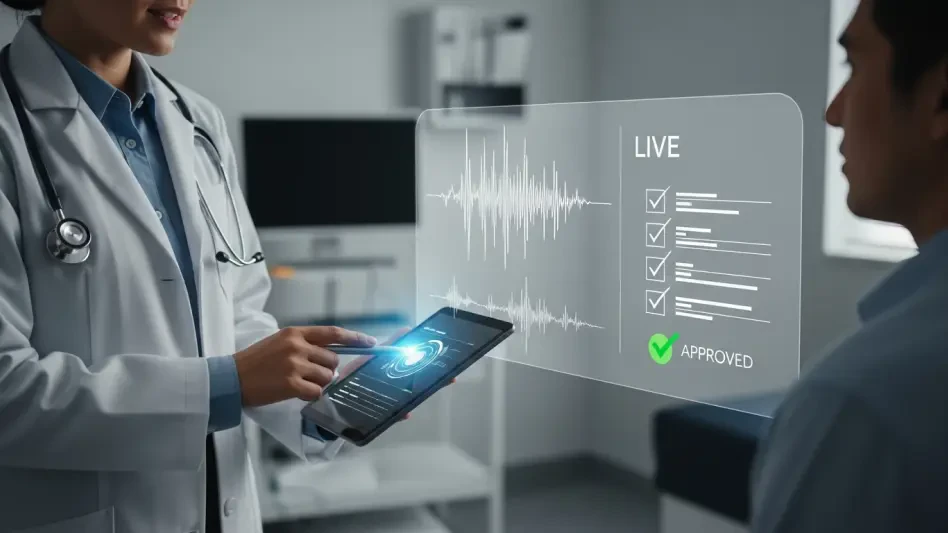

The seemingly endless cycle of faxes, phone calls, and administrative paperwork that defines prior authorization has long been a source of frustration for healthcare providers, but a new wave of artificial intelligence is poised to dismantle this archaic process from within the clinical encounter itself. For decades, this utilization management step has functioned as a necessary but cumbersome checkpoint, creating significant delays between a physician’s recommendation and a patient’s access to care. Now, the convergence of conversational AI and real-time data exchange promises to transform this post-visit burden into a seamless, in-visit activity, raising the critical question of whether technology can finally deliver on the promise of instantaneous approval.
The Administrative Bottleneck: Understanding Today’s Prior Authorization Landscape
Prior authorization acts as a critical cost-control measure for payers, but it imposes a substantial administrative load on the entire healthcare system. For providers, it translates into hours of non-clinical work, diverting resources from patient care and contributing to professional burnout. Patients, in turn, often face prolonged and anxious waits for necessary treatments, tests, and medications, which can lead to adverse health outcomes. This friction highlights a fundamental disconnect between clinical decision-making and administrative approval, a gap that current workflows have struggled to bridge efficiently.
The complexity of this process is magnified by the fragmented health information ecosystem. Data must traverse a complicated network connecting providers’ Electronic Health Record (EHR) systems, payer databases, and intermediary information networks like Availity. Each player operates with distinct systems and data requirements, creating interoperability challenges. Without a standardized, real-time communication channel, the exchange of clinical evidence required for an authorization decision remains clunky and inefficient.
Consequently, the prevailing workflows are still heavily reliant on manual processes that are relics of a pre-digital era. Clinician staff spend an inordinate amount of time on the phone with insurance representatives, filling out unique forms for different payers, and sending clinical notes via fax. These manual- and fax-heavy operations are not only slow but also prone to human error, often resulting in submission mistakes, lost documentation, and the need for rework, further extending the timeline for approvals and fueling frustration for all involved.
The Convergence of AI and Healthcare: Catalysts for Change
Shifting from Reactive to Real-Time: The In-Visit Revolution
A fundamental shift is underway, driven by the ambition to embed administrative functions directly into the clinical workflow. This “in-visit revolution” aims to move tasks like prior authorization from a reactive, post-encounter chore to a proactive, real-time event. By addressing documentation and authorization requirements during the patient visit, healthcare organizations can prevent downstream delays and ensure that care plans are approved and actionable before the patient even leaves the clinic.
This trend is exemplified by the collaboration between Abridge, a conversational AI platform, and Availity, a leading health information network. Their partnership aims to synthesize Abridge’s ability to capture and structure clinical conversations with Availity’s FHIR-native Intelligent Utilization Management technology. As a clinician speaks with a patient, the AI can identify the need for a procedure requiring pre-approval and surface the specific clinical documentation payers require, all in real time.
At the core of this innovation are conversational intelligence and contextual reasoning engines. These AI systems listen to the natural dialogue between a doctor and patient, interpreting clinical intent and comparing the generated notes against payer policy rules delivered via Availity’s APIs. This allows the technology to spot and flag documentation gaps during the encounter, prompting the clinician to add necessary details on the spot. The goal is to submit a complete, compliant authorization request immediately, potentially receiving a payer determination moments later.
Quantifying the Shift: Market Projections for Intelligent Automation
The move toward intelligent automation is supported by significant market momentum. Projections indicate robust growth in the AI markets for medical documentation and revenue cycle management, with industry investment flowing toward solutions that promise to reduce administrative waste and improve operational efficiency. This financial backing signals strong confidence that AI can deliver a tangible return by automating tasks that currently consume immense human capital.
Adoption rates for modern, interoperable solutions are also poised for a sharp increase. The industry is moving decisively toward FHIR-native utilization management platforms that enable the seamless, secure data exchange necessary for real-time approvals. As federal mandates continue to push for electronic prior authorization and greater interoperability, healthcare systems are increasingly replacing outdated systems with these more agile, API-driven technologies.
This evolving market has attracted a host of formidable competitors, creating a dynamic and innovative landscape. Beyond the Abridge and Availity partnership, established giants and agile startups are vying for dominance. Microsoft’s Nuance, with its DAX Copilot, is a major player in ambient clinical documentation, while companies like Commure are also developing platforms to streamline clinical and administrative workflows. This competition is accelerating the pace of innovation, benefiting providers and patients alike.
Overcoming Implementation Hurdles: Challenges on the Path to Instant Approval
Despite the promise of AI, significant technological complexities stand in the way of widespread adoption. The healthcare industry is notorious for its disparate and often antiquated IT infrastructure. Integrating a sophisticated AI platform with dozens of different EHRs and a multitude of payer systems—many of which lack modern API capabilities—presents a formidable integration challenge. Achieving seamless data flow across this fragmented landscape is a prerequisite for success.
Beyond the technical hurdles, clinician adoption remains a critical challenge. Physicians are already contending with technology-related burnout from cumbersome EHRs, and the introduction of another tool, no matter how promising, can be met with resistance. For these AI solutions to be effective, they must be unobtrusive, intuitive, and demonstrate immediate value by simplifying, not complicating, the clinical workflow. Failure to achieve a user-friendly experience will doom even the most powerful technology.
Furthermore, the risks associated with AI accuracy and potential bias cannot be ignored. An AI system that misinterprets a clinical conversation or overlooks a key detail could lead to an incorrect submission and a wrongful denial of care. There is also a risk that algorithms trained on historical data could perpetuate existing biases in care delivery. Consequently, robust systems for quality assurance, human oversight, and continuous algorithm monitoring are essential to ensure these tools are safe, equitable, and effective.
The Regulatory Tightrope: Balancing Innovation with Compliance
The foundation for this new era of real-time data exchange is the FHIR (Fast Healthcare Interoperability Resources) standard. FHIR provides a common language and a set of modern, API-based rules for exchanging healthcare information electronically. Its adoption is critical for enabling AI platforms to securely and reliably pull payer requirements and push clinical documentation to the right systems at the right time. Without this foundational standard, the goal of system-wide interoperability remains out of reach.
The use of conversational AI in the exam room also introduces heightened concerns around patient data privacy. These systems capture and process some of the most sensitive personal health information, making strict adherence to HIPAA and other privacy regulations non-negotiable. Technology vendors and healthcare organizations must implement robust encryption, access controls, and data governance policies to protect patient confidentiality and maintain trust.
Finally, these intelligent systems must be designed for agility. Payer rules for utilization management are not static; they evolve constantly based on new clinical evidence, drug formularies, and internal policies. At the same time, federal mandates are increasingly shaping the requirements for electronic prior authorization. AI-driven platforms must therefore be capable of rapidly ingesting and adapting to these changing rules to ensure their recommendations remain compliant and accurate over time.
Envisioning Tomorrow’s Clinic: The Future of AI-Powered Healthcare
The long-term impact of integrating administrative functions into the clinical encounter extends far beyond efficiency gains. For patients, it promises to drastically reduce the frustrating delays that create barriers to care. Receiving an approval for a needed MRI or specialty medication during the initial visit transforms the care journey from one of uncertainty to one of clear, actionable next steps. This immediacy enhances patient satisfaction and can lead to better health outcomes.
The potential applications for this technology also extend well beyond prior authorization. The same conversational AI that identifies documentation needs for a payer can simultaneously check for gaps in care, flag opportunities for preventive screenings, and abstract data for quality reporting programs. This transforms the patient encounter into a comprehensive opportunity to address clinical, administrative, and population health needs concurrently.
Ultimately, this trend points toward a future with a fully integrated healthcare ecosystem. In this vision, the act of a clinician documenting a patient visit triggers a cascade of automated background processes. The AI-powered system generates the clinical note, suggests the appropriate billing codes, submits the claim, and secures any necessary authorizations—all seamlessly and instantaneously. This would free clinicians to focus entirely on what matters most: the patient in front of them.
Final Verdict: The Promise and Practicality of Instant Authorization
Artificial intelligence is not merely accelerating the old, broken prior authorization process; it is fundamentally reshaping it. By shifting the administrative burden from a post-visit, reactive task to an in-visit, proactive one, these technologies are dissolving the traditional barrier between clinical and administrative worlds. The process becomes a natural extension of the clinical conversation rather than a separate, time-consuming ordeal.
While achieving true, 100% “instant” authorization for every service and every patient remains an ongoing aspiration, the progress is undeniable. The convergence of conversational AI, robust interoperability standards like FHIR, and real-time payer data is making near-instant decisions a practical reality in a growing number of cases. The pursuit of this goal is driving meaningful innovation that reduces friction across the healthcare system.
For healthcare leaders, the path forward involves a strategic evaluation of these emerging technologies. It is crucial to prioritize solutions that integrate deeply with existing EHR workflows, adhere to industry-wide data standards, and offer transparent models for ensuring accuracy and mitigating bias. By investing in platforms that deliver a clear return through reduced administrative costs and improved patient access, organizations can begin to build the clinic of tomorrow, today.