
With a deep background in the manufacturing of medical devices for diagnostics and treatment, Faisal Zain has a unique vantage point on the technological revolution reshaping healthcare. His work driving innovation puts him at the forefront of one of the most significant shifts in modern medicine: the integration of artificial intelligence into daily clinical practice. Today, we sit down with him to demystify the rise of the “AI-first” clinic in diabetes management.
Our conversation explores the practical realities of a future that’s already arriving. We’ll discuss how AI assistants are transforming the structure of a patient visit, freeing clinicians from data overload to focus on human connection. We will also examine the critical need for human oversight when algorithms and clinical judgment diverge, the ethical imperative to eliminate bias from these powerful tools, and the art of communicating these changes to patients to build trust. Finally, we’ll look ahead at the collaborative future of diabetes care, where technology and human expertise merge to create a more proactive and personalized standard of care.
Imagine a clinic where, before the clinician enters the room, an AI has already summarized CGM data and flagged risks. How does this pre-visit analysis change the dynamic of the patient consultation, and what practical steps are needed to integrate this workflow effectively?
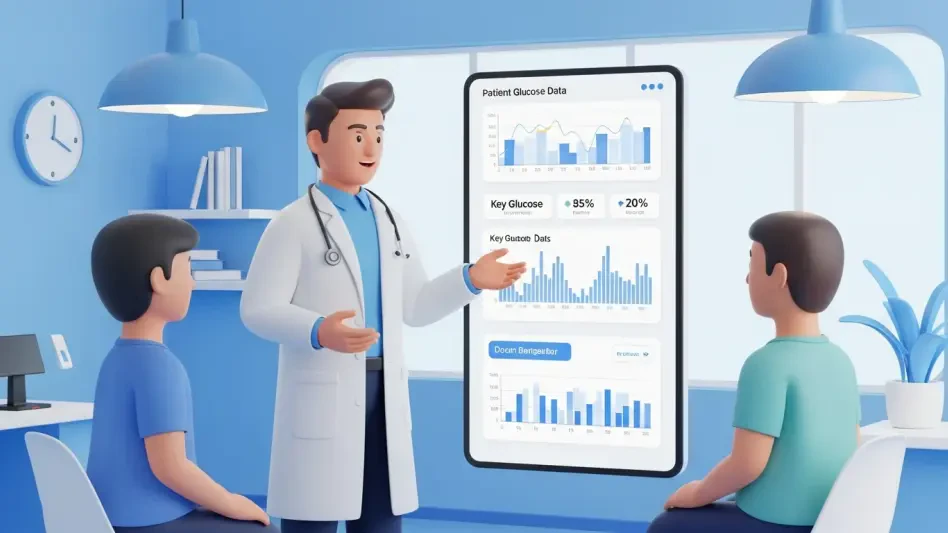
It completely transforms the consultation from a data-gathering session into a strategic conversation. In a traditional visit, a significant portion of the precious face-to-face time is spent just sifting through CGM downloads, trying to spot trends. With this pre-visit analysis, the clinician walks in already armed with a concise narrative summary of the patient’s recent glycemic patterns, including time in range, variability, and any nocturnal events. The dynamic shifts immediately. Instead of asking “What happened?”, the clinician can ask “Why did this happen?” and focus on shared decision-making and education. To make this work, the first practical step is ensuring data interoperability; the AI needs seamless access to data from CGMs, pumps, and the EHR. The second is establishing a protocol for robust clinical oversight, so every clinician knows how to quickly verify the AI-generated summary and use it as a launchpad, not a crutch.
AI promises to increase efficiency by rapidly processing glucose data and standardizing its interpretation. Can you share a real-world example of how this boosts a clinic’s capacity? What key metrics should a practice track to measure the impact on clinician burnout and patient care?
Absolutely. Think of a busy endocrinology practice. Without AI, each clinician might spend 10-15 minutes per patient just interpreting complex glucose data before they can even start forming a plan. With an AI tool, that analysis is done in seconds. This efficiency gain means the clinic can now see more patients without extending work hours, or they can dedicate that reclaimed time to population health management, using the AI to stratify their entire patient panel by risk and proactively reach out to those who need urgent intervention. To measure the impact, I’d track a few key metrics. For burnout, you’d want to look at clinician satisfaction surveys and time spent on administrative tasks versus direct patient care. For patient care, you’d measure appointment length and quality—are patients reporting better understanding of their care plan? And, of course, you track clinical outcomes like improvements in time-in-range, A1c levels, and reductions in severe hypoglycemic events.
When an AI suggests a treatment path that conflicts with a clinician’s professional judgment, what is the best practice for resolving that discrepancy? Describe the ideal workflow that ensures human oversight remains central for safety without negating the tool’s efficiency benefits.
This is a critical point where the human element is irreplaceable. The AI’s suggestion should never be seen as a mandate, but as a piece of decision support. The ideal workflow is a “verify and contextualize” model. When a discrepancy occurs, the clinician’s first step is to question the algorithm’s logic. They must dig into the data points the AI flagged and ask, “What is the AI seeing, and what is it missing?” The AI might see a pattern of hyperglycemia but miss the fact that the patient just reported a week of high-stress life events or an illness. The clinician’s role is to integrate that crucial context—the patient’s preferences, their social determinants of health, their emotional state—which the algorithm simply cannot access. The final decision must always rest with the human expert, who documents why they are overriding the AI’s suggestion. This preserves safety and leverages the clinician’s unique expertise while still benefiting from the AI’s initial, rapid data synthesis.
AI models trained on non-diverse data risk perpetuating health disparities. What concrete steps can developers and healthcare organizations take to ensure these tools perform equitably across different patient populations? Please walk us through how an algorithm should be audited for bias.
This is one of the most significant ethical hurdles we face. The first concrete step for developers is intentional data sourcing. They must actively seek and curate training datasets that are representative across age, ethnicity, socioeconomic status, and even geographic regions. It’s not enough to just use data from a single academic medical center. For healthcare organizations, the responsibility is to demand transparency from vendors about their training data and to conduct their own internal validation before deployment. An audit for bias involves a multi-step process. First, you stratify your own patient population into demographic subgroups. Then, you run the algorithm on each subgroup and compare its performance metrics—things like accuracy in predicting hypoglycemia or suggesting insulin adjustments. If the tool is significantly less accurate for one group versus another, it fails the audit. The results must be fed back to the developer to retrain the model, creating a continuous cycle of improvement to ensure it serves all patients equitably.
How should clinicians introduce the role of AI in a patient’s diabetes management to build trust and reduce anxiety? Can you provide some specific phrases or an approach that effectively communicates that AI is an assistant, not a replacement for their doctor’s expertise?
Building trust starts with transparency and framing the technology correctly. A clinician should never say, “The computer says you should…” as that immediately disempowers both the patient and the provider. Instead, I’d suggest an approach that emphasizes partnership. A clinician could say something like, “We’re using a new tool that helps me quickly analyze all of your glucose data from the past few weeks. Think of it as an assistant that highlights patterns for us to talk about, so we can spend less time looking at charts and more time focusing on you.” Another effective phrase is, “This system flagged a few overnight lows for us to look at together. It helps me make sure we don’t miss anything important, but you and I will make the final decision on our plan.” This language reinforces that the AI is a data synthesizer, while the clinician remains the empathetic expert and decision-maker, which is crucial for reducing patient anxiety.
Implementing these systems often faces hurdles like EHR integration and data interoperability. Based on your experience, what is the most significant technical barrier for a typical clinic, and what is a step-by-step strategy to overcome it?
The single most significant technical barrier is, without a doubt, data interoperability. Many clinics are working with electronic health record systems that are notoriously siloed and weren’t designed to seamlessly accept the torrent of real-time data from CGMs, insulin pumps, and other patient devices. The AI tool is useless if it can’t get clean, comprehensive data. A step-by-step strategy to overcome this starts with a thorough tech audit. First, map out all your data sources. Second, work with your EHR vendor and the AI developer to identify existing integration pathways or APIs. If a direct path doesn’t exist, the third step is to explore third-party data aggregators or middleware that can act as a bridge. This requires a dedicated IT project, but it’s foundational. You can’t build an AI-first clinic on a fragmented data foundation. It’s a painstaking process, but it’s the only way to ensure the AI tool has the fuel it needs to be effective.
What is your forecast for the collaboration between AI and clinicians in diabetes management over the next five years?
My forecast is for a rapid evolution from AI as a data summarizer to AI as a proactive, predictive partner. Over the next five years, we’ll see hybrid models become the standard of care. The AI will handle the immense cognitive load of continuous data monitoring, not just summarizing past events but accurately predicting acute glycemic events before they happen. This will allow care teams to intervene proactively, moving from reactive to preventative management. For clinicians, their roles will become even more focused on the human aspects of care that machines can’t replicate: empathy, complex problem-solving for patients with multiple comorbidities, and coaching on behavioral health. The technology will become so integrated that it will feel less like a separate tool and more like an extension of the clinician’s own expertise, ultimately leading to a more personalized and effective standard of care for every person living with diabetes.