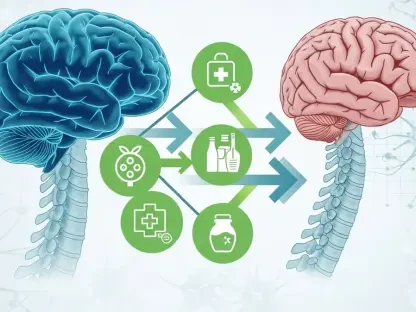

The traditional image of a physician listening intently through a stethoscope has been increasingly overshadowed by the sight of a clinician hunched over a glowing monitor while typing furiously into a digital ledger. This pervasive administrative burden, largely driven by the complexities of Electronic Health Records (EHR), has precipitated a crisis of burnout that threatens the stability of the modern healthcare workforce. In response, a sophisticated category of technology known as AI ambient documentation, or AI scribing, has emerged as a potential remedy. This technology aims to transform the clinical encounter by shifting the focus from manual data entry back to the patient. By reviewing the current capabilities and performance of these systems, it becomes possible to understand how generative AI is beginning to untether clinicians from their keyboards.
The Rise of AI-Powered Ambient Documentation
The emergence of AI ambient documentation is a direct response to the “clericalization” of medicine, where practitioners often spend two hours on documentation for every one hour spent in direct patient care. This administrative bloat has historically contributed to a decline in professional satisfaction and a rise in clinical errors due to cognitive fatigue. Ambient technology differs fundamentally from traditional dictation or human scribing services by operating as a passive, non-intrusive observer within the exam room. Instead of a doctor speaking directly into a microphone or a third party sitting in the corner, a smartphone or specialized device captures the natural dialogue of the encounter as it happens.
This shift represents a maturation of generative AI, moving beyond simple word recognition toward context-aware comprehension. Unlike the rigid systems of the past decade, contemporary AI scribes utilize large language models to understand the flow of a medical interview. This technology does not merely transcribe; it interprets. It recognizes when a patient is describing a symptom and when a clinician is providing a diagnosis, effectively filtering out casual small talk about the weather or local sports to focus on the clinical core. By automating the capture of these interactions, ambient systems attempt to restore the “human” element of the visit, allowing eye contact and empathy to take precedence over typing and scrolling.
Core Technical Components and Performance Metrics
Natural Language Processing and Real-Time Transcription
The engine of ambient documentation is a sophisticated blend of speech-to-text conversion and advanced Natural Language Processing (NLP). This implementation is unique because it must operate in the chaotic environment of a real-world clinic, where cross-talk, background noise, and medical jargon are the norms. Advanced NLP models are trained on vast datasets of medical terminology and anatomical references, allowing them to distinguish between homophones that might confuse a consumer-grade AI. For instance, the system must accurately differentiate between “ileum” and “ilium” based solely on the context of the conversation.
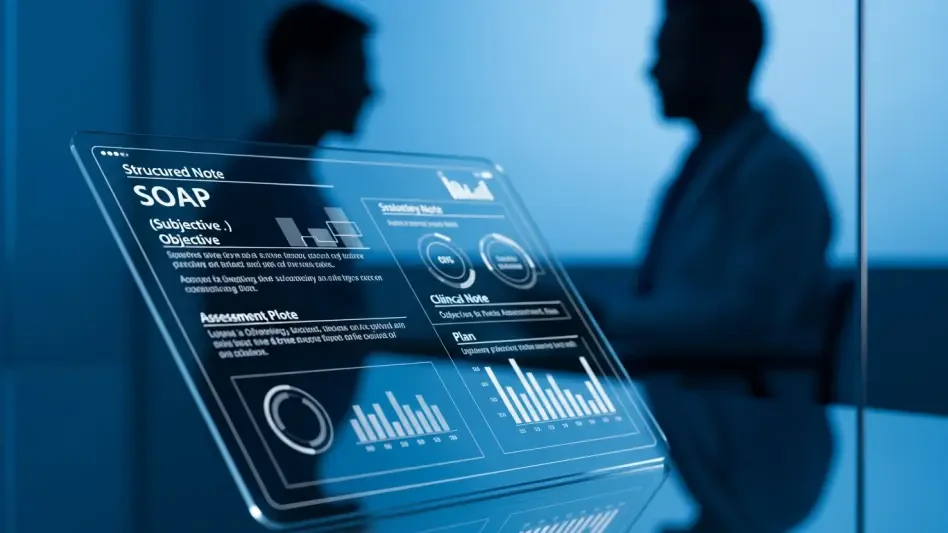
Beyond simple transcription, these systems perform real-time summarization. As the conversation unfolds, the AI organizes the information into a structured draft, typically following the SOAP (Subjective, Objective, Assessment, and Plan) format preferred by medical professionals. This process involves identifying key clinical entities, such as medications, dosages, and follow-up instructions, and mapping them to the appropriate sections of the medical record. This capability matters because it reduces the “cleanup” time required by the clinician after the visit. A high-performing system provides a draft that is 80% to 90% accurate, leaving the physician to perform the high-level task of verification rather than the low-level task of initial drafting.
Time Efficiency and Workflow Integration
When evaluating the impact of AI scribes, time management remains the most critical metric. Recent large-scale multisite studies indicate that clinicians using these tools experience a measurable reduction in daily EHR usage, specifically in documentation-intensive tasks. On average, users have seen a decrease of approximately 16 minutes per day dedicated solely to note-writing. While 16 minutes might seem marginal in a vacuum, within the context of a high-pressure clinical schedule, it represents a significant opportunity to either see an additional patient or conclude the workday on time.
The true value of this efficiency lies in the removal of the “screen-between” barrier. By eliminating the need to type during the encounter, the technology reduces the physical and psychological distance between the provider and the patient. This integration is not just about saving minutes; it is about changing the quality of those minutes. When a clinician is not preoccupied with hitting the correct keys, their cognitive resources are freed to engage in more complex diagnostic reasoning and emotional support. This improvement in workflow fluidity is a primary reason why high-intensity users of the technology report greater satisfaction compared to those who only use it sporadically.
Evolving Trends in Clinical Documentation
The landscape of clinical documentation is currently moving away from transactional record-keeping toward relational care models. In the transactional model, the EHR was a ledger for billing and liability, requiring rigid data entry that often hindered communication. The new trend, supported by AI, treats the medical record as a dynamic narrative that reflects the true nature of the patient-clinician interaction. This evolution is being accelerated by multi-institutional initiatives like the Ambient Clinical Documentation Collaborative (ACDC), which works to establish evidence-based standards for how AI should be implemented across diverse healthcare systems.
Moreover, there is a clear trend toward high-intensity technology adoption. Data suggests that the benefits of AI scribes are not linear but exponential based on usage frequency. Clinicians who use the tool for more than half of their encounters see a much larger relative gain in efficiency than those who use it occasionally. This indicates that as clinicians build trust in the AI’s ability to capture medical nuances, they delegate more of the documentation burden to the system. This trend toward deeper integration suggests that AI is moving from being a secondary tool to becoming a foundational component of the modern exam room.
Real-World Applications and Sector Impact
The deployment of AI scribes has shown varying degrees of success across different medical specialties, with primary care and advanced practice providers seeing the most pronounced benefits. In these fields, visits are often narrative-heavy and involve multiple chronic conditions, making manual documentation particularly grueling. By automating the narrative synthesis, AI scribes have enabled primary care clinics to improve patient throughput without increasing the clinician’s perceived workload. In specialized departments, such as orthopedics or cardiology, the technology helps organize complex physical exam findings and diagnostic plans into concise, readable notes.
Beyond productivity, the technology has a disproportionate impact on different clinician demographics. Studies have noted that female clinicians, who historically spend more time on documentation and patient communication than their male counterparts, often experience greater time savings from AI adoption. This suggests that the technology can act as an equalizer, addressing some of the structural inefficiencies that contribute to higher burnout rates in certain groups. However, the sector impact is not just about the clinicians; patients also report feeling more “heard” when their doctor is not staring at a screen, which can lead to better adherence to treatment plans and improved health outcomes.
Challenges to Widespread Adoption
Despite the clear benefits, widespread adoption of ambient documentation faces significant behavioral and technical hurdles. The most prominent is the “learning curve” associated with any generative AI tool. Clinicians must learn how to structure their conversations in a way that the AI can easily parse, and they must remain vigilant in reviewing the AI-generated drafts. There is a persistent risk of “hallucinations”—instances where the AI might misinterpret a statement or invent a clinical detail—which necessitates a high level of human oversight. This requirement for final verification means that the technology is an assistant, not an autonomous replacement.
Another challenge is the persistent issue of “pajama time.” While AI scribes reduce the time spent on notes during the day, they have not yet completely eliminated the need for after-hours work. Many clinicians still prefer to review and finalize their AI-generated notes in the evening to ensure total accuracy. Furthermore, institutional support and comprehensive training are often lacking. Without a robust framework for implementation, many clinicians find the initial setup and integration into the EHR to be more frustrating than the problem the technology was intended to solve. Moderate adoption rates reflect these growing pains as the industry adjusts to a new way of working.
The Future Landscape of Ambient Intelligence
The future of ambient intelligence in healthcare lies in the continued refinement of generative models to understand increasingly complex clinical contexts. We are moving toward a period where AI will not only transcribe and summarize but also provide real-time clinical decision support. Future iterations of this technology may be able to flag potential drug interactions or suggest missing diagnostic codes while the patient is still in the room. Breakthroughs in understanding medical dialects and non-linear speech patterns will likely reduce the frequency of errors, further lowering the cognitive load on the clinician.
Long-term, the goal of ambient intelligence is to make the technology “invisible.” In such an environment, the documentation process happens entirely in the background, requiring only a quick digital signature from the physician. This could lead to a more sustainable healthcare system where the focus is entirely on patient-side outcomes rather than administrative compliance. As the technology matures, it will likely integrate with other ambient sensors to monitor patient vitals or gait, creating a truly holistic digital representation of the clinical encounter that goes far beyond a simple text-based note.
Final Assessment of AI Ambient Documentation
The evaluation of AI ambient documentation revealed that while the technology was not a total replacement for human documentation, it functioned as a powerful tool for optimizing clinical workflows. The integration of these systems led to measurable time savings, particularly for high-intensity users and those in primary care, which directly translated into increased patient access and nominal revenue gains. The analysis showed that the value of the technology was often found in the reduction of cognitive load and the restoration of the patient-clinician relationship, rather than in just the raw minutes saved.
The transition toward ambient intelligence represented a necessary step in addressing the systemic crisis of clinician burnout. While technical hurdles such as the risk of hallucinations and the persistence of after-hours review remained, the progress made by generative AI models provided a clear path forward. This technology served as a bridge toward a more sustainable and patient-centric healthcare system, where the focus returned to the human interaction at the heart of medicine. Ultimately, the adoption of AI scribes signaled a shift in how the medical community viewed documentation—no longer as a manual chore, but as an automated byproduct of quality care.