
The relentless surge in 911 call volumes, coupled with persistent resource shortages, has pushed emergency response systems to a critical juncture where traditional operational methods are proving insufficient. These mounting pressures on emergency medical services (EMS), fire departments, and healthcare organizations demand a fundamental shift in strategy. This is not a distant future scenario; it is the current reality. The integration of artificial intelligence (AI) and predictive analytics represents an imminent and necessary evolution, providing the tools to transition from a reactive posture to a proactive, data-driven operational model that enhances efficiency and improves patient outcomes. This transformation touches every aspect of emergency services, from predictive response and operational management to community health and the responsible implementation of new technologies.
The Dawn of a New Era: AI in Emergency Response
The operational landscape for emergency responders is increasingly complex. Agencies face the dual challenge of rising public demand for services and significant constraints on staffing and budgets. This environment stretches personnel thin and strains the capacity of the entire emergency response network. Relying on historical precedent and gut instinct alone is no longer a sustainable approach to managing resources or anticipating community needs.
The thesis for this new era is clear: leveraging AI and predictive analytics is the most viable path forward. This technological shift enables a move away from simply reacting to calls as they come in toward a more intelligent, forward-looking strategy. By harnessing data, agencies can anticipate demand, optimize the deployment of their valuable resources, and ultimately deliver faster, more effective care. The key areas of AI’s impact are already taking shape, focusing on predictive response, streamlining operational efficiency, fostering better community health, and ensuring a framework of responsible innovation guides every step.
The Imperative for Change: Why AI Integration is Critical
For decades, data in emergency services was primarily used for retrospective review—analyzing past performance to identify areas for improvement. While valuable, this approach is inherently reactive. The strategic imperative has shifted toward using data for real-time, predictive decision-making. This means transforming data from a historical record into an active asset that informs what will happen next, allowing leaders to get ahead of events rather than constantly trying to catch up.
The adoption of AI yields profound benefits that address the core challenges facing modern emergency services. Enhanced efficiency is achieved by optimizing resource allocation, ensuring that ambulances and fire apparatus are positioned where they are most likely to be needed. This data-driven deployment minimizes response times. Moreover, AI-powered automation significantly reduces the administrative burdens on front-line personnel, freeing them from time-consuming paperwork and allowing them to focus on patient care.
Beyond efficiency, the integration of AI leads directly to improved outcomes. Shorter response times for critical events like cardiac arrests and strokes are directly correlated with better survival rates. Furthermore, by creating seamless data pathways between the field and the hospital, AI enables a more effective continuity of care, giving receiving physicians a complete picture of a patient’s condition before they even arrive. On a systemic level, these technologies build greater resilience. By analyzing system-wide data, AI can identify and address operational blind spots—such as gaps in coverage or recurring bottlenecks—that might otherwise go unnoticed, creating a more robust and reliable emergency response system for the entire community.
Transforming Operations: Key Applications of AI in Emergency Services
From Reaction to Prediction: Leveraging Predictive Analytics for Proactive Response
The most transformative application of AI in emergency services is its ability to forecast demand with remarkable accuracy. By analyzing vast datasets—including historical call volumes, weather patterns, traffic conditions, and even public event schedules—predictive analytics algorithms can identify patterns and anticipate when and where service surges are likely to occur. This foresight enables agencies to move beyond static deployment models and preemptively adjust staffing levels and position resources in high-probability areas, ensuring a faster response when seconds count.
This predictive capability extends beyond daily operations to broader public health. Through a process known as syndromic surveillance, analytics platforms can monitor real-time data streams for early indicators of emerging health threats. By tracking trends in symptoms reported to 911 dispatchers, such as a spike in calls related to fever and respiratory distress, public health officials can receive an early warning of a potential disease outbreak. This allows them to mobilize resources, issue public health advisories, and prepare healthcare facilities before the crisis reaches its peak.
Real World Example: Forecasting a Public Health Crisis
During the initial waves of the COVID-19 pandemic, this concept was put to the test. Health systems and public safety agencies with advanced analytics capabilities monitored inbound emergency call data in real time. They were able to detect significant increases in calls for respiratory distress and other related symptoms days or even weeks before hospital admissions began to surge. This early warning gave them invaluable time to prepare by sourcing personal protective equipment, configuring ICU beds, and adjusting staffing plans to meet the impending wave of critically ill patients, ultimately saving lives and preventing health systems from being completely overwhelmed.
Enhancing Front Line Efficiency: AI Powered Decision Support and Automation
A significant portion of a first responder’s shift is consumed by administrative tasks, particularly documentation. AI-powered systems are designed to alleviate this burden. By using intelligent data entry and automation, these platforms can auto-populate fields, reduce redundant keystrokes, and streamline the creation of patient care reports. This not only returns precious time to clinicians, allowing them to focus on patient interaction and care, but also improves the accuracy and completeness of the data collected, which is vital for billing, quality assurance, and clinical research.
Perhaps more critically, AI serves as a powerful tool for breaking down the data silos that have long plagued the healthcare ecosystem. Information often remains trapped within separate systems for EMS, fire, dispatch, and hospitals, hindering effective communication and continuity of care. AI-driven interoperability solutions help bridge these gaps by intelligently matching patient records and automating the flow of critical clinical information from the ambulance’s electronic patient care record (ePCR) directly into the hospital’s electronic health record (EHR).
Real World Example: Streamlining Cardiac Care with Real Time Data
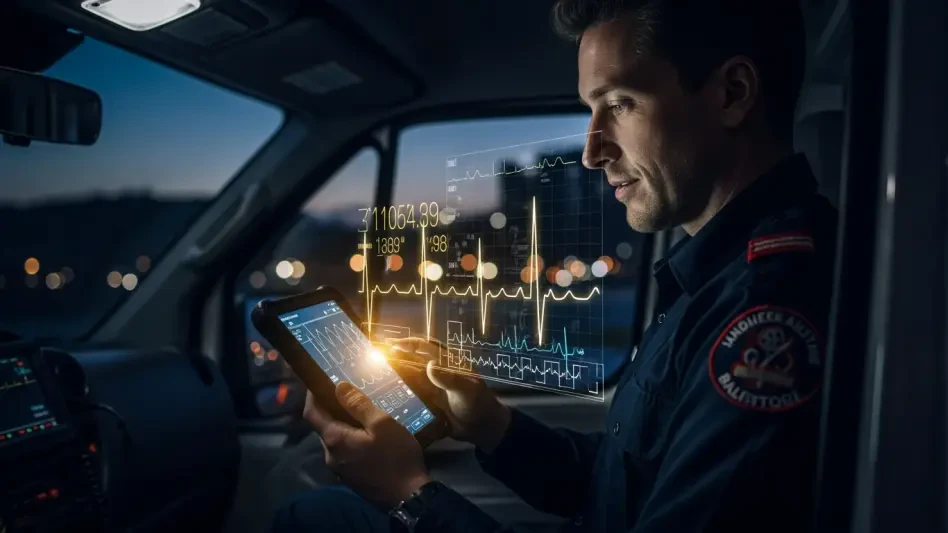
A prime illustration of this connectivity is in the treatment of heart attacks. An EMS crew can perform a 12-lead EKG in the field and, using an AI-enabled system, transmit the results directly from the ambulance to the hospital’s cardiac catheterization lab team. The system alerts the cardiologists, who can review the EKG and confirm the diagnosis while the patient is still in transit. This allows the hospital team to be fully prepared upon the patient’s arrival, bypassing the emergency department and significantly reducing the critical door-to-treatment time, a key factor in improving survival and reducing heart muscle damage.
Building Healthier Communities: The Shift to Proactive Care Models
AI is also enabling a fundamental shift in the mission of emergency services, from a purely reactive force to a proactive partner in community health. Analytics platforms can sift through health data to identify at-risk individuals within a population—such as elderly patients recently discharged from the hospital or those with poorly managed chronic conditions like diabetes or heart failure. This information empowers innovative programs like Community Paramedicine.
Instead of waiting for these individuals to call 911 during a crisis, community paramedics can conduct proactive follow-up visits. During these visits, they can perform wellness checks, ensure medication adherence, identify safety hazards in the home, and connect patients with primary care physicians and social services. By addressing health risks before they become emergencies, these data-driven interventions reduce the frequency of 911 calls and preventable emergency department visits, easing the strain on the entire system while improving the long-term health of the community.
Real World Example: A Community Paramedicine Program for High Risk Patients
One agency implemented an analytics program to identify elderly patients who had been recently discharged from the hospital for conditions like pneumonia or congestive heart failure. The system flagged these individuals as having a high risk of readmission. A dedicated community paramedic team then scheduled follow-up visits within 72 hours of discharge. By providing in-home support and reinforcing the hospital’s care plan, the program achieved a marked reduction in hospital readmissions for this vulnerable population, improving their quality of life and generating significant cost savings for the local healthcare system.
Ensuring Responsible Innovation: Overcoming Implementation Challenges
The successful integration of AI is not merely a technical challenge; it requires a deep commitment to responsible innovation. The most critical safeguards include establishing robust data privacy and security protocols to protect sensitive patient information. Equally important is maintaining a steadfast commitment to human oversight. AI should function as a decision support tool—a “backup, not the boss”—with final clinical and operational judgments always resting with experienced professionals. Furthermore, agencies must implement proactive bias mitigation strategies to ensure that algorithms do not inadvertently perpetuate or amplify existing health disparities among different populations.
At a strategic level, achieving true data interoperability must be a core priority, not an afterthought. A connected ecosystem where data flows seamlessly between public safety agencies, hospitals, and other healthcare providers is the foundation upon which all advanced AI applications are built. This system-wide visibility is essential for tracking patient outcomes, coordinating complex care, and understanding the health of the community as a whole. Without this connectivity, even the most sophisticated AI tools will operate with an incomplete picture.
Real World Example: Fostering a Culture of Trust and Adoption
An EMS agency preparing to launch a new predictive analytics platform understood that technology is only effective if its users trust it. Before the rollout, leadership engaged in a transparent communication campaign, explaining how the tool worked and the specific problems it was designed to solve. They conducted comprehensive, hands-on training for all personnel, from dispatchers to front-line paramedics and supervisors. Most importantly, they focused on demonstrating how the technology provided clear, actionable insights that made daily tasks easier and more effective, proving its value and fostering a culture of adoption rather than resistance.
A Data Driven Future: Recommendations and Final Outlook
The integration of AI and predictive analytics into the fabric of emergency services was no longer a speculative concept but a foundational component of modern public safety. The organizations that successfully navigated the immense pressure to “do more with less” were those that built their strategy upon three essential pillars: comprehensive data coverage, seamless system connectivity, and a culture that valued actionable insights.
Agency leaders found that prioritizing these pillars created a virtuous cycle of improvement. Better data coverage led to more accurate predictive models. Enhanced connectivity broke down silos, enabling true continuity of care and a holistic view of the patient journey. Finally, by empowering their teams with actionable insights, they cultivated an environment of data-driven decision-making at every level. The future of emergency services was ultimately defined not by technology alone, but by a holistic commitment to responsible innovation and an unwavering focus on improving care for every patient and community served.