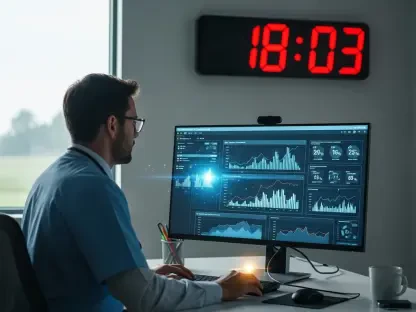
The traditional stethoscope is quickly being superseded by ambient digital ears that capture the nuances of patient whispers and clinical diagnostic reasoning simultaneously. This shift represents a fundamental reorganization of medical informatics, moving away from static databases toward dynamic, self-evolving systems. The Generative AI Healthcare Transformation signifies a departure from the era of “predictive analytics,” where machines merely flagged risks, to an era of “agentic action,” where AI actively participates in the clinical workflow. This review examines how these advancements, particularly through frameworks like ThinkAndor®, are redefining the operational limits of modern medicine by bridging the gap between raw data and actionable bedside intelligence.
Evolution of Generative AI: From Analytics to Agency
The journey of artificial intelligence in the medical sector has transitioned through three distinct phases, culminating in the current state of generative sophistication. Initially, the industry relied on descriptive AI to organize historical patient records. This evolved into predictive models that could forecast patient readmissions or the onset of sepsis. However, the emergence of generative models marks the most significant leap, as these systems possess the ability to synthesize new content, such as discharge summaries and treatment plans, while operating with a level of agency previously reserved for human administrative staff.
Contextually, this evolution addresses the structural failures of the 2020s, where clinician burnout reached critical levels due to documentation burdens. The shift toward agentic AI represents a move toward systems that do not just provide “insights” but actually complete “tasks.” By understanding the context of a clinical encounter, these models transition from passive tools into active participants in the healthcare ecosystem, effectively acting as digital extensions of the medical team rather than mere record-keeping software.
Core Pillars: AI-Driven Clinical Infrastructure
Multimodal Agentic AI: The Ambient Intelligence Factor
Modern clinical infrastructure now relies heavily on multimodal agentic AI, a technology that processes various data types—voice, text, and visual imagery—simultaneously. Platforms such as ThinkAndor® utilize ambient intelligence to transform the physical examination room into a responsive data environment. Instead of a physician typing into a computer, the AI “listens” to the conversation, filters out irrelevant chatter, and populates the Electronic Health Record (EHR) with structured medical data. This unique implementation distinguishes itself from standard transcription services by understanding medical intent and clinical hierarchies.
The significance of this pillar lies in its ability to reduce administrative overhead by nearly eighty percent in some trial settings. By capturing the clinical encounter as it happens, the technology ensures that the nuances of patient-provider interactions are preserved without requiring manual input. This ambient layer acts as a foundation for more complex operations, such as real-time clinical decision support, where the AI might suggest a specific lab test based on the symptoms discussed during the live consultation.
Virtual Clinical Workforces: Digital Enablement Strategies
Supplementing the software layer is the rise of virtual clinical workforces, exemplified by services like PsynergyHealth. This model addresses the acute shortage of on-site medical professionals by integrating human expertise with AI-driven efficiency. Unlike traditional staffing agencies, these virtual workforces are “digitally enabled,” meaning they operate within the same AI ecosystem as the on-site team. This creates a seamless loop where an AI agent flags a patient’s deteriorating condition, and a virtual nurse immediately intervenes to coordinate care.
The integration of human-in-the-loop systems ensures that AI remains grounded in clinical reality. While the AI manages the heavy lifting of data processing and routine monitoring, the virtual workforce provides the empathy and complex judgment necessary for sensitive patient interactions. This synergy is particularly effective in specialties like behavioral health or chronic disease management, where consistent human contact is just as vital as accurate data tracking.
Emerging Trends: Decentralized Medical Delivery Models
A major shift is occurring toward “workforce multiplier” models that move healthcare delivery away from centralized hospitals and toward the patient’s home. This decentralization is powered by AI that can monitor chronic conditions through wearable devices and home-based sensors. The trend represents a transition from reactive treatments—where a patient visits the ER after a crisis—to proactive, continuous monitoring. AI agents act as the connective tissue in this model, analyzing thousands of data points daily to identify subtle shifts in a patient’s health before they manifest as symptoms.
Moreover, the industry is witnessing the rise of decentralized diagnostic routing. In this framework, AI determines the most efficient path for a patient’s care, whether it be a virtual consultation, a local clinic visit, or a specialized hospital admission. This removes the administrative bottleneck of traditional referral systems, ensuring that medical resources are allocated based on real-time clinical need rather than bureaucratic availability.
Real-World Applications: Rural and Resource-Constrained Settings
In rural environments, where the ratio of patients to providers is often dangerously high, generative AI has become a lifeline for maintaining operational viability. By automating referral management and triaging patients via telehealth, these systems allow small clinics to function with the capacity of much larger institutions. For example, a rural nurse can use AI-powered routing to connect a patient with a specialized cardiologist in a different state within minutes, a process that used to take weeks of manual coordination.
These applications also solve the persistent problem of data fragmentation across disparate EHR platforms. In many resource-constrained settings, patient data is trapped in legacy systems that do not communicate with each other. Generative AI layers can sit on top of these fragmented systems, extracting and normalizing data to provide a unified view of the patient’s history. This interoperability is not just a technical convenience; it is a clinical necessity that prevents medication errors and redundant testing.
Addressing Challenges: Adoption Hurdles and Technical Constraints
Despite the rapid progress, the technology faces significant hurdles regarding data privacy and regulatory compliance. The Centers for Medicare & Medicaid Services (CMS) have established rigorous standards that AI models must meet to ensure patient safety and data security. Ensuring that generative models do not “hallucinate” or invent medical facts is a primary technical constraint. Developers are currently focusing on “grounding” these models in peer-reviewed medical literature and verified patient data to maintain a high level of clinical accuracy.
Furthermore, the transition to AI-heavy workflows requires a cultural shift among medical staff. Clinician burnout is a double-edged sword; while AI aims to reduce it, the learning curve associated with new digital tools can initially increase stress. Successful implementation requires intuitive interfaces that feel like a natural part of the clinical process rather than a technical burden. Overcoming these adoption hurdles involves not only technical refinement but also comprehensive training programs that emphasize the supportive, rather than the replacement, role of AI.
Future Trajectory: The Path toward Autonomous Healthcare
The trajectory of intelligent healthcare systems points toward a future defined by semi-autonomous care coordination. We are moving toward a reality where specialized medical Large Language Models (LLMs) will be capable of managing entire episodes of care, from initial triage to final recovery, with minimal human intervention for routine tasks. These systems will likely feature advanced predictive analytics that can simulate the long-term outcomes of different treatment paths, allowing doctors to choose the most effective intervention based on a patient’s unique genetic and environmental profile.
Breakthroughs in edge computing will also play a role, allowing AI models to run locally on devices within the patient’s home, thereby enhancing privacy and reducing latency. This evolution will likely democratize access to high-quality specialty care, making the geographic location of a patient irrelevant to the quality of medical attention they receive. The long-term impact will be a more resilient, equitable, and efficient healthcare system that prioritizes patient outcomes over administrative process.
Summary: Clinical and Operational Impact Assessment
The review of generative AI in the healthcare sector demonstrated that the synergy between agentic software and virtual services created a robust framework for modernization. The implementation of ambient intelligence successfully mitigated the documentation crisis, allowing providers to return their focus to direct patient interaction. Furthermore, the integration of virtual workforces provided a scalable solution to the global labor shortage, particularly in underserved rural areas. It was observed that the shift toward proactive monitoring significantly reduced the operational costs associated with emergency care and chronic disease mismanagement.
Ultimately, the technology established a new standard for clinical efficiency and data interoperability. By transforming the EHR from a static repository into a dynamic clinical assistant, these systems provided a cohesive strategy for stabilizing the healthcare economy. The transition toward autonomous care coordination represented a logical progression in the quest for accessible, high-quality medicine. This review concluded that the current trajectory of AI-driven infrastructure offered a viable path toward a more sustainable and patient-centric future.