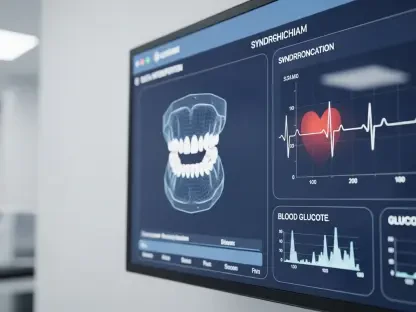

The seamless flow of sensitive patient information across national boundaries has long been heralded as the ultimate milestone for clinical efficiency, yet recent legal battles suggest this interconnectedness may have opened a digital back door for predatory exploitation. The American healthcare data architecture relies on a complex web of Electronic Health Records and Health Information Networks designed to bridge the gap between disparate providers. This transition from siloed, paper-based systems to integrated digital environments aimed to improve patient outcomes by ensuring that a doctor in New York could instantly access the history of a patient from California. Central to this mission are frameworks like the Trusted Exchange Framework and Common Agreement and the Carequality Interoperability Framework, which establish the rules of engagement for data sharing.
Key market players like Epic Systems dominate the landscape, while interoperability specialists such as Health Gorilla have emerged to facilitate these connections. These entities navigate a strict regulatory environment defined by HIPAA and the 21st Century Cures Act. The foundational principle governing these exchanges is the Treatment Use protocol, which mandates that data retrieval must be strictly for the purpose of patient care. When this principle is compromised, the entire security of the national health infrastructure is put at risk, revealing a tension between the federal push for open data and the necessity of protecting individual privacy.
Forces Reshaping the Medical Data Ecosystem
Technological Shifts and the Emergence of Fraudulent Exploitation
The transition toward automated, high-speed data exchange has significantly outpaced the development of oversight capabilities. While automation allows for the near-instantaneous transfer of medical records, it also creates blind spots that bad actors are increasingly eager to exploit. These entities often masquerade as legitimate healthcare providers, using the credentials of clinical services to bypass security protocols. As consumer-driven health data access becomes more prevalent, the risk of data commodification rises, leading to a landscape where personal health information is viewed as a valuable asset for unauthorized monetization rather than a private clinical record.
This evolution presents a dual-edged sword for the industry. On one hand, streamlined care pathways allow for faster diagnoses and better coordination; on the other, the threat of data brokers infiltrating these networks is a growing reality. The emergence of these deceptive patterns forces a re-evaluation of how trust is established in a digital ecosystem. It is no longer enough to verify a company once; continuous monitoring of data retrieval behavior has become a vital necessity to prevent clinical frameworks from being used as tools for commercial gain or legal maneuvering.
Market Projections and the Performance of Data Networks
Current growth indicators show a robust demand for health information exchange services, with the interoperability market expected to expand significantly through 2028. However, this growth is being met with a new set of operational challenges. Legal precedents, such as the litigation involving Epic and Health Gorilla, are forecasted to drive up the costs of network participation as vetting standards become more rigorous. Intermediaries that once focused solely on speed must now invest heavily in compliance and verification to avoid the liability associated with fraudulent data requests.
Forward-looking analysis suggests that the industry must find a delicate balance between the federal government’s mandate for open data and the reality of network security. Market participants are increasingly wary of the risks posed by unverified endpoints. The future performance of these networks will likely depend on their ability to prove to both regulators and patients that their data is not being sold to the highest bidder. This shift in priority from volume to integrity is expected to reshape the competitive landscape, favoring organizations that prioritize rigorous participant verification over sheer network size.
Navigating Complexities in Network Security and Ethical Oversight
Identifying unusual data retrieval patterns is one of the most difficult challenges currently facing health information networks. Fraudulent entities often request records at a scale or frequency that does not align with traditional patient care, yet detecting these anomalies in real time requires sophisticated analytical tools. The industry has recently grappled with the emergence of sham business models, where remote patient monitoring or telehealth firms are established primarily as a front for data harvesting. These entities claim to provide clinical services that never actually occur, using their status to pull vast amounts of data for external use.
To overcome these threats, technological and procedural solutions are being developed to verify the legitimacy of clinical services before any data is released. This includes multi-factor verification of provider credentials and more granular audits of why specific records are being requested. However, there remains a persistent tension between fostering a competitive market and ensuring strict gatekeeping. If the barriers to entry become too high, smaller, innovative providers may be shut out; if they are too low, the sanctity of the medical record is sacrificed.
The Regulatory Landscape and Mandatory Compliance Standards
The Role of the Trusted Exchange Framework and Common Agreement remains the most significant regulatory force in standardizing data sharing across the United States. By providing a common set of rules, TEFCA aims to minimize the fragmentation that has historically plagued the medical industry. A central component of this framework is the strict enforcement of the Treatment Use protocol. Legal consequences for misrepresenting data requests are becoming more severe, as the industry realizes that even a single breach can undermine public confidence in digital health initiatives.
The litigation between Epic and Health Gorilla has highlighted the need for greater accountability among data brokers and intermediaries. Future regulatory requirements are expected to include more detailed audit trails and mandatory reporting of suspicious activities within national frameworks. These measures are intended to ensure that every entity in the chain of data exchange is held responsible for the integrity of the information they handle. Compliance is no longer just a checkbox; it has become a central pillar of the operational strategy for any organization involved in health data exchange.
Future Projections for Global Health Data Exchange
The integration of artificial intelligence and machine learning is poised to become the primary defense against fraudulent medical record requests. These technologies can analyze millions of data points to identify signatures of deceptive behavior that would be impossible for human auditors to spot. Furthermore, potential market disruptors like decentralized health identities and patient-controlled data keys are gaining traction. These systems would return control of the data to the patient, requiring their explicit permission for each exchange, thereby bypassing the risks inherent in centralized broker models.
Predicted shifts in consumer preferences suggest that health privacy will soon become a primary driver of market share. As patients become more aware of how their data is used, they will likely favor providers and platforms that offer the highest levels of data sovereignty. On a global scale, the economic implications of trust-based interoperability are vast. A digitized healthcare economy can only thrive if there is a universal standard of trust, ensuring that innovation does not come at the expense of individual privacy or ethical standards.
Safeguarding the Sanctity of Personal Medical Information
The GuardDog admission served as a stark verification of the systematic fraud that had infiltrated medical data exchange networks. It demonstrated that without rigorous oversight, clinical data frameworks could be easily subverted for litigation and commercial purposes. The case clarified that the responsibility for data protection rested not only with individual providers but also with the networks that facilitated the exchange. This realization prompted a shift in how industry leaders approached the vetting of participants, as the consequences of negligence became clear.
Moving forward, stakeholders in the digital health sector should implement enhanced verification protocols to ensure that every data request is tied to a verifiable clinical event. Prioritizing vetting integrity proved to be the only effective way to prevent the commercialization of sensitive patient information. Strengthening this ecosystem of trust ensured the longevity of digital health innovation, protecting the system from those who viewed patient history as a commodity. Industry leaders subsequently focused on building more transparent audit mechanisms to sustain the progress made in interoperability while honoring the private nature of the clinical record.