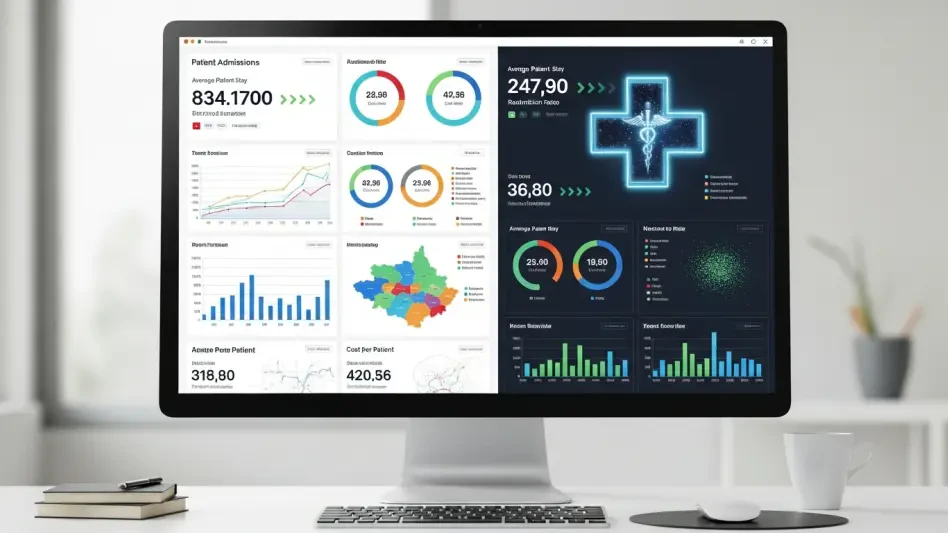

The immense and ever-expanding ocean of health information, once locked away in paper charts and isolated databases, is now being harnessed to chart a new course for patient care and operational excellence. Healthcare systems globally are grappling with a complex web of rising costs, systemic inefficiencies, and the growing demands of an aging population. In this challenging environment, data analytics has emerged not merely as a tool for improvement but as the fundamental driver of a paradigm shift. This evolution is transforming the industry from a reactive model, which treats illness as it appears, to a proactive system that predicts health risks, personalizes treatments, and optimizes the delivery of care at every level.
The New Nexus of Health and Data and Industry Overview
The modern healthcare landscape is a data-rich environment, yet it is often burdened by its own complexity. Every patient visit, diagnostic test, and prescription generates a digital footprint, creating vast reservoirs of information. However, without the means to interpret this data, it remains fragmented and underutilized, leading to operational bottlenecks, duplicated procedures, and suboptimal patient outcomes. This informational chaos contributes significantly to the escalating costs that strain health systems worldwide.
This is where a profound paradigm shift is taking place. Analytics is enabling a transition from traditional, reactive care to a proactive, predictive, and personalized model. Instead of waiting for a patient to present with advanced symptoms, healthcare providers can now use data to identify at-risk individuals and intervene preemptively. This move toward predictive health is not just a technological upgrade; it represents a fundamental rethinking of how wellness and disease are managed, with an emphasis on prevention and early-stage intervention.
This transformation involves a diverse ecosystem of stakeholders, each playing a critical role. Hospitals and health systems are the primary generators and consumers of clinical data, using analytics to improve patient flow and clinical decision-making. Payers, such as insurance companies, leverage data to manage risk, detect fraud, and design value-based reimbursement models. Meanwhile, researchers and pharmaceutical companies analyze large-scale datasets to accelerate drug discovery and clinical trials, while digital health innovators develop new tools and platforms that empower both patients and providers with actionable insights.
The Ascendancy of Analytics: Key Trends and Projections
The Analytics Maturity Model: From Hindsight to Foresight
The journey toward data-driven healthcare can be understood through a four-tiered analytics maturity model that shapes the industry’s intelligence capabilities. The foundational layer is Descriptive analytics, which answers the question, “What happened?” by summarizing historical data like patient admission rates or medication usage. Building on this is Diagnostic analytics, which digs deeper to understand “Why did it happen?” by identifying the root causes of events like an unexpected spike in hospital-acquired infections.
This progression empowers organizations to evolve from simply understanding past events to actively shaping future outcomes. The next tier, Predictive analytics, uses statistical models and machine learning to forecast “What will happen?”, enabling clinicians to anticipate patient deterioration or predict emergency department surges. The pinnacle of this model is Prescriptive analytics, which answers “What should we do?” by providing data-backed recommendations for optimal treatment pathways or resource allocation. This complete framework allows healthcare systems to move from hindsight to foresight, transforming data into actionable intelligence.
This maturity model unlocks significant opportunities for transforming care delivery. Proactive care becomes a tangible reality when providers can use risk stratification models to identify patients susceptible to chronic diseases before they become acute. Clinical decision support systems, powered by predictive and prescriptive analytics, can provide clinicians with real-time, evidence-based suggestions at the point of care. These capabilities not only enhance patient safety but also ensure that resources are directed toward the interventions that will have the greatest impact.
Quantifying the Impact: The Tangible Returns of Data-Driven Care
The adoption of analytics yields substantial operational and financial benefits that extend far beyond the clinical setting. Hospitals are using data-driven insights to optimize staffing schedules, ensuring that clinical teams are aligned with patient demand and acuity. In parallel, supply chain management is being revolutionized through predictive forecasting, which minimizes waste and prevents shortages of critical medical supplies. Analytics also plays a crucial role in maintaining financial integrity by identifying and reducing fraudulent claims and billing errors.
The growth trajectory for healthcare analytics is projected to continue its steep ascent, fueled by its proven ability to deliver a dual mandate: enhancing patient outcomes while lowering the overall cost of care. As organizations accumulate more evidence of its return on investment, capital will increasingly flow toward data infrastructure and analytical talent. This investment cycle is creating a more efficient, sustainable healthcare model where data is treated as a strategic asset.
The success of these initiatives is measured through clear and impactful performance indicators. For example, predictive models have been shown to significantly reduce hospital readmission rates by identifying high-risk patients who need additional post-discharge support. Real-time dashboards tracking patient flow help to reduce wait times in emergency departments and optimize operating room utilization. Furthermore, the use of analytics has led to measurable improvements in diagnostic accuracy, ensuring patients receive the right diagnosis and treatment plan sooner.
Navigating the Hurdles: Overcoming Barriers to Implementation
Despite the immense potential, widespread adoption of advanced analytics is hindered by significant challenges, chief among them being data fragmentation. Critical patient information is often siloed in disparate and incompatible IT systems across different departments, clinics, and hospitals. This lack of a unified data source makes it nearly impossible to build a comprehensive view of a patient’s health journey, limiting the effectiveness of any analytical model.
The quality of the data itself presents another formidable obstacle. Healthcare data is notoriously complex, comprising a mix of structured fields, unstructured clinical notes, medical images, and real-time streams from medical devices. This information is frequently incomplete, inconsistent, or entered in non-standardized formats, which can severely compromise the accuracy and reliability of analytical insights. Cleaning and standardizing this data is a resource-intensive but essential prerequisite for successful implementation.
Overcoming these barriers requires a concerted effort to modernize legacy IT systems and foster a strong culture of data governance. Organizations must invest in data architectures that can integrate information from various sources and establish clear policies for data quality, access, and usage. This cultural shift ensures that data is treated as a shared, enterprise-wide asset, creating the foundation upon which powerful and trustworthy analytical solutions can be built.
The Interoperability Imperative: Standards, Security, and Compliance
At the heart of a data-driven healthcare system is the principle of interoperability—the seamless and secure exchange of electronic health information. To achieve this, the industry is increasingly adopting data standards like HL7 FHIR (Fast Healthcare Interoperability Resources). These standards provide a common language and framework for health data, allowing different IT systems to communicate with one another and enabling the creation of a unified, longitudinal patient record.
This free flow of data operates within a stringent regulatory landscape designed to protect patient privacy and security. Regulations mandate that organizations implement robust safeguards to protect sensitive health information from unauthorized access or breaches. Adherence to these rules is not merely a matter of legal compliance; it is a critical component of building and maintaining patient trust.
Ultimately, compliance and security are foundational pillars that enable the entire data analytics ecosystem. When patients and providers are confident that health information is being managed responsibly, they are more willing to participate in data-sharing initiatives. This trust allows for the creation of richer datasets, which in turn fuel more accurate and powerful analytics, creating a virtuous cycle that benefits the entire healthcare system.
The Next Frontier: AI, Precision Medicine, and Real-Time Insights
The future of healthcare analytics is being shaped by a new wave of emerging technologies set to redefine clinical practice. Artificial intelligence and machine learning are moving beyond predictive models to power AI-driven diagnostics that can identify diseases from medical images with superhuman accuracy. These technologies are also poised to automate routine clinical and administrative workflows, freeing up clinicians to focus on more complex patient care.
Simultaneously, the rise of remote monitoring tools, wearables, and internet-connected medical devices is creating an unprecedented stream of real-time patient data. Integrating this continuous flow of information with advanced analytics provides clinicians with unparalleled visibility into a patient’s health status outside of the traditional hospital setting. This capability is critical for managing chronic conditions and enabling timely interventions before a health issue escalates.
Perhaps the most transformative development is the application of analytics to genomics. By analyzing an individual’s unique genetic makeup, clinicians can advance the practice of precision medicine, delivering highly personalized treatment plans tailored to a patient’s specific biology. This approach holds the promise of making treatments more effective, reducing adverse side effects, and unlocking new therapies for complex diseases.
The Verdict: How Data Analytics is Redefining the Future of Health
The evidence overwhelmingly shows that data analytics is a transformative force, actively reshaping healthcare into a system that is more predictive, efficient, and fundamentally patient-centric. By converting raw data into actionable intelligence, it empowers clinicians with the insights needed to anticipate health events, personalize care plans, and optimize outcomes. This shift moves the entire industry beyond its traditional reactive footing and toward a more proactive and preventative future.
As these technologies become more deeply embedded in daily workflows, analytics is evolving from a specialized, back-office function into an essential, foundational component of modern clinical and operational practice. It is the connective tissue that links disparate parts of the healthcare ecosystem, enabling a holistic and coordinated approach to patient care. From the emergency room to the research lab, data-driven decision-making is becoming the new standard.
The industry’s trajectory points toward sustained growth and deepening investment in data-driven innovation. As analytics platforms become more sophisticated and data interoperability improves, their impact will only accelerate. The journey is far from over, but the course is set: data analytics is not just changing healthcare—it is redefining the very future of health and wellness for generations to come.