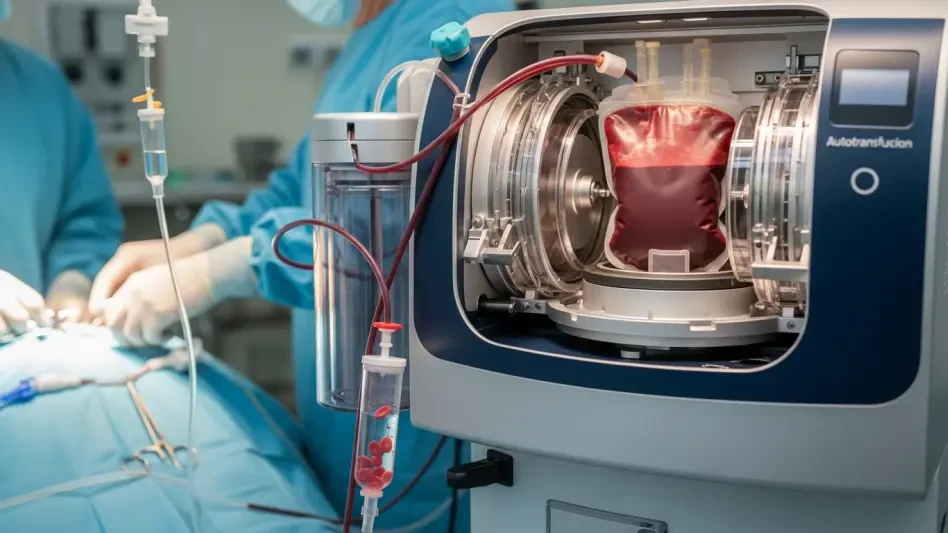

Imagine a surgical room where the risk of blood transfusion complications is slashed dramatically, not by chance, but by design. Autotransfusion devices, which recycle a patient’s own blood during surgery, are transforming this vision into reality. With cardiovascular diseases claiming 17.9 million lives annually—31% of global deaths, according to the World Health Organization—the stakes for safer surgical interventions have never been higher. These innovative tools are stepping into the spotlight as critical allies in enhancing patient outcomes. This report dives into the evolving landscape of autotransfusion devices, exploring their current impact, growth potential, and the challenges they face in revolutionizing surgical safety across hospitals and clinics worldwide.
Unveiling the Autotransfusion Devices Landscape: Current State and Significance
The global autotransfusion devices market stands at a robust valuation of USD 622.250 million in 2025, reflecting its growing importance in modern healthcare. These devices, pivotal in reducing reliance on donor blood, are increasingly adopted in hospitals, ambulatory surgical centers, and specialty clinics. Their ability to minimize transfusion-related risks, such as infections or allergic reactions, positions them as a cornerstone of surgical safety, particularly in high-stakes procedures. From intricate cardiac surgeries to urgent trauma cases, autotransfusion systems are proving indispensable across various medical settings.
Beyond their practical applications, these devices cater to distinct segments like intraoperative, postoperative, and emergency care, each addressing specific surgical needs. Technological advancements, such as automated blood processing and real-time monitoring, are driving innovation, making systems more efficient and user-friendly. Key industry players are fueling this progress with cutting-edge solutions, while stringent regulations ensure that safety and efficacy remain paramount. This dynamic interplay of technology, market leadership, and oversight shapes a sector poised for transformative impact on patient care.
Market Dynamics and Growth Trajectory of Autotransfusion Devices
Emerging Trends and Technological Innovations in Blood Management
A wave of innovation is sweeping through blood management, with autotransfusion devices at the forefront. Advanced filtration systems and compact designs are making these tools more accessible, even in resource-limited settings. Meanwhile, the pressing burden of cardiovascular conditions, responsible for millions of deaths each year, underscores the urgent need for safer surgical options. As healthcare demands evolve, the push for precision and reduced risk during operations is steering the industry toward groundbreaking solutions that prioritize patient well-being.
Moreover, the expansion of healthcare infrastructure in developing regions is creating fertile ground for adoption. Governments and institutions are investing heavily in medical technologies, spurred by policies that encourage innovation and access. This convergence of need and opportunity is a powerful catalyst, opening doors for manufacturers to introduce cost-effective systems tailored to diverse markets. Such trends signal a future where autotransfusion becomes a standard in surgical protocols worldwide.
Market Performance and Future Forecasts
Turning to the numbers, the market’s trajectory is nothing short of promising, with projections estimating growth from USD 622.250 million in 2025 to USD 833.890 million by 2030, at a steady compound annual growth rate of 6.03%. This expansion reflects robust demand across segments, particularly in regions with aging populations and rising surgical volumes. Detailed data triangulation and market engineering reveal strong performance in intraoperative applications, alongside growing interest in emergency settings where rapid response is critical.
Looking ahead, regional disparities in adoption rates highlight both challenges and untapped potential. North America and Europe lead with established healthcare systems, while Asia-Pacific markets are catching up fast, driven by infrastructure upgrades. These forecasts paint a picture of an industry on the cusp of broader impact, with sustained investment and innovation expected to fuel long-term growth in surgical safety solutions.
Navigating Challenges in the Autotransfusion Devices Sector
Despite the optimism, the road ahead isn’t without hurdles. Developing and integrating sophisticated autotransfusion systems often involve complex technologies, posing significant barriers for smaller manufacturers. High production costs can limit scalability, particularly when catering to budget-constrained facilities in less-developed areas. These technical and financial obstacles threaten to slow the pace of widespread adoption if not addressed strategically.
Additionally, the competitive landscape adds another layer of difficulty, as major players vie for market share with aggressive innovation and pricing strategies. This rivalry, while driving progress, can marginalize smaller firms unable to keep up. To counter these issues, forging strategic partnerships and focusing on modular, affordable designs could democratize access. Overcoming such barriers will be key to ensuring that the benefits of autotransfusion reach every corner of the globe.
Regulatory Frameworks Governing Autotransfusion Devices
Navigating the regulatory maze is a critical aspect of this industry’s evolution. Stringent standards, enforced by bodies like the FDA and European Medicines Agency, mandate rigorous testing to guarantee device safety and effectiveness. Compliance isn’t just a legal requirement; it’s a safeguard for patient health, ensuring that every unit meets high-quality benchmarks before reaching operating rooms.
Recent updates to global guidelines have introduced stricter protocols for manufacturing and cybersecurity in medical devices, reflecting the growing digital integration in healthcare. These changes, while challenging, push companies to elevate their standards, ultimately benefiting end-users. Adhering to such frameworks not only fosters trust but also facilitates market expansion by aligning with international norms, paving the way for smoother cross-border operations.
Future Horizons: The Evolution of Autotransfusion in Surgical Care
Peering into the future, emerging technologies like artificial intelligence and machine learning stand ready to redefine autotransfusion practices. These advancements could enable predictive analytics for blood loss, enhancing precision in surgical planning. As consumer preferences shift toward minimally invasive and safer procedures, the industry must adapt, potentially reshaping traditional approaches to blood management with smarter, more efficient tools.
In parallel, investments in emerging economies are set to unlock significant growth, as healthcare systems modernize and prioritize patient safety. However, market disruptors—ranging from economic fluctuations to evolving regulations—could alter this trajectory. Staying agile amidst such uncertainties will be crucial for stakeholders aiming to capitalize on these opportunities and drive the next wave of innovation in surgical care.
Summarizing the Impact: Autotransfusion Devices as a Pillar of Surgical Safety
Reflecting on this exploration, it was evident that autotransfusion devices played a pivotal role in tackling the global scourge of cardiovascular diseases and elevating surgical outcomes. Their integration into medical practice marked a significant stride toward reducing transfusion risks. The market’s vigorous growth path through 2030, propelled by relentless technological progress and strategic funding, underscored a transformative era in healthcare.
For industry participants, the journey ahead demanded a sharp focus on navigating regulatory intricacies with proactive compliance measures. Embracing partnerships to lower costs and expand reach emerged as a vital strategy. As a linchpin of modern surgical safety, the sector’s potential to enhance patient care called for sustained innovation and collaboration, ensuring that life-saving solutions became accessible to all who needed them most.