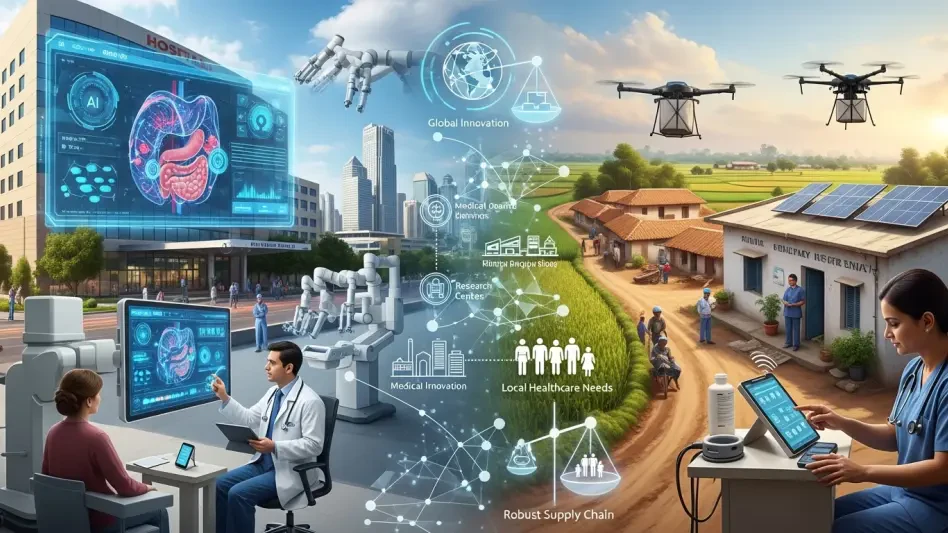

The Indian healthcare ecosystem has evolved into a high-stakes arena where cutting-edge medical innovation frequently collides with the harsh realities of global supply chain instabilities. As the nation attempts to solidify its position as a premier global hub for clinical excellence, it faces the daunting task of reconciling a sophisticated pharmaceutical industry with an infrastructure that remains sensitive to external economic shocks. This transition represents a shift from a traditional service model toward a multi-dimensional ecosystem that integrates high-end diagnostics, medical device manufacturing, and massive hospital networks.
The core pillars of this transformation are increasingly defined by the integration of digital health records and government-sponsored insurance schemes that have expanded the industry’s reach. While these initiatives provide the scale necessary for growth, the regulatory framework continues to demand rigorous compliance and quality standards. Market participants now navigate a terrain where the promise of a digital-first approach must be balanced against the physical constraints of an aging infrastructure and the need for decentralized service delivery.
The Dual Identity of the Indian Healthcare Ecosystem
Analyzing the current landscape reveals a complex duality where urban centers offer world-class treatment while rural regions still struggle for basic access. This gap is being addressed through a transition toward a hybrid model that combines traditional physical clinics with telehealth services. The scope of the industry has expanded beyond basic care to include specialized medical device production and advanced genomic research, positioning the country as a critical player in the global pharmaceutical supply chain.
Moreover, the regulatory landscape has become more sophisticated, focusing on data privacy and the standardization of clinical outcomes. As government-led initiatives like the National Digital Health Mission gain momentum, they provide a structured pathway for private entities to participate in public health goals. This partnership between the state and private capital is essential for maintaining the momentum of the current expansion, though it requires a careful navigation of price caps and stringent manufacturing regulations.
Assessing Market Dynamics and Economic Trajectories
Catalysts for Transformation and Shifting Consumer Trends
The rise of medical tourism has emerged as a powerhouse for the economy, attracting international patients who seek high-quality procedures at a fraction of Western costs. This trend is complemented by a profound shift in domestic patient behavior, characterized by an increased focus on preventative diagnostics and chronic disease management. This heightening of health consciousness is creating a permanent demand for specialized testing, which in turn fuels the growth of domestic laboratory chains and imaging centers.
Leveraging technology has become the primary method for bridging the healthcare divide in remote areas. By utilizing mobile diagnostics and remote monitoring, providers can extend their reach without the immediate need for massive brick-and-mortar investments. This efficiency is vital because reducing the national disease burden is now recognized as a critical economic imperative; failing to address public health effectively could result in a significant loss of potential GDP over the next decade.
Projecting Growth: Performance Metrics and Future Valuation
Quantitative data points toward a significant upward trajectory in revenue, with the diagnostic and medical device sectors showing the most resilience. Financial indicators suggest that while some industry leaders carry high price-to-earnings ratios, their strong, often debt-free balance sheets provide a necessary cushion against market volatility. The demand for medical consumables, ranging from basic syringes to advanced surgical kits, is expected to remain steady as hospital bed capacity increases across tier-two cities.
Investment analysts are closely monitoring the performance of specialized players who have successfully carved out niches in the diagnostic space. For instance, companies like Metropolis Healthcare are being evaluated based on their ability to maintain margins in an inflationary environment. While some market participants have seen their stock performance fluctuate due to earnings misses, the underlying demand for imaging services and routine testing remains a cornerstone of the sector’s financial health.
Critical Vulnerabilities and Structural Obstacles
The global helium shortage has introduced a significant risk to diagnostic imaging, specifically impacting the operation of MRI machines. Because the sector relies heavily on the import of this rare gas, the increasing scarcity has led to a spike in operational costs for imaging centers. This vulnerability highlights a broader supply chain fragility, where dependence on foreign raw materials and specialized components leaves the industry exposed to geopolitical tensions and logistical bottlenecks.
In addition to imaging challenges, the rising cost of basic medical consumables is putting pressure on hospital margins. Inventories of essential supplies are often thin, making it difficult to maintain price stability for patients. To mitigate these risks, many organizations are now seeking to diversify their suppliers and invest in local manufacturing. However, bridging the financing gap remains a hurdle, as high out-of-pocket expenses continue to limit the affordability of advanced treatments for a large portion of the population.
Navigating the Regulatory and Compliance Landscape
National health policies have become more prescriptive, demanding that providers adhere to international quality standards to remain competitive. This push for excellence is not just about patient safety; it is a strategic move to attract foreign direct investment. However, the influence of price caps on essential medicines and medical devices creates a challenging environment for manufacturers who must balance the need for innovation with the reality of restricted profit margins.
Security and data privacy have moved to the forefront of the regulatory agenda as the ecosystem becomes more digitized. Ensuring that patient information is protected against cyber threats is now a prerequisite for any healthcare enterprise. Strengthening these compliance frameworks is essential for building trust with international partners, especially as the industry moves toward more collaborative research and development models that involve cross-border data sharing.
The Horizon of Innovation and Future Market Disruptors
The integration of artificial intelligence and machine learning is no longer a peripheral trend; it is becoming a central tool for predictive diagnostics and personalized treatment plans. These technologies allow for more accurate disease detection and more efficient hospital management, potentially lowering long-term costs. Decentralized healthcare models, including the expansion of home-based care services, are also disrupting traditional hospital-centric approaches by bringing medical assistance directly to the consumer.
Future growth areas are expected to concentrate on biotechnology and advanced medical manufacturing. As the global economy dictates the flow of medical supplies, local production of high-tech devices will be the key to maintaining stability. Genomic research is another frontier that holds the potential to transform the Indian market from a volume-driven service provider to a value-driven innovation leader, provided that the necessary research infrastructure is supported by both public and private funding.
Synthesis of Industry Prospects and Strategic Recommendations
The assessment of the healthcare sector demonstrated that long-term value creation depends entirely on the ability of firms to insulate themselves from supply chain shocks while embracing digital integration. Investors were encouraged to look toward resilient, low-debt players who have diversified their service offerings to include both diagnostics and home-based care. The path forward required a strategic shift away from import dependency, focusing instead on localizing the production of critical components like medical gasses and specialized consumables.
Ultimately, the sector was viewed as a primary engine for broader economic stability, provided that the current inflationary pressures were managed through technological efficiency. Strategic recommendations emphasized that the next phase of maturity for Indian healthcare would involve a deeper commitment to genomic research and biotechnology. By addressing the structural financing gaps and improving rural accessibility, the industry was positioned to move from a state of reactive crisis management to proactive, sustainable growth.